Content Freshness: When Updating Helps and When It Doesn’t
Freshness only helps rankings when an update changes something a reader or Google can act on. A date change alone does neither.
Updating a page helps rankings only when the update changes something a reader or Google can actually use — new figures, a corrected claim, expanded coverage of a gap competitors have closed — a changed publish date with no substantive edit does nothing, and Google has said as much directly. The instinct to “refresh” content on a schedule, regardless of whether anything meaningful changed, is where most freshness efforts waste time or, worse, unsettle a page that was already performing.
Freshness isn’t a single lever. It matters enormously for some queries and barely at all for others, and treating every page on a site with the same update cadence ignores that difference entirely.
Does Google actually reward fresh content?
Selectively, not universally. Google’s freshness systems, sometimes referred to as Query Deserves Freshness (QDF), detect queries where users are clearly looking for recent information — breaking news, current prices, this year’s version of a tool comparison — and temporarily favour newer or recently updated pages for those specific queries. For queries without that time-sensitivity, freshness carries far less weight next to depth, accuracy, and how well the page matches intent. A well-aged, thorough page on a stable topic regularly outranks a page updated last week that says less.
When does an update genuinely help a page?
| Situation | Update helps because |
|---|---|
| Rankings dropped after a core update | Content quality or accuracy has likely fallen behind what now ranks |
| The query is genuinely time-sensitive | Prices, tool lists, statistics, or “current year” content need current facts to stay useful |
| A named tool, law, or process changed | Leaving outdated specifics live actively misleads readers |
| Competitors have added depth the page lacks | The page is now thinner than what’s ranking above it |
When does updating do nothing, or actively hurt?
| Situation | Why an update is the wrong move |
|---|---|
| The page ranks well and traffic is stable | A defensive edit risks the established signals for no clear upside |
| Only the visible publish date is changed | Google’s guidance treats an unsubstantiated date change as a low-value or misleading signal |
| The topic is stable and evergreen | Nothing has actually changed in the underlying facts to justify a rewrite |
| Content is thin, not outdated | The real gap is depth, which an update won’t fix — this needs a rewrite instead |
When a freshness update helps vs when it doesn’t
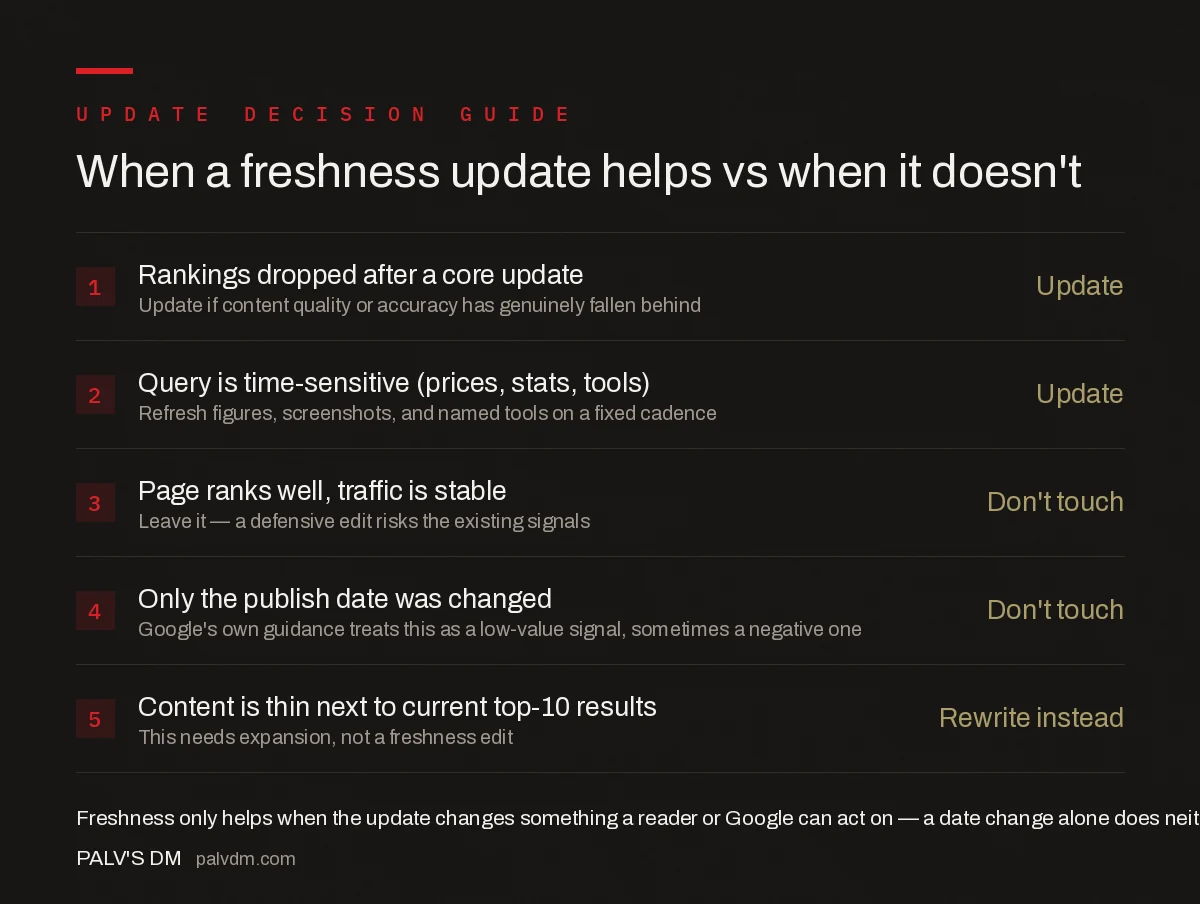
- Update — rankings dropped after a core update: update if content quality or accuracy has genuinely fallen behind.
- Update — query is time-sensitive (prices, stats, tools): refresh figures, screenshots, and named tools on a fixed cadence.
- Don’t touch — page ranks well, traffic is stable: leave it; a defensive edit risks the existing signals.
- Don’t touch — only the publish date was changed: Google’s own guidance treats this as a low-value signal, sometimes a negative one.
- Rewrite instead — content is thin next to current top-10 results: this needs expansion, not a freshness edit.
How do you decide between updating, rewriting, or leaving a page alone?
Start by pulling up the current top 10 for the page’s primary query and comparing structure, depth, and specificity against your own page, not against how the page looked when it was written. If the gap is a handful of outdated facts in an otherwise comprehensive page, that’s an update: correct the facts, add anything genuinely new, update the dateModified field, and stop there. If the gap is structural — missing sections, shallower coverage, no comparison table where competitors have one — a light freshness pass won’t close it; the page needs a rewrite that treats the existing URL as a starting point, not a template to preserve.
What does a genuine freshness update actually involve?
- Verify every statistic, price, or named tool still reflects current reality — replace or remove anything that’s aged out, don’t just leave it with an updated date stamp nearby.
- Check whether the page’s internal links point to content that’s since been merged, redirected, or removed, and fix any that have gone stale.
- Compare the FAQ section against what people are actually asking now — search behaviour shifts, and a freshness pass is a natural point to catch that.
- Update
dateModifiedin the schema only when the visible content actually changed, matching what Google’s guidance asks for.
What mistakes turn a freshness strategy into wasted effort?
- Updating on a fixed calendar regardless of need. “Refresh every post quarterly” treats a stable, well-ranking evergreen guide the same as a fast-moving statistics page, wasting effort on the former and under-serving the latter.
- Changing the date without changing the substance. This is the exact pattern Google has warned against, and it risks looking manipulative rather than helpful if it becomes a visible habit.
- Treating every ranking dip as a freshness problem. A drop can come from a core update reassessing quality broadly, a competitor publishing something genuinely better, or a technical issue — freshness is one possible cause, not the default diagnosis.
- Rewriting pages that were already working. Touching a stable, well-performing page without a clear reason introduces risk without a matching upside.
How do you track whether a page’s performance is actually decaying?
Organic traffic naturally fluctuates week to week, which makes a single dip a poor trigger for a freshness update. A more reliable signal is a sustained decline over eight to twelve weeks, checked against Search Console’s performance report filtered to the specific page, alongside average position for its primary query. A page that’s held steady for a year and then drifts down gradually over two months — without a corresponding site-wide drop that would point to a core update or technical issue — is a much stronger candidate for a freshness pass than a page that dipped for a week and recovered on its own.
It’s also worth checking whether the decline is genuinely about the page’s own content ageing, or whether a competitor has simply published something more comprehensive that now outranks it. Search Console shows the ranking trend; a manual comparison against the current top three results shows the reason. These call for different responses — an update closes an accuracy gap, but it won’t close a depth gap a competitor has opened up.
Does content freshness matter more for some industries than others?
Substantially. Finance, health, technology, and any topic where facts, prices, or regulations change frequently see a much stronger freshness effect than stable, reference-style topics like historical explanations or fixed definitions. A page about current mortgage rates has almost no shelf life without updates; a page explaining what a mortgage is has a very long one. Applying the same update cadence to both wastes effort on the definitional page and, more dangerously, under-updates the rate page if the team assumes “we refresh everything quarterly” is a sufficient policy. Sorting existing content by how time-sensitive its underlying facts are, rather than by publish date, produces a far more accurate update priority list.
What tools help prioritise which pages need a freshness review?
Search Console’s performance report, filtered by page and sorted by declining clicks or impressions over a rolling quarter, is the most direct source — it shows exactly which URLs are losing visibility, not just which ones feel old. Cross-referencing that list against publish date surfaces a useful pattern: pages losing visibility that are also more than twelve to eighteen months old are strong freshness candidates, while pages losing visibility that were updated recently point to a different problem entirely, often competitive or algorithmic rather than an accuracy gap.
A simple spreadsheet combining publish date, last substantive update, current position trend, and a manual note on whether the topic is time-sensitive gives most teams enough to prioritise without needing specialised software. The goal isn’t a perfect scoring system — it’s avoiding the two failure modes covered above: updating pages that don’t need it, and leaving genuinely decaying pages untouched because nobody looked.
Frequently asked questions
Does changing the published date on a page improve rankings?
No, not on its own. Google has repeatedly warned against updating a visible date without meaningfully updating the content behind it, and has stated this practice can be treated as a misleading signal rather than a helpful one.
How often should evergreen content be updated?
Evergreen content needs far less frequent updating than time-sensitive content — a review once or twice a year to confirm accuracy is usually enough, unless a core update or a competitive shift changes what’s ranking above it.
What is Query Deserves Freshness (QDF)?
QDF is Google’s mechanism for detecting when a query suddenly needs newer results, and temporarily favouring recently published or updated pages for that query. It applies selectively to queries with a genuine freshness need, not to every search.
Can updating a page that’s already ranking well hurt it?
Yes, it’s a real risk. A page ranking well has an established set of signals — links, engagement history, relevance match. A substantial rewrite can reset some of that context, and if the update doesn’t genuinely improve the content, the page can lose position rather than gain it.
How do I know if a page needs an update or a full rewrite?
Compare the page against what currently ranks in the top 10 for its query. If the gap is missing or outdated details, an update is enough. If the gap is depth, structure, or coverage the page never had, that’s a rewrite, not a freshness edit.
Sources
- Creating helpful, reliable, people-first content — Google Search Central
- On-Page SEO Checklist: The Complete Working List
- Deciding Which URL Survives a Merge
- How to Merge Two Competing Posts Into One
- How to Update an Old Blog Post for Rankings
Want this done on your site?
Every PalV’s DM engagement starts with a free audit of your actual website — a 12-point
crawl covering what is blocking indexation, on-page gaps against your primary keywords, speed
findings, and the three to five fixes worth making first. Delivered in two working days. No
payment details, and the findings are yours whether you hire us or not.