Anchor Text Optimisation Without Over-Optimising
Effective anchor text is descriptive and relevant, kept safe by mixing exact-match, partial-match, branded, and generic phrasing rather than repeating one keyword across every link.
Effective anchor text is descriptive, concise, and relevant to both the page it’s on and the page it points to — and it stays safe by mixing exact-match, partial-match, branded, and generic phrasing rather than repeating one keyword across every link. Over-optimisation happens when a large share of a link profile uses identical or near-identical exact-match text, which is exactly the pattern Google’s Penguin update was built to catch. The fix isn’t avoiding keywords in anchor text; it’s making sure they’re one ingredient among several, not the whole recipe.
This applies differently to internal links, which you fully control, and external backlinks, which depend on how other sites choose to reference you. Internal anchor text deserves more deliberate keyword use precisely because there’s no risk of it looking like manipulation — you’re not paying for or requesting those links.
What makes anchor text effective?
Anchor text works when someone could skim just the linked phrases on a page and understand what each destination covers, without needing the surrounding sentence for context. That standard rules out both extremes: “click here” tells a reader nothing, and a five-word exact-match keyword phrase crammed into a sentence reads as unnatural and often breaks the sentence’s grammar to accommodate it.
Google’s own link guidance frames this the same way — anchor text should be relevant to the linked page, not engineered to manipulate rankings. Search engines use anchor text as one relevance signal for the destination page, so descriptive, accurate text still carries real value; it just needs to read like something a person would actually write.
What types of anchor text should you use?
| Type | Example | Best use | Over-use risk |
|---|---|---|---|
| Exact match | “cumulative layout shift fix” | Sparingly, on the page’s most important few links | High — the main trigger for over-optimisation flags |
| Partial match | “fixing layout shift issues” | Most internal links to a target page | Low |
| Branded | “PalV’s DM’s audit process” | Links from guest content or citations | Very low — reads as natural, not manipulative |
| Generic | “read more,” “this guide” | Where surrounding text already gives context | Low risk, but wastes a relevance signal if overused |
| Naked URL | “https://palvdm.com/blog/…” | Citations, footnotes, reference lists | None — but poor for readability in body copy |
How much exact-match anchor text is safe?
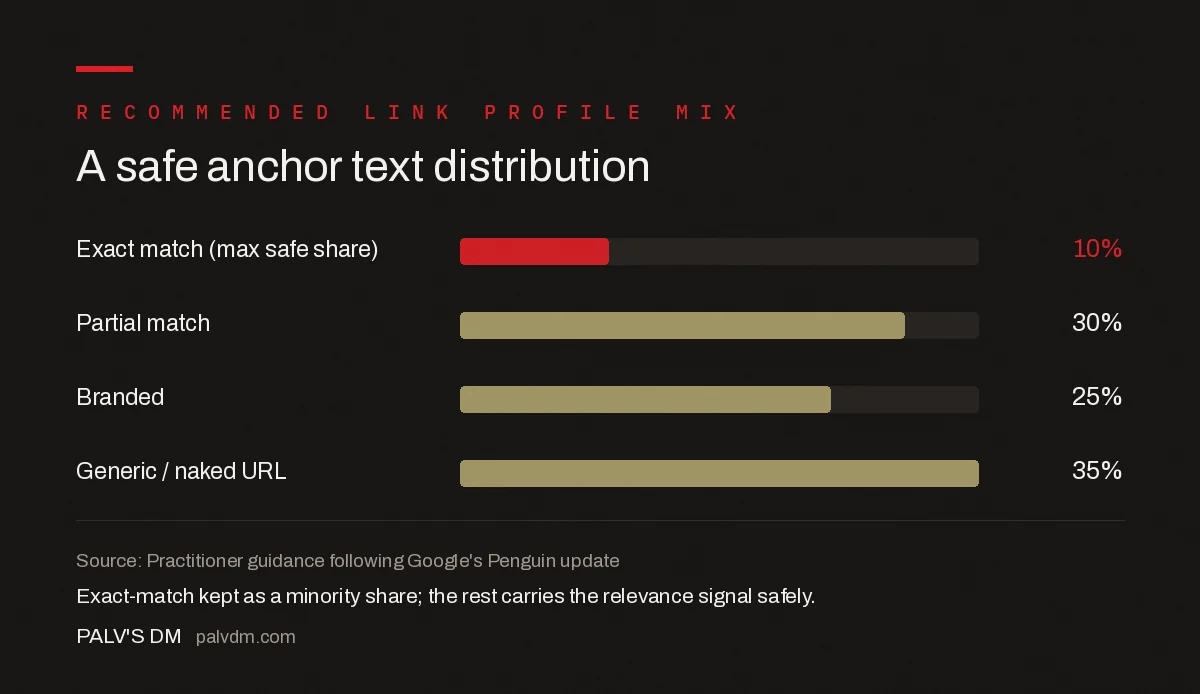
There’s no official Google percentage, but the practical guidance that survived the Penguin update era is to keep exact-match anchors as a small minority of a page’s or a site’s total link profile — commonly cited in the 5-10% range — with the majority split across partial-match, branded, and natural variations. This isn’t a hard rule Google publishes, but a pattern-avoidance heuristic: an unnaturally uniform anchor text distribution is itself a signal, independent of whether any single anchor looks spammy in isolation.
For internal links specifically, this ratio matters less than for external backlinks, since you’re not vulnerable to a manipulative-link penalty on links entirely within your own site. Even so, varying the phrasing across internal links to the same page reads better and lets you reinforce a wider set of related terms than one repeated phrase would.
A practical anchor text mix
- Exact match — Keep under 10% of total links; use only on the highest-priority link per page.
- Partial match — The workhorse category; safe to use for most internal contextual links.
- Branded — Use freely; carries no over-optimisation risk and reads naturally in any context.
- Generic / naked URL — Use where context is already clear or in reference and citation lists.
What does over-optimised anchor text look like?
The clearest sign is repetition: the same exact-match phrase used as the anchor for every link to a given page, across multiple articles, in a pattern that reads as templated rather than written. A second sign is anchor text that’s grammatically forced into a sentence purely to fit the keyword, rather than phrased the way the sentence would naturally read without a link in it.
A third, subtler sign is anchor text density disconnected from actual relevance — linking a keyword phrase to a page that only tangentially covers that topic, which both confuses users and sends a weaker relevance signal than an accurately matched anchor would.
How should anchor text differ for internal vs external links?
Internal anchor text is entirely within your control, which makes it safer to be more deliberate about including keywords — you’re describing your own content accurately, not soliciting a link from someone else. Use partial-match and exact-match phrasing more freely here, varied across mentions, since the risk profile is fundamentally different from earned or built external links.
External anchor text depends on what other sites choose to write when they link to you, and trying to control it — through guest post requirements, link exchanges, or paid placements demanding specific exact-match phrasing — is precisely the pattern Google’s link spam guidance targets. A natural external link profile tends toward branded and naked-URL anchors, with exact-match phrasing appearing only occasionally and without obvious coordination.
How do you audit anchor text across an existing site?
A site crawl with a tool like Screaming Frog, configured to extract “All Anchor Text,” produces a full inventory of internal anchor text by source and destination page. Pull that into a spreadsheet, group by destination URL, and check for pages where one anchor phrase accounts for more than half the internal links pointing to it — that concentration is the pattern worth diversifying, even without any external penalty risk, simply because it wastes the opportunity to reinforce related search terms.
Frequently asked questions
What percentage of anchor text should be exact match?
A commonly cited safe range is under 5-10% exact-match anchors across a link profile, with the rest spread across branded, partial-match, generic, and naked URL text. There’s no official Google figure, but Penguin-era penalties concentrated on profiles with unnaturally high exact-match ratios.
Is it bad to use the same anchor text for every internal link to a page?
Repeating identical anchor text for every internal link to one page looks unnatural and wastes an opportunity to reinforce different related terms. Vary the phrasing across mentions while keeping each one accurately descriptive of the destination page.
Should anchor text always contain the target keyword?
No. Google explicitly recommends anchor text be descriptive and relevant rather than keyword-stuffed, and natural writing produces a mix where the keyword appears in some links and related or branded phrasing appears in others.
Does generic anchor text like ‘click here’ hurt SEO?
It doesn’t get penalised, but it wastes a relevance signal Google could otherwise use, and it gives users and screen readers no context about the destination. Reserve generic anchors for cases where the surrounding sentence already makes the destination obvious.
Should internal links use different anchor text than external backlinks?
Internal anchor text is fully within your control and safer to keep descriptive and keyword-relevant, since you’re not at risk of an unnatural external link profile. External anchor text depends on how other sites choose to link, which is why a heavily exact-match external profile is the bigger red flag.
Sources
- SEO Link Best Practices for Google — Google Search Central
- Internal Linking: The Complete Guide
- On-Page SEO Checklist
- Image Alt Text: What to Write and What to Skip
- URL Slugs: Short, Clean, and Keyword-Bearing
Want this done on your site?
Every PalV’s DM engagement starts with a free audit of your actual website — a 12-point
crawl covering what is blocking indexation, on-page gaps against your primary keywords, speed
findings, and the three to five fixes worth making first. Delivered in two working days. No
payment details, and the findings are yours whether you hire us or not.