How to Win Featured Snippets, Format by Format
Featured snippets come in three formats — paragraph, list, and table — and each needs a different structure to win. Here's how to match your content to the right one.
Featured snippets come in three formats — paragraph, list, and table — and Google’s systems pick the format based on the query’s intent, not your page layout, so winning one means matching your content structure to what that specific query already pulls: a 40-60 word answer for paragraph snippets, a numbered or bulleted list for process queries, and real HTML table markup for comparisons and specs. A well-written answer in the wrong format rarely wins, no matter how accurate it is.
The mistake that costs most pages a featured snippet isn’t a lack of authority or the wrong keyword — it’s writing a single long paragraph for a query that Google is already answering with a list, or building a beautifully designed comparison as styled <div> blocks that no crawler reads as a table.
What is a featured snippet and how does Google choose the format?
A featured snippet is a search result shown in a reversed format — the descriptive answer appears above the page’s title link and URL, in a highlighted box near the top of results. Google’s own documentation describes it as an automatic elevation: the systems evaluate whether a page would make a good featured snippet for a query and select it, with no way for a site owner to request or mark a page for the format.
The format itself — paragraph, list, or table — is chosen per query, not per page. Look at what’s currently showing for your target query before writing: if Google is already answering it with a numbered list, restructuring your content as one long paragraph works against you regardless of how well it’s written.
How do you win a paragraph snippet?
Paragraph snippets dominate definitional and “what is” queries. The pattern that wins them:
- Place a question-phrased heading —
<h2>or<h3>— that mirrors the actual search query as closely as natural phrasing allows. - Answer it in the first sentence or two directly beneath the heading, in 40-60 words, with no throat-clearing or setup before the answer starts.
- Follow with supporting detail, but keep the extraction-ready answer self-contained in that first block — it needs to make sense pulled out of context, since that’s exactly what happens.
How do you win a list snippet?
List snippets — numbered or bulleted — dominate process, ranking, and “steps to” queries. The structure Google pulls from:
- Use a real
<ol>or<ul>element, not paragraph text with manually typed numbers. - Keep each list item to a single clear action or point — Google typically extracts five to eight items, so a list that’s excessively long or short both underperform.
- Put a short heading immediately above the list that states what the list is a list of, matching the query’s phrasing.
How do you win a table snippet?
Table snippets dominate comparison, pricing, and specification queries — anything shaped like “X vs Y” or “X specs.” These are the most technically strict of the three formats:
- Use genuine
<table>,<thead>,<tbody>,<tr>, and<th>/<td>markup. Google does not extract table-shaped data from styled<div>grids or paragraph text formatted to look like a table. - Give every column a clear
<th>header — the header row is part of what gets extracted and displayed. - Keep the table focused on the comparison itself; a table mixed with unrelated columns dilutes what Google can cleanly pull.
Which format should you target for your query?
| Query pattern | Typical format | Structure to use |
|---|---|---|
| “What is X” / definitions | Paragraph | Question H2/H3, 40-60 word answer directly beneath |
| “How to” / step processes | List | Real ol/ul markup, 5-8 concise items |
| “X vs Y” / specs / pricing | Table | Genuine table/thead/tbody markup with clear th headers |
| “Best X” / rankings | List (occasionally table) | Ordered list matching the ranking criteria in the query |
What share of snippets does each format actually claim?
Paragraph snippets account for the largest share of featured snippets overall, list snippets are the second most common format, and table snippets claim the smallest share but are close to unavoidable for comparison-shaped queries specifically — Google rarely answers a genuine “X vs Y” query with a paragraph.
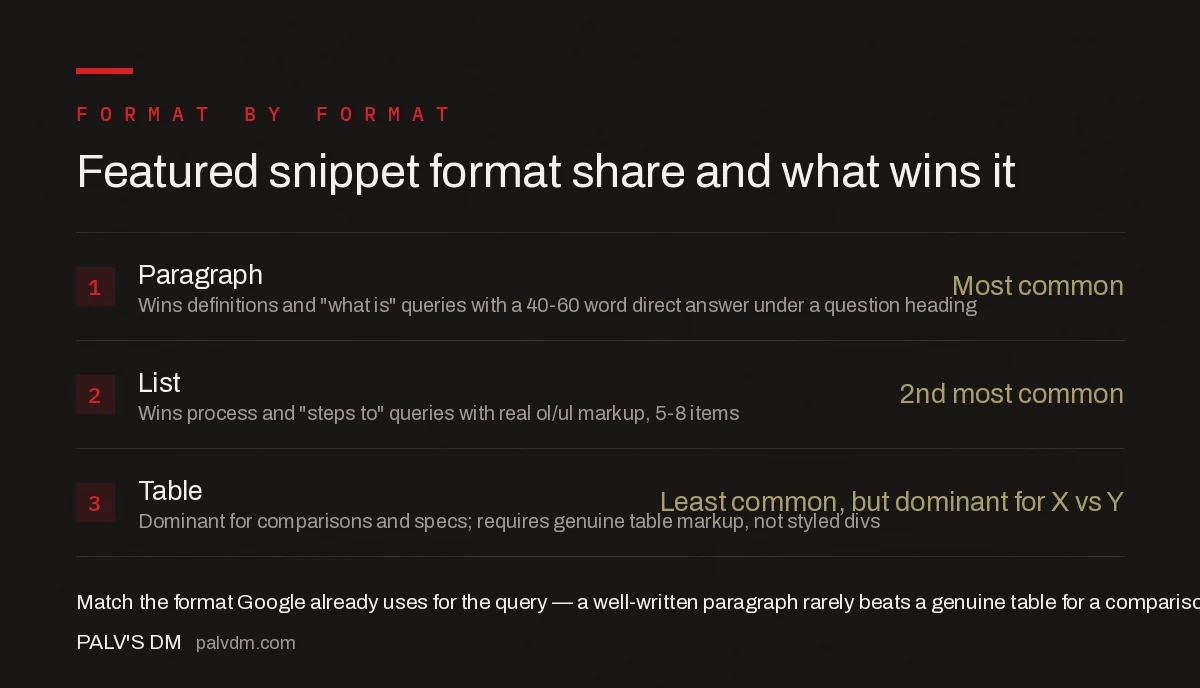
Snippet format, share, and what wins it
- Paragraph — Most common. Wins definitional and “what is” queries with a 40-60 word direct answer under a question heading.
- List — Second most common. Wins process and “steps to” queries with real ol/ul markup, 5-8 items.
- Table — Least common overall, but dominant for comparisons. Requires genuine table markup — styled divs are never extracted.
What happens when a searcher clicks a featured snippet?
Clicking a featured snippet takes the user directly to the section of the source page that generated it, scrolling automatically to that position without any special markup required on the page’s part. If the browser can’t support that behaviour, or Google’s systems can’t confidently pinpoint the exact section, the click lands at the top of the page instead — one more reason the snippet content needs to work as a genuinely self-contained section, not just an isolated sentence.
Frequently asked questions
What are the three featured snippet formats?
Google displays featured snippets as a paragraph, a list (numbered or bulleted), or a table. Google’s systems choose the format based on the query’s intent — definitions and “what is” queries tend to pull paragraphs, processes pull lists, and comparisons or specs pull tables.
Can I mark a page to appear as a featured snippet?
No. Google’s own documentation confirms there is no tag or markup that requests a featured snippet. Google’s systems determine automatically whether a page is a good fit for a given query and elevate it if so.
Do I need to rank number one to win a featured snippet?
No, but you do need to rank in the top 10. Featured snippets are pulled from pages already ranking on page one, and a meaningful share come from positions two through ten rather than exclusively the top result.
How long should a paragraph snippet answer be?
Roughly 40 to 60 words placed directly under a question-phrased heading. Google doesn’t publish an exact minimum or maximum, since the ideal length varies by query and device, but answers in that range are consistently the ones pulled into paragraph snippets.
How do I stop a page from appearing in featured snippets?
Add the nosnippet rule to block all snippets, including regular search snippets, or lower the max-snippet value in a robots meta tag to reduce the chance of a featured snippet specifically while keeping regular snippets. There’s no way to opt out of featured snippets alone without affecting other snippet types.
Sources
- Featured Snippets and Your Website — Google Search Central
- On-Page SEO Checklist: The Complete Guide
- Sitelinks: What Influences Them and What Doesn’t
- Above-the-Fold Content: Answering Before Scrolling
- Losing a Featured Snippet: Common Causes
Want this done on your site?
Every PalV’s DM engagement starts with a free audit of your actual website — a 12-point
crawl covering what is blocking indexation, on-page gaps against your primary keywords, speed
findings, and the three to five fixes worth making first. Delivered in two working days. No
payment details, and the findings are yours whether you hire us or not.