How to Write a Comparison Post Without Being Dishonest
Learn how to write comparison posts that name a real winner, disclose bias, and update pricing on schedule so readers and AI engines trust the verdict.
Published: August 2026
An honest comparison post names a real winner for a specific use case instead of declaring your product best at everything. It discloses when you have a stake in the outcome, links to the competitor’s own pages so readers can verify claims, and updates pricing and feature rows on a set schedule instead of leaving them stale for years. Readers and search engines have both gotten better at spotting comparison posts that are rigged, and the trust cost of getting caught outweighs any short-term conversion lift.
Comparison content converts well because people read it at the exact moment they’re choosing between options. That’s also why it’s the content type most prone to quiet dishonesty — cherry-picked criteria, a “winner” chosen before the research started, or a scoring table with categories invented specifically to favour one side. This guide covers how to write comparison posts that hold up to scrutiny, rank, and still support a sale.
What makes a comparison post dishonest, even without lying?
Most misleading comparison content never states a falsehood. It misleads through selection and framing instead:
- Cherry-picked criteria. Choosing comparison categories after you already know which option wins each one, rather than picking categories readers actually care about.
- Missing context. Quoting a competitor’s old pricing, a discontinued feature, or a limitation they fixed two versions ago.
- False equivalence. Comparing a ₹15,000/month tool against a ₹1,50,000/month enterprise platform as if they serve the same buyer.
- No disclosed stake. Not mentioning that you sell one of the two options, or that a link is an affiliate link.
- Zero losses. Every comparison you’ve ever published has the same company winning. That pattern is itself a signal, to readers and to algorithms trained on E-E-A-T signals, that the “comparison” is closer to an ad.
None of this requires an outright lie. It just requires choosing what to show and what to leave out — which is precisely why it’s easy to slide into without noticing.
How do you pick what to compare?
Start from the reader’s decision, not your product’s strengths. If someone is choosing between two accounting tools, they care about bank reconciliation accuracy, GST filing support, and what happens when they outgrow the free tier — not whichever five features happen to make your tool look strongest. A workable process:
- List the three to five decisions the reader is actually trying to make (cost at scale, ease of migration, support quality, integration depth).
- Pull those criteria from the reader’s likely search behaviour and forum questions (Reddit threads, G2 reviews, Quora), not from your sales deck.
- Include at least one category where the other option genuinely wins. If you can’t find one, you haven’t researched hard enough or you’re comparing two things that aren’t real alternatives.
- Verify every claim against the competitor’s current pricing page or documentation on the day you publish, not a cached memory of it from six months ago.
What structure do comparison posts need?
The dominant format across ranking comparison content is: quick verdict up top, comparison table, then a criteria-by-criteria breakdown, then use-case-specific recommendations. Readers skim the table first and only read the prose if they need more detail on a specific row.
| Section | Purpose | Typical length |
|---|---|---|
| Quick verdict | Answer “which one” in the first 100 words for skimmers and AI summarisers | 50-100 words |
| Comparison table | Scannable side-by-side on the criteria that matter | 5-10 rows |
| Criteria breakdown | Explain the “why” behind each table row, with specifics | 150-300 words per criterion |
| Use-case verdicts | “Choose A if… Choose B if…” — this is the section readers actually convert from | 100-200 words |
| Disclosure | State any commercial relationship plainly | 1-2 sentences |
How do you disclose bias without killing conversions?
A one-line disclosure near the top — “We build and sell [Product], so treat our take on it accordingly, but every number below is sourced and dated” — does more for trust than it costs in conversion. Readers already assume a company blog favours its own product. Naming that assumption out loud, then backing every claim with a checkable source, is what separates a post readers trust from one they bounce off.
The disclosure works better paired with genuine trade-offs. A comparison that says “Product B has better native WhatsApp integration, which matters if that’s your primary support channel” costs you nothing in most conversions and buys real credibility with the minority of readers for whom that trade-off decides the purchase.
What mistakes make a comparison post lose reader trust?
Beyond the core dishonesty patterns already covered, several execution mistakes undermine comparison content even when the intent behind it is genuinely fair.
- Comparing an old snapshot of a competitor against your current product. Features and pricing change on both sides of a comparison, not just yours. A table last updated eight months ago compares your current state against the competitor’s past state, flattering you by accident.
- Letting the table and the prose disagree. A table row saying “Product B: no mobile app” while the prose later mentions Product B’s mobile app in passing happens when a table gets updated but the surrounding text doesn’t. Readers who catch it lose trust in the entire post, not just that detail.
- Scoring criteria that don’t map to a real decision. A table row for “innovation” or “modern design” invites a subjective score dressed up as objective data. Every row should be verifiable independently: a price, a feature’s presence or absence, a specific limit.
- No stated methodology for how the comparison was researched. Readers increasingly discount comparison content that doesn’t say how the information was gathered, whether from hands-on testing, documentation, or user reports. A brief methodology note adds credibility a bare table doesn’t.
- Writing the comparison before finishing the research. Drafting the verdict before every criterion is checked against a current source almost guarantees the writer anchors on an early impression rather than genuinely weighing the options.
A worked example: building one honest comparison row
Take a hypothetical comparison between two invoicing tools on “GST filing support,” a genuinely important decision factor for Indian small business buyers. A weak approach to this row: “Both tools support GST,” which is true but useless, since it tells the reader nothing that differentiates the options.
A properly researched version looks like this: checking both products’ current documentation shows Tool A auto-generates GSTR-1 and GSTR-3B reports directly within the platform, while Tool B generates the underlying data but requires exporting to a separate filing tool to complete the submission. Tool A includes this on its ₹999/month plan; Tool B includes basic GST calculation on its ₹499/month plan but the auto-filing feature is a paid add-on at ₹300/month more, verified against both pricing pages on the publication date.
Written into the table, this becomes: “GST filing: Tool A includes auto-filing on its standard plan; Tool B requires a paid add-on for the same capability.” The prose below then expands on why this matters: a business that already has an accountant handling filing separately may not need Tool A’s built-in workflow, in which case Tool B’s lower base price could be the better fit despite losing this comparison point. That “it depends” framing, backed by a checkable difference, turns a comparison row into something a reader can actually use.
What role do comparison posts play for AI answer engines?
AI Overviews, Perplexity, and ChatGPT increasingly pull from comparison content when a user asks “X vs Y” style questions, because that format already contains the structured trade-off data these systems are trying to summarise. A comparison post that states its verdict plainly in the first hundred words, with a table an AI engine can parse cleanly, gets cited more often than one that buries the conclusion in paragraph six.
The same honesty principle that builds reader trust also helps here: an AI system synthesising several sources will surface the same “winner” your post claims only if other independent sources roughly agree. A comparison that’s wildly out of step with consensus, because it inflated one side, is more likely to get filtered out of an AI-generated answer than quoted in one.
How often should a comparison post be updated?
Pricing, plan names, and feature availability change more often in comparison content than in almost any other content type. A comparison post that’s two years stale on pricing is actively giving readers wrong information at the moment they’re about to spend money — which is the worst possible place for your content to be wrong.
Set a recurring quarterly check: pricing pages, plan tiers, and any “coming soon” features you mentioned. If a competitor ships something you called a gap, either update the row or remove the comparison until you’ve verified the new state.
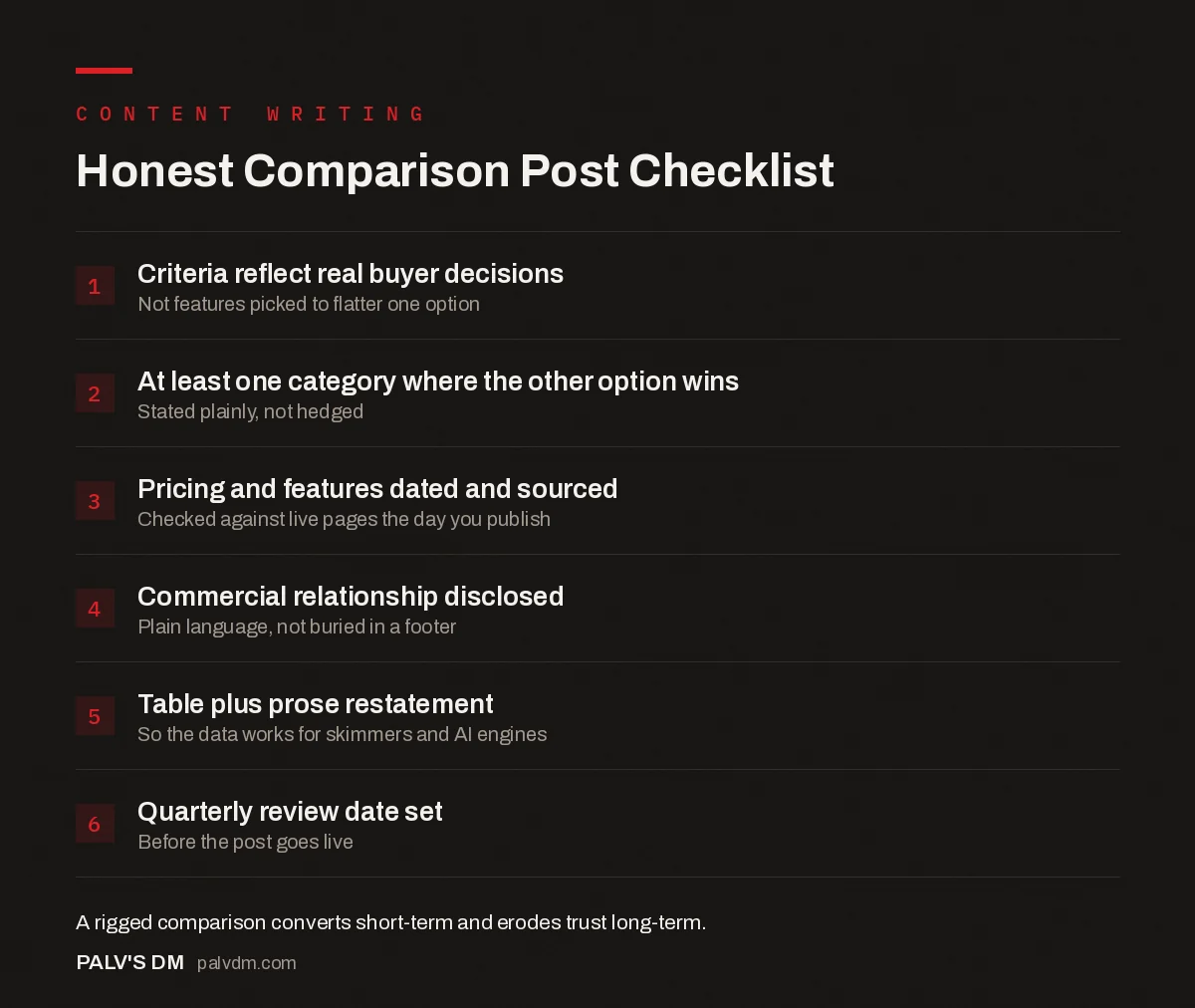
Honest Comparison Post Checklist
- Criteria reflect real buyer decisions. Not features picked to flatter one option.
- At least one category where the other option wins. Stated plainly, not hedged.
- Pricing and features dated and sourced. Checked against live pages the day you publish.
- Commercial relationship disclosed. Plain language, not buried in a footer.
- Table plus prose restatement. So the data works for skimmers and AI engines.
- Quarterly review date set. Before the post goes live.
Comparison post checklist
Run every comparison draft against these six checks before it goes live:
FAQs
Should a comparison post ever declare a tie?
Yes, when it’s genuinely close on the criteria that matter to a specific reader. A forced winner on a real toss-up reads as biased even if you had no commercial stake. It’s more useful to say “both handle this well; the deciding factor is X” than to manufacture a winner.
Is it fine to compare your own product against a competitor?
Yes, as long as you disclose the relationship and hold the same evidence standard for both sides. The disclosure is what keeps it from reading as a disguised ad. Readers forgive a company writing about its own product; they don’t forgive being misled about it.
How many criteria should a comparison table include?
Five to ten is typical. Fewer than five usually means you haven’t dug deep enough into what the buyer actually weighs; more than ten and the table stops being scannable, which defeats its purpose.
Do comparison posts need pricing in Indian Rupees for an Indian audience?
Yes, if the tools being compared serve Indian buyers. USD-only pricing forces the reader to do currency conversion mid-decision, which is friction you don’t need to add, and it also signals the content wasn’t written with an Indian buyer in mind.
What’s the biggest mistake in comparison content?
Writing the verdict before doing the research. If you know how the post ends before you’ve checked current pricing and features, the “research” section becomes evidence-gathering for a conclusion you’d already reached — which is the dishonesty this whole format is prone to.
Where this fits in a content programme
Comparison posts sit in the middle of the funnel: the reader already knows the problem and is now choosing between solutions. They pair well with case study content that proves outcomes and a documented post structure so every comparison in your content library reads consistently instead of each writer inventing a new format. If comparison content sits inside a broader plan, it should trace back to a content strategy that maps which posts serve which stage of the buyer’s decision.
Getting comparison posts right consistently is partly a research discipline and partly a writing discipline — most teams underinvest in the second half. PalV’s DM’s content writing service handles both: sourcing verifiable claims and structuring the post so it reads as evidence, not a sales pitch with a table attached.