Assigning Value to a Ranking You Haven’t Converted Yet
A new ranking has no conversion history yet, but it isn't valueless. Here is how to model traffic value, intent, and time-to-convert.

Published August 2026. Written by the SEO team at PalV’s DM.
A keyword ranking that hasn’t converted yet can still be assigned a defensible value by calculating its traffic value (what the equivalent clicks would cost via paid search), applying a funnel-stage multiplier for search intent, and estimating an assisted-conversion rate from similar pages already in your GA4 data. This produces a modelled value, not a real one, and it should always be labelled that way in a report. But it’s a far better answer than “we don’t know yet” when a stakeholder asks whether a new page-1 ranking is worth anything.
Why does a new ranking need a value before it converts?
SEO has a lag problem that other channels don’t share as sharply. A paid search campaign shows conversion data within days. A new organic ranking might sit at position 4 for two months before enough traffic accumulates to calculate a real conversion rate. During that gap, a stakeholder reviewing quarterly results sees a ranking with no revenue attached to it and reasonably asks whether the work was worth it.
A modelled value, built from data the business already has, fills that gap honestly. It doesn’t claim the ranking generated revenue. It estimates what the ranking is likely worth based on comparable pages, search intent, and known conversion patterns, clearly labelled as an estimate until real data replaces it.
How do you calculate traffic value for a ranking?
The simplest defensible method is the paid search cost equivalent: what would it cost to buy the same volume of clicks via Google Ads for the same keyword. Multiply estimated monthly clicks (from search volume and a CTR-by-position curve) by the average cost-per-click for that keyword, pulled from Google Ads’ Keyword Planner or your own paid search account if you run one.
This method has a real limitation worth stating plainly: it measures what the traffic would cost to buy, not what it’s actually worth in revenue. A keyword with a high CPC but low purchase intent will look more valuable under this method than it deserves. That’s why traffic value should always be paired with a funnel-stage multiplier, not used alone.
What is a funnel-stage multiplier and how do you set one?
Not all traffic is worth the same amount, even at identical volume. A funnel-stage multiplier adjusts the traffic value estimate based on how close the search intent sits to a purchase decision:
| Search intent stage | Example query pattern | Typical multiplier range |
|---|---|---|
| Awareness / informational | “what is [category]” | 0.2x – 0.4x |
| Consideration / comparison | “[category] vs [alternative]” | 0.5x – 0.9x |
| Decision / near-transactional | “[category] pricing” or “best [category] for [use case]” | 1.0x – 1.3x |
| Transactional | “buy [product]” or branded + “price” | 1.2x – 1.5x |
These multiplier ranges are directional starting points, not fixed constants. Calibrate them against your own site’s historical GA4 data once you have enough conversion history from similar pages: if informational-intent pages on your site convert at roughly a quarter the rate of transactional pages, that ratio should set your multiplier, not a generic industry range.
How do you estimate an assisted-conversion rate before real data exists?
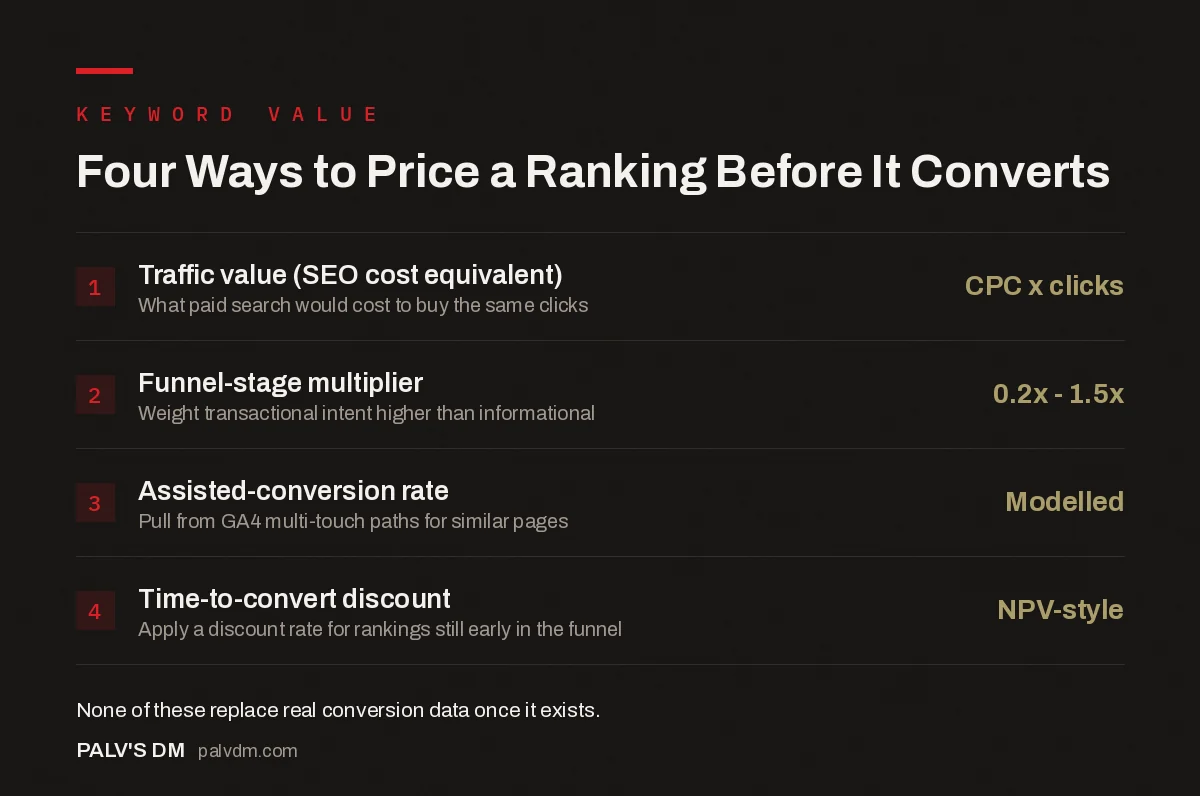
Four ways to price a ranking before it converts
- Traffic value (SEO cost equivalent) — what paid search would cost to buy the same clicks.
- Funnel-stage multiplier — weight transactional intent higher than informational, roughly 0.2x to 1.5x.
- Assisted-conversion rate — pulled from GA4 multi-touch paths for similar existing pages.
- Time-to-convert discount — an NPV-style discount for rankings still early in the funnel.
Look at GA4’s multi-touch conversion paths for pages with similar content type and search intent that are already ranking and converting. If your site has ten existing “comparison” pages converting at an average 2.1% assisted-conversion rate, that’s a reasonable starting estimate for an eleventh comparison page that just reached page 1, adjusted for any meaningful differences in competitiveness or audience size.
This only works with enough comparable pages already in the data. A genuinely new content type with no comparable history on the site doesn’t have a reliable estimate available yet, and forcing one produces false precision. In that case, state the value range widely and flag it as low-confidence until real data accumulates.
Why apply a time-to-convert discount?
A ranking that just reached position 3 this week is not worth the same as a ranking that’s been stable at position 3 for six months, even if the projected traffic value is identical. New rankings carry more risk: Google’s results fluctuate more in the weeks after a page first breaks into a competitive position, and the conversion pattern hasn’t been proven out yet.
A simple discount approach, borrowed from how finance discounts future cash flows, reduces the estimated value based on how recently the ranking was achieved and how volatile the position has been. A ranking stable for one month might get a 20-30% discount against its full modelled value; a ranking stable for six months might get little to no discount. This keeps early estimates conservative and avoids overstating the value of a ranking that could easily drop next month.
How does this work for a real example?
Take a services business that just moved a “pricing comparison” page from position 14 to position 5 for a mid-volume, consideration-stage keyword with 2,400 monthly searches. Here’s how the four inputs combine:
- Estimated monthly clicks at position 5 (using a CTR curve): 96
- Average CPC for the keyword: ₹85
- Traffic value: 96 × ₹85 = ₹8,160/month
- Funnel-stage multiplier (consideration-stage): 0.7x
- Adjusted value: ₹5,712/month
- Assisted-conversion rate from five comparable pages already on the site: 1.8%
- Time-to-convert discount (ranking stable for 3 weeks): 25% reduction
- Final modelled monthly value: approximately ₹4,284
That number isn’t revenue. It’s a stated, checkable estimate of what the ranking is likely worth per month until real conversion data replaces it. Every input in the chain is visible, which is what makes it defensible in a report rather than a guess dressed up as a figure.
What mistakes make a modelled value indefensible?
The method itself is sound, but a few execution errors turn a defensible estimate into a number that collapses under the first hard question:
- Borrowing CPC data from the wrong market. Pulling a global or US-centric average CPC for a keyword when the actual audience and paid search competition are local produces a traffic value that’s disconnected from reality. Pull CPC from the account and geography actually being modelled.
- Skipping the funnel-stage multiplier entirely. Reporting raw traffic value as if it were the final number, without adjusting for search intent, is the single most common way this method overstates a ranking’s worth. An informational query and a transactional query at the same search volume are not worth the same amount, and reporting them as if they were erodes trust in every future estimate.
- Using a single comparable page instead of an average. Basing the assisted-conversion rate on one similar page that happened to convert unusually well overstates the estimate. Average across at least three to five comparable pages where the sample exists, and note the sample size in the report.
- Forgetting to revisit the estimate. A modelled value calculated once and left in a quarterly deck without ever being replaced by real data, even after the page has months of actual conversion history, misrepresents current performance and eventually gets caught by anyone cross-checking the number against GA4 directly.
Each of these is fixable without abandoning the modelling approach. The fix is discipline in how the inputs get sourced and how often the estimate gets refreshed, not a different formula.
Frequently asked questions
Is a modelled keyword value the same as real revenue?
No, and reports should never present it as such. A modelled value is an estimate built from comparable data and stated assumptions, useful for decision-making before real conversion data exists. Once actual GA4 conversion data accumulates for that specific page, replace the modelled figure with the real number and note the date of the switch.
How long should you keep using a modelled value before switching to real data?
Switch as soon as a page has enough traffic and conversion volume to calculate a statistically meaningful conversion rate, typically after a few hundred sessions at minimum. For most mid-traffic pages that reach page 1, this happens within eight to twelve weeks. Keeping a modelled estimate in a report long after real data is available undermines trust in the reporting.
Should every new ranking get a value assigned, or only high-priority ones?
Only ones tied to commercially relevant, non-branded search intent. Assigning a modelled value to every ranking movement, including low-intent informational queries with no realistic path to conversion, adds noise without adding useful decision-making information. Reserve the exercise for rankings on pages built to drive a specific business outcome.
What’s the biggest risk in reporting modelled keyword values?
Presenting the estimate with more confidence than the underlying data supports. A modelled value built on thin comparable data and a wide funnel-stage assumption range should be reported as a range, not a single number, exactly like a traffic forecast. Overstating precision here is how a legitimate estimation method turns into a credibility problem the first time it’s challenged.
The bottom line
A ranking without a conversion history yet isn’t valueless, it’s just unmeasured. Traffic value, a funnel-stage multiplier, an assisted-conversion estimate from comparable pages, and a time-to-convert discount together produce a defensible, clearly-labelled estimate that holds up in a stakeholder conversation, without pretending to be something it isn’t.
PalV’s DM’s SEO Growth service includes this kind of interim valuation model as part of quarterly reporting, so a new ranking has a defensible number attached from month one, not just after conversions finally show up.
For the broader ROI calculation this feeds into, see our guide to calculating SEO ROI. To understand why organic search often looks undervalued in the first place, read attribution models and why SEO looks underpaid. Once real conversion data exists, our post on identifying which pages drive revenue covers the next step. Our Google Search Console guide covers the ranking and impression data this model starts from.