Blog Post Structures That Work, by Intent Type
Blog post structure should match search intent: informational, commercial, and transactional posts each need a different layout to convert.
The right blog post structure depends on search intent, not on a single “best” template: informational queries need a direct answer followed by depth, commercial queries need a comparison table, and transactional queries need the answer and the next step in the first screen, not after 1,500 words of setup. Using the same structure for every post, regardless of what the searcher actually wants at that moment, is one of the more common reasons a well-written post still underperforms.
Published August 2026.
Why does structure need to change with intent?
A searcher typing “what is a pillar page” wants a definition and an explanation. A searcher typing “best CRM for small teams” wants a comparison. A searcher typing “book SEO audit” wants a form, not a 2,000-word essay on why audits matter. Each of these is a different job, and forcing all three into the same “intro, three H2s, conclusion” template ignores what got the searcher there in the first place. Google’s own ranking behaviour reflects this: the pages that rank for commercial queries are overwhelmingly comparison and listicle formats with tables, while the pages ranking for informational queries are guides and explainers. Matching structure to intent isn’t a stylistic preference, it’s answering the query in the format the searcher already expects.
How should informational posts be structured?
Informational intent means the reader wants to learn something, not buy or compare anything yet. The structure that serves this best opens with a direct, self-contained answer in the first two to three sentences, then expands with depth, context, and examples underneath. Headings should mirror how people actually ask the question, since that’s also what search engines and AI answer tools use to identify which passage answers which query. An FAQ block near the end, addressing three to six real follow-up questions, captures the “People Also Ask” style queries that cluster around the main topic.
- Answer-first opening: 50-150 words that fully answer the core question on their own
- Question-phrased H2s: matching real search phrasing, not abstract topic labels
- Self-contained sections: each one should make sense even if it’s the only part someone reads
- FAQ block: 3-6 genuine follow-up questions, each answered in a tight 40-60 words
How should commercial (comparison) posts be structured?
Commercial investigation intent means the reader has narrowed their options and is actively comparing. A comparison table near the top of the post, showing the key differentiators at a glance, does more work here than paragraphs of prose, because it lets the reader scan rather than read linearly. The structure should state a clear verdict or recommendation early, then walk through the trade-offs for each option in enough depth to justify that verdict. Burying the comparison at the bottom of a long article forces readers to scroll past content they don’t need yet.
A typical commercial post structure
- Lead with the verdict or the comparison table, not a long preamble about why the decision matters
- Break down each option with enough specific detail (pricing, features, real trade-offs) to justify the comparison
- Address the “it depends” cases, since most commercial decisions have more than one right answer depending on the reader’s situation
- Close with a clear next step, whether that’s a link to try one of the options or a related resource
How should transactional posts be structured?
Transactional intent means the reader is ready to act right now, whether that’s signing up, buying, or booking. This is the one intent type where a blog post structure should actively resist the instinct to add more educational content. Someone searching a transactional phrase wants the offer and a visible next step immediately, not a long explanation before getting there. A single primary call to action, supported by a short, credible proof section and a brief objections FAQ, outperforms a long-form article trying to also rank informationally on the same page.
| Intent type | Structural priority | What to avoid |
|---|---|---|
| Informational | Answer-first opening, question H2s, FAQ block | Burying the direct answer under a long introduction |
| Commercial | Early comparison table, clear verdict, trade-off detail | Vague “it depends” with no actual recommendation |
| Transactional | Visible offer and CTA above the fold, short proof section | Long educational content before the action step |
| Navigational | Rarely a blog post’s job; usually belongs on a dedicated landing page | Trying to rank a blog post for a brand-name search |
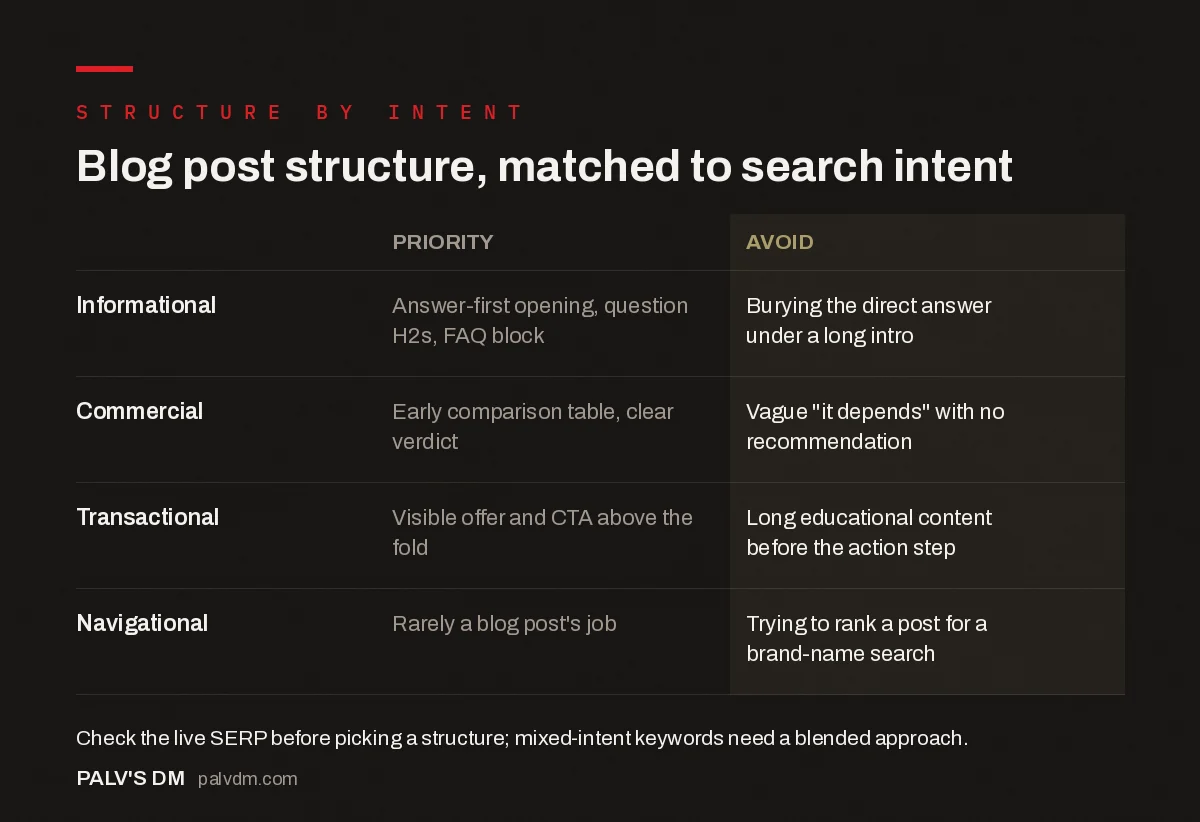
Blog post structure, matched to search intent
| Priority | Avoid | |
|---|---|---|
| Informational | Answer-first opening, question H2s, FAQ block | Burying the direct answer under a long intro |
| Commercial | Early comparison table, clear verdict | Vague “it depends” with no recommendation |
| Transactional | Visible offer and CTA above the fold | Long educational content before the action step |
| Navigational | Rarely a blog post’s job | Trying to rank a post for a brand-name search |
What mistakes cause a post to fight its own intent?
A handful of structural mistakes recur across content built for the wrong intent, even when the underlying research and writing quality is solid.
- Writing a commercial post like an informational one. A “best project management tools” post that opens with three paragraphs on why project management matters, before mentioning a tool, makes a reader who already knows they need one wade through content meant for someone who doesn’t.
- Adding a long FAQ block to a transactional page. A page meant to convert a ready-to-act visitor that closes with eight FAQ questions covering general curiosity re-introduces exactly the kind of browsing behaviour a transactional structure is supposed to short-circuit. A short, targeted objections FAQ serves this intent; a broad educational one works against it.
- Using topic labels instead of question-phrased headings on informational content. A heading like “Benefits” tells a search engine and an AI system far less than “What are the benefits of X for small teams,” which mirrors how the underlying query is actually phrased and makes the section easier to extract as a standalone answer.
- Assuming intent from the keyword alone. The same keyword can carry different intent depending on the market or the moment; checking what’s actually ranking is a five-minute step that prevents building the wrong structure.
- Forcing every post into the same fixed template regardless of intent. A content team with a single “intro, three H2s, FAQ, conclusion” template applied uniformly will underperform on commercial and transactional queries specifically, even if the same template performs fine on informational content.
A worked example: restructuring a mismatched post
Take a hypothetical post targeting “best invoicing software for freelancers,” originally written as a 1,800-word narrative essay: three paragraphs on why invoicing matters, a history of invoicing software, then finally, around word 900, a rundown of five tools in prose form with no table.
Checking the live SERP for this keyword shows eight of the top ten results are listicle or comparison formats, each with a table in the first or second screen. This confirms commercial investigation intent, meaning the existing structure is fighting the query rather than serving it.
The restructure: the historical content moves to a single short paragraph, or gets cut entirely as material better suited to a definitional post on “what is invoicing software” instead. A comparison table goes in immediately after the opening, covering the five tools across pricing, free-tier limits, and the features freelancers most often ask about, based on real search behavior rather than guesswork. Each tool then gets a shorter breakdown addressing the “who this is actually right for” question, and the post closes with a “choose X if… choose Y if…” block. The word count likely drops, not grows, since removing content that doesn’t serve commercial intent usually does more for performance than adding more of it.
How does structure affect AI answer engine citation?
Generative engines like AI Overviews and Perplexity extract passages, not whole pages, and self-contained sections with clear headings are far more likely to get lifted as a citation than a page written as one continuous argument. This reinforces the same structural choices that already serve human readers and featured snippets: a question-phrased H2 followed by a complete, standalone answer gives an AI system a clean unit of text to quote. A post where every paragraph depends on the one before it, using phrases like “as mentioned above” or “this approach,” is harder for both a skimming human and an extraction algorithm to use in isolation.
What if a keyword has mixed intent?
Some keywords genuinely pull mixed results: part guide, part comparison, part product page. When this happens, check what’s actually ranking rather than picking a structure in advance. If the top 10 results are split between guides and comparison posts, lead with the dominant format and add a secondary block for the other, for example a solid informational guide with a comparison table partway through for readers who’ve moved further along in their decision. Forcing a single, pure format onto a genuinely mixed-intent keyword usually leaves the post competing against pages built for a format the SERP has already told you works.
Frequently asked questions
Can one blog post serve more than one intent?
To a limited extent, yes, particularly for TOFU-to-MOFU topics where a reader might be researching and comparing in the same session. But trying to serve informational, commercial, and transactional intent all in one post usually means doing none of them particularly well. It’s more effective to serve the primary intent thoroughly and link to a more targeted page for readers whose intent shifts partway through.
How do you figure out a keyword’s intent before writing?
Search the keyword yourself and look at what’s actually ranking. Guides and blog posts dominating the results signal informational intent. Listicles, “best of,” and comparison tables signal commercial investigation. Product or pricing pages ranking well signal transactional intent, in which case a blog post likely won’t outrank them and a landing page is the better format.
Does structure matter more than writing quality?
No, but the wrong structure can make good writing invisible. A well-researched, accurate post that buries its answer under three paragraphs of preamble loses readers and featured snippet opportunities that a more direct structure would have captured, even with identical underlying research.
Should every post have an FAQ section?
Informational and comparison posts generally benefit from one, since it captures follow-up questions readers are likely to have. Transactional posts benefit more from a short, targeted objections FAQ (addressing hesitations, not general curiosity) rather than a broad FAQ block that reintroduces educational content the page was trying to avoid.
Matching format to intent, every time
There’s no universal best blog post structure, only the structure that matches what a specific searcher, with a specific intent, actually needs from that specific query. Checking the live SERP before writing, rather than defaulting to a fixed template, is the single highest-leverage habit for getting this right consistently. If your team is producing content across multiple intent types and wants each one structured to match, our content writing service builds intent-appropriate structure into every brief before a word gets written.
This post is part of our content strategy guide and sits within our writing craft series. For how-to specific structure, see how-to posts: prerequisites, steps, and failure modes. For comparison content specifically, see how to write a comparison post without being dishonest. And for the opening lines that make or break any structure, see writing an introduction that doesn’t waste the reader’s time.