Myth-Buster Posts: Claim, Reality, Why the Confusion Exists
A myth-buster post needs three parts: the claim stated fairly, a sourced correction, and why the confusion exists. Skip part three, it reads as a lecture.
Published: August 2026
A myth-buster post works in three parts: state the claim exactly as people actually believe it, correct it with evidence, and explain why the misconception exists in the first place. Skipping that third part is the most common mistake — without it, the correction reads as “you’re wrong” instead of “here’s how this confusion started, and here’s what’s actually true,” which is a much harder pitch for a reader to accept, especially if they’ve repeated the myth themselves.
Myth-busting content performs well because it targets a real gap between what people believe and what’s actually true, which usually means real search volume and low genuine competition, since accurately correcting a misconception takes more research than restating the myth. This guide covers how to structure myth-buster content so it corrects without condescending.
Why does the “why the confusion exists” section matter so much?
Most myths aren’t random. They usually have a real origin: something that used to be true and stopped being true, a rule that applies in one context getting generalised to all contexts, or a genuinely confusing piece of official guidance. Explaining that origin does two things a flat correction can’t.
First, it makes the reader feel less foolish for having believed it, which keeps them reading instead of getting defensive. Second, it’s often more useful information than the correction itself, because it tells the reader how to spot the next outdated or misapplied rule before it becomes a myth they repeat.
How do you state a myth fairly before correcting it?
State the myth the way people who believe it would state it, not a weakened strawman version that’s easy to knock down. If the actual belief in circulation is “you need to submit your sitemap to Google or your pages won’t get indexed,” don’t soften it to something vaguer before correcting it. A strawman version undermines the whole piece, because readers who hold the real, stronger version of the belief will notice the gap and stop trusting the correction.
| Weak myth statement | Fair myth statement |
|---|---|
| “Some people think sitemaps matter a lot” | “Submitting an XML sitemap is required for Google to index your pages” |
| Vague, easy to dismiss | Specific, stated as confidently as believers actually state it |

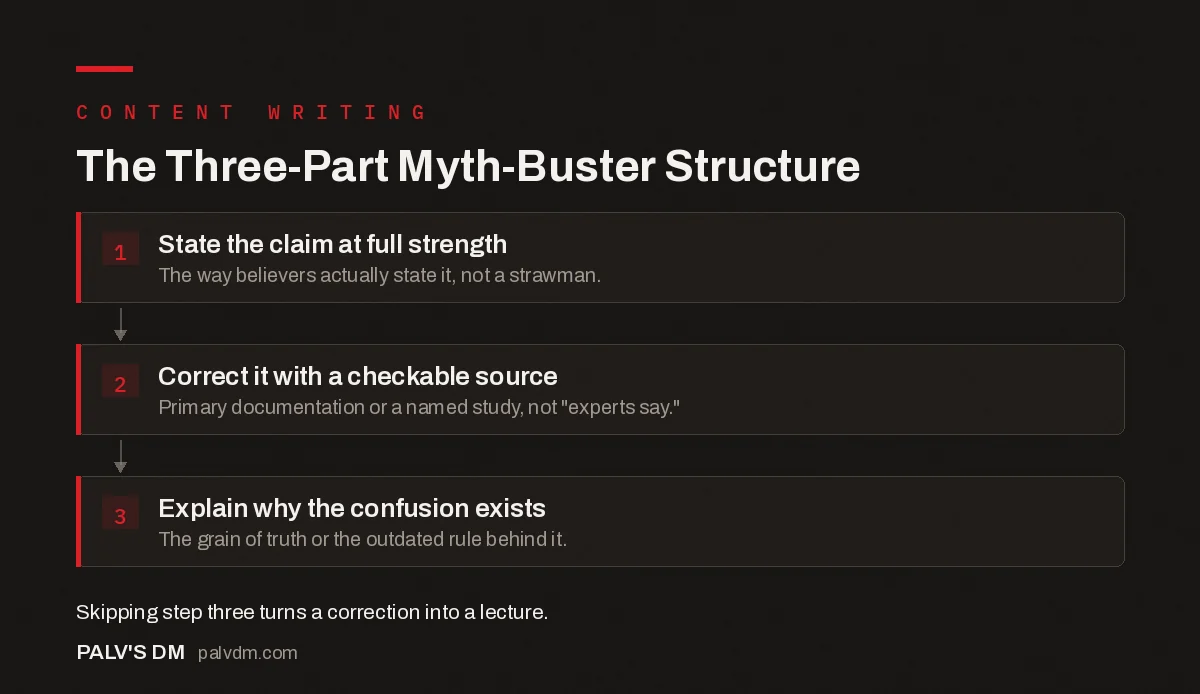
The Three-Part Myth-Buster Structure
- State the claim at full strength. The way believers actually state it, not a strawman.
- Correct it with a checkable source. Primary documentation or a named study, not “experts say.”.
- Explain why the confusion exists. The grain of truth or the outdated rule behind it.
What evidence does a correction actually need?
A myth-buster post lives or dies on its sourcing. The correction needs to point to something checkable: primary documentation (Google Search Central, for SEO topics), a named published study, or an official statement from the organisation the myth is about. “Experts say” or “it’s widely known” carries no weight in a piece specifically about correcting bad information — using the same vague sourcing the myth itself probably relies on undercuts the entire premise of the post.
Where a claim can’t be sourced to something verifiable, the honest move is to soften the framing to “the general pattern across published data suggests” rather than stating it as settled fact. A myth-buster post that fabricates authority to correct a myth is doing the same thing it’s criticising.
How do you avoid sounding condescending?
Tone matters more in myth-busting content than almost any other format, because the entire premise involves telling readers something they may currently believe is wrong. A few habits keep it from reading as a lecture:
- Frame it as common, not foolish. “This is one of the most repeated claims in SEO” lands very differently from “people wrongly assume.”
- Acknowledge the grain of truth. Most myths were true once, or are true in a narrower context than people apply them to. Naming that context is fairer than a blanket “false.”
- Avoid absolute language when the reality has nuance. If the correction is “it depends,” say that, instead of forcing a clean true/false for a genuinely conditional situation.
- Skip the victory lap. The goal is an accurate belief, not proving the reader was gullible for holding the old one.
How many myths belong in one post?
This depends on depth versus breadth. A single, well-sourced myth with real depth in the “why it persists” section can be a complete post on its own, especially for a widely repeated and consequential misconception. A roundup of five to ten smaller myths works better when each one is genuinely common but doesn’t individually justify 1,000+ words of its own. What doesn’t work is forcing ten myths into a post and giving each one two sentences — that format doesn’t leave room for the “why the confusion exists” section that makes the format valuable in the first place.
What structure holds up best for a single myth deep dive?
For a single, well-researched myth, four parts in sequence tend to work: state the myth at full strength, deliver the correction with its source in the same breath (don’t make readers wait for evidence), explain the origin or the grain of truth, and close with the practical implication — what a reader should actually do differently now that the myth is corrected. That last part is easy to skip and shouldn’t be, because a correction without a practical takeaway leaves the reader informed but not equipped to act on it.
For example, correcting “you need to submit a sitemap for Google to index your pages” isn’t complete until the post also says what actually helps indexing (internal linking, crawlable navigation, a reasonable site structure) and where a sitemap does still add value (helping Google discover pages faster, not acting as a gatekeeper for indexing itself). The correction plus the practical next step is what makes the post useful beyond just being technically accurate.
What’s a full worked example of the three-part structure?
Take the persistent claim that keyword density — hitting a specific percentage of a target keyword’s repetitions in a page — determines rankings. Stated at full strength, the way people who believe it actually phrase it: “You need your keyword to appear at 2-3% density or Google won’t rank you for it.”
The correction, with source: Google’s own search documentation and public statements from Google’s Search Relations team (John Mueller has addressed this repeatedly in Search Central office-hours sessions) describe keyword density as not a ranking factor Google’s systems use directly. Modern ranking systems evaluate topical relevance and language patterns far more holistically than a repetition count.
Why the confusion exists: keyword density was a meaningfully useful heuristic in the late 1990s and early 2000s, when search engines had far less sophisticated language understanding and repetition was a rough proxy for relevance. Density-checking tools built during that era are still widely used and still report a percentage, which makes the metric look current and authoritative even though the algorithm it was designed to game no longer works that way. The practical implication: write naturally for the topic and let relevant terms and their variations appear where they make sense, rather than counting repetitions or hitting a target percentage.
How do you handle a myth where the evidence is genuinely mixed?
Not every popular claim is cleanly false. Some myths are outdated-but-were-true, some are true-in-a-narrower-context-than-claimed, and some are genuinely contested with real evidence on both sides. Forcing a flat “myth” or “fact” verdict onto a genuinely mixed case produces a post that’s technically inaccurate in the opposite direction from the myth it’s correcting.
The honest structure for a mixed-evidence myth still uses the same three parts, but the correction section needs to hold more nuance: state what part of the claim holds up, what part doesn’t, and under what conditions the belief is more or less accurate. For example, “publishing frequency affects rankings” is a common claim that’s neither clearly true nor clearly false — consistent publishing correlates with sites that also tend to have stronger topical coverage and more internal links, but frequency alone, isolated from those other factors, has no established direct effect. A myth-buster post on this topic that says “totally false, frequency doesn’t matter at all” would be overcorrecting into its own inaccuracy. The reader is better served by “the correlation is real, the causation claim usually isn’t” than by a clean but wrong verdict in either direction.
FAQs
Should myth-buster posts name who’s spreading the myth?
Generally no, unless it’s a specific, attributable, and verifiable source worth naming for context (an official but outdated guideline, for instance). Naming individual people or brands as the source of a misconception, without solid evidence, risks becoming its own inaccuracy.
What if the “myth” turns out to be partly true?
Say so directly. A myth-buster post that discovers real nuance during research and still forces a flat “false” verdict is less useful and less honest than one that says “this was true until [date/version], and here’s what changed.” Nuance is a better outcome than a clean headline.
How do you find myths worth writing about?
Forums, comment sections, and client or customer questions are the richest source, since they show what people actually believe rather than what a content team assumes they believe. If a question or claim keeps recurring in the same wrong form across multiple sources, it’s usually worth a dedicated post.
Do myth-buster posts need a summary table?
They benefit from one when the post covers multiple myths, since it lets skimmers see the claim-versus-reality pattern at a glance before deciding which section to read in full. For single-myth deep dives, a table is less essential since the whole post already functions as one long answer.
Is myth-busting content good for AI citation?
Often, yes, because “is X true” and “does X actually work” are exactly the kind of question AI answer engines are built to resolve, and a well-sourced myth-buster post gives them a clean claim-and-correction pair to summarise. Vague or unsourced corrections get filtered out in favour of ones that cite something checkable.
Where myth-busting content fits in a content programme
Myth-buster posts work well alongside definitional content that clarifies terms the myth may be confusing, and they benefit from the same sourcing discipline covered in honest comparison writing, since both formats live or die on verifiable claims rather than assertion. As with other formats here, myth-busting content works best when it’s planned inside a broader content strategy that identifies which misconceptions are actually worth a dedicated post.
Correcting a misconception convincingly takes real research into where it came from, not just a confident “actually.” PalV’s DM’s content writing team sources every claim and reality-checks the “why this persists” section before a myth-buster post goes live, which is the part most teams skip.