Definitional Posts: Owning ‘What Is X’ Queries
A definitional post wins what-is-X queries by answering fast in plain language, then adding real depth. Here is how to structure and write one that ranks.

Published: August 2026
A definitional post wins “what is X” queries by answering the question in the first sentence, in plain language, before adding nuance. Google’s own guidance rewards content that satisfies the searcher immediately rather than making them scroll past a company history and three paragraphs of throat-clearing. The same rule applies to AI answer engines: they pull the most direct, self-contained definition available, so a page that buries its answer gets skipped in favour of one that doesn’t.
“What is X” queries are some of the highest-volume, lowest-competition-per-click keywords available to a content team, because most businesses treat them as an afterthought — a quick paragraph bolted onto a longer guide instead of a page built to own the query. This post covers how to structure, write, and maintain definitional content that actually ranks and gets cited.
What is a definitional post, exactly?
A definitional post is a page built to answer one specific “what is” or “what does X mean” query as completely and directly as possible. It differs from a how-to guide (which walks through a process) or a comparison post (which weighs two options) in that its entire job is to define a term, concept, or category clearly enough that the reader doesn’t need to look elsewhere.
Examples relevant to content and SEO work: “what is content SEO,” “what is a content brief,” “what is topical authority.” Each of these gets searched by people at very different points in their journey — some are just curious, others are about to hire someone to do the thing being defined — which is why the post needs to serve both without alienating either.
Why do definitional queries convert, even though they look purely informational?
A reader searching “what is content SEO” isn’t always just curious. Some fraction of that search volume is a decision-maker doing due diligence before a purchase — checking whether a term they heard in a sales call is real, and whether the agency pitching them actually understands it. A definitional post that nails the answer and then shows depth beyond the bare minimum is doing quiet credibility work at exactly the moment a prospect is evaluating whether to trust you.
That’s also why definitional posts shouldn’t be thin. A 200-word dictionary-style answer satisfies the query technically but does nothing to demonstrate expertise. The winning format answers fast, then goes deeper than a dictionary would.
How should a definitional post be structured?
Five parts make up a durable definitional post, shown below with the reasoning behind the order.
The direct-answer-first structure matters more here than in almost any other content type, because a large share of readers on a “what is” query only want the first paragraph. Everyone past that point is a reader worth investing depth in.
What does a strong opening definition actually look like?
Compare two openings for “what is content SEO”:
| Weak opening | Strong opening |
|---|---|
| “In today’s digital landscape, businesses are increasingly turning to content as a way to improve their online visibility…” | “Content SEO is the practice of writing and structuring web content so it satisfies both a search engine’s ranking systems and the reader’s actual question. It sits alongside technical SEO and link building as one of the three core levers in organic search.” |
| Buries the definition three sentences in, adds no information | Answers in sentence one, places the term in context in sentence two |
The strong version works for a human skimming, a Google featured snippet extraction, and an AI engine generating a summary — the same sentence serves all three audiences because it’s just a clear, complete answer.
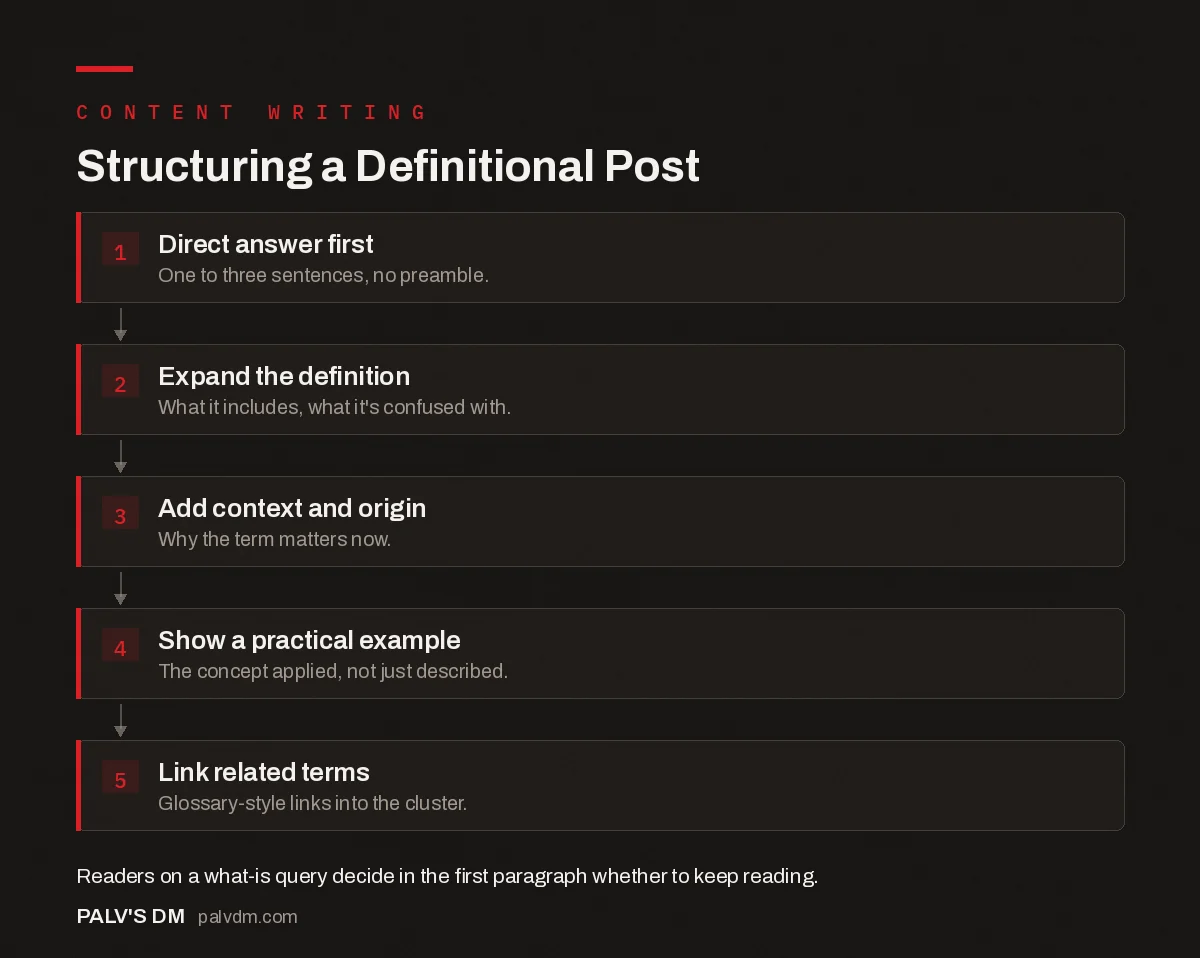
Structuring a Definitional Post
- Direct answer first. One to three sentences, no preamble.
- Expand the definition. What it includes, what it’s confused with.
- Add context and origin. Why the term matters now.
- Show a practical example. The concept applied, not just described.
- Link related terms. Glossary-style links into the cluster.
How do you avoid writing a thin, forgettable definition page?
Thin definitional content is the most common failure mode here. Signs a definitional post is too thin to be worth publishing:
- It only restates the term in different words without adding examples, context, or nuance
- It doesn’t mention what the term is commonly confused with
- There’s no practical example of the concept being applied
- It has no internal links to related terms or deeper guides on the same topic
- It could have been written without any subject-matter research, purely from the term itself
A useful test: could a competent writer with no background in the field have produced this page in ten minutes using only the search results? If yes, it’s not going to outrank pages written by people who actually understand the subject.
What mistakes keep definitional content from ranking?
Beyond generic thinness, several specific mistakes recur in definitional content that otherwise looks reasonably complete.
- Defining the term using the term itself. “Content SEO is the SEO of content” is circular and tells the reader nothing they didn’t already know from the phrase itself. A working definition needs to explain the concept using different, plainer language than the term being defined.
- Writing the definition for someone who already understands the field. Unexplained jargon inside the definition of a jargon term defeats the purpose. If defining “topical authority” requires the reader to already know “search intent,” that needs at least a one-line gloss rather than an assumption of prior knowledge.
- No worked example of the concept in use. An abstract definition without a concrete instance leaves readers unsure how the concept actually shows up in practice. Even a two-sentence example makes an abstract definition tangible.
- Ignoring adjacent terms readers commonly confuse with this one. “What is a pillar page” content that never mentions how it differs from a category page misses one of the most common reasons people search the definitional query: they’ve heard multiple similar terms and need help telling them apart.
- Letting the page go stale as the field’s terminology shifts. Fast-moving areas redefine terms faster than most content calendars account for. A definitional post that hasn’t been checked in two years in a field like AI search risks defining a term the way it was used when the post launched, not how it’s used now.
A worked example: writing a definition that clears the bar
Take the term “topical authority” as a test case. A thin, forgettable version: “Topical authority means Google trusts your site on a topic. It’s important for SEO because it helps you rank better and get more traffic.”
This restates the term without adding real information, doesn’t explain what builds trust, and offers no example. A version that clears the bar: “Topical authority is the degree to which a search engine treats a site as a credible, comprehensive source on a specific subject, based on signals like the breadth and depth of content published on that topic, internal linking between related pages, and external validation like backlinks from other sites covering the same subject. It’s distinct from domain authority, which is a general measure of a site’s overall strength regardless of topic; a site can have high topical authority in one narrow subject while having modest domain authority overall.”
That version adds a worked example: “A site that has published forty well-linked, in-depth posts about email marketing, with consistent internal linking between them, is more likely to rank a new email marketing post quickly than a general business blog publishing its first post on the topic, even if the general blog has more total traffic.” The example makes the abstract mechanism concrete, and the adjacent-term comparison against domain authority heads off the confusion that sends a meaningful share of readers to this query in the first place.
How do definitional posts fit into a content strategy?
Definitional posts work best as connective tissue in a topic cluster rather than as isolated pages. A “what is content SEO” post should link out to the deeper guides that cover each component (writing for readability, structuring for AI citation, technical execution) and should itself be linked to from those deeper guides, so search engines and readers alike understand it as the conceptual anchor for the cluster.
They also age differently from other content types. A definitional post rarely needs a full rewrite, but the “related terms” and “common confusion” sections benefit from a review every six to twelve months as terminology in fast-moving fields (like AI search) shifts.
How does definitional content perform in AI search results?
AI Overviews and chat-based answer engines lean heavily on definitional content because a clean, self-contained definition is exactly the kind of text these systems can lift and cite with minimal rewriting. Google’s own documentation on featured snippets has long emphasised direct, well-structured answers, and the same structural habits that win a snippet tend to win an AI citation.
The practical implication is that formatting discipline matters as much as accuracy. A correct definition wrapped in vague throat-clearing gets paraphrased or skipped; the same definition stated plainly in the opening sentence, with the term itself appearing early, gets quoted close to verbatim. Structure isn’t just an SEO nicety here, it’s the difference between being the source and being invisible.
FAQs
How long should a definitional post be?
Long enough to go beyond a dictionary answer but not so long it stops feeling like a direct response. Most well-performing definitional posts run 800 to 1,500 words once you include context, examples, and related terms — longer if the concept genuinely has that much nuance.
Should the definition be in the meta description too?
Yes. The meta description is often what a searcher reads before clicking, so restating the core definition there, in under 155 characters, reinforces relevance and improves click-through from people who wanted exactly that answer.
Do definitional posts need FAQ sections?
They benefit from one, since “what is X” queries often cluster with related questions like “is X the same as Y” or “why does X matter.” A short FAQ block captures that adjacent search intent without diluting the main definition.
Can a definitional post also rank for a how-to query?
Rarely, and it shouldn’t try to. Mixing intents dilutes both purposes. A definitional post that also tries to be a full how-to guide typically ends up too shallow at both jobs. Keep them separate and link between them instead.
How do you know if a term is worth a dedicated definitional post?
Check whether the term gets searched on its own, independent of a longer question. If people search “what is topical authority” as a standalone query with meaningful volume, it earns its own page. If it only ever appears inside longer, more specific searches, it’s better handled as a section within a broader guide.
Where definitional content fits alongside other formats
Definitional posts pair naturally with how-to content that shows the concept in action and with a documented style guide that keeps definitions consistent across every writer touching the cluster. Inside a wider plan, they should be mapped explicitly in a content strategy that assigns each definitional term to a specific cluster rather than written ad hoc whenever a writer feels like a term needs explaining.
Definitional pages look simple but are easy to get wrong — either too thin to earn a ranking or too padded to answer the query fast. PalV’s DM’s content writing team builds definitional content as part of a structured cluster, not a one-off page, so each definition does real work for the pages around it.