Tone of Voice: Documenting It So Others Can Write In It
Vague adjectives like friendly and professional do not transfer between writers. Here is how to document tone of voice with rules people can follow.
Published: August 2026
Documenting a brand’s tone of voice means turning “we sound direct and unhyped” into rules specific enough that a writer who’s never spoken to the founder can produce a passable draft on the first try. Adjectives alone don’t do this — every brand describes itself as “friendly” and “professional,” and those words don’t tell a writer what to actually do differently in a sentence. A usable tone document pairs each trait with real before-and-after examples pulled from the brand’s own content.
Tone documentation matters most the moment a brand grows past one person writing everything. As soon as a second writer, a freelancer, or an agency gets involved, tone either survives as a documented, checkable standard or it degrades into “sounds off, not sure why” feedback on every draft. This guide covers how to document tone so it transfers, not just how to describe it.
What’s the difference between brand voice and tone?
Voice is constant: it’s the brand’s underlying personality, the same across every piece of content. Tone is how that voice flexes by context — a support ticket response and a product launch announcement come from the same voice but land in a different tone, one more measured and reassuring, the other more energetic. Documentation needs to cover both: the fixed personality traits, and a guide to how those traits shift across contexts like customer service, marketing, and technical documentation.
How do you turn a vague trait into a usable rule?
Take each voice adjective and answer three questions about it: what does this look like in a sentence, what’s the opposite failure mode, and where’s a real example from existing content. A trait like “direct” might break down like this:
| Element | Example |
|---|---|
| What it looks like | “This plan costs ₹25,000 a month and includes four blog posts.” |
| Opposite failure mode | “Our flexible pricing options are designed to accommodate a range of business needs.” |
| Real example from existing content | Pull an actual sentence from a published page that nails this trait |
This structure works for any adjective, and it’s the difference between a tone document that changes how people write and one that just describes an aspiration nobody can act on.

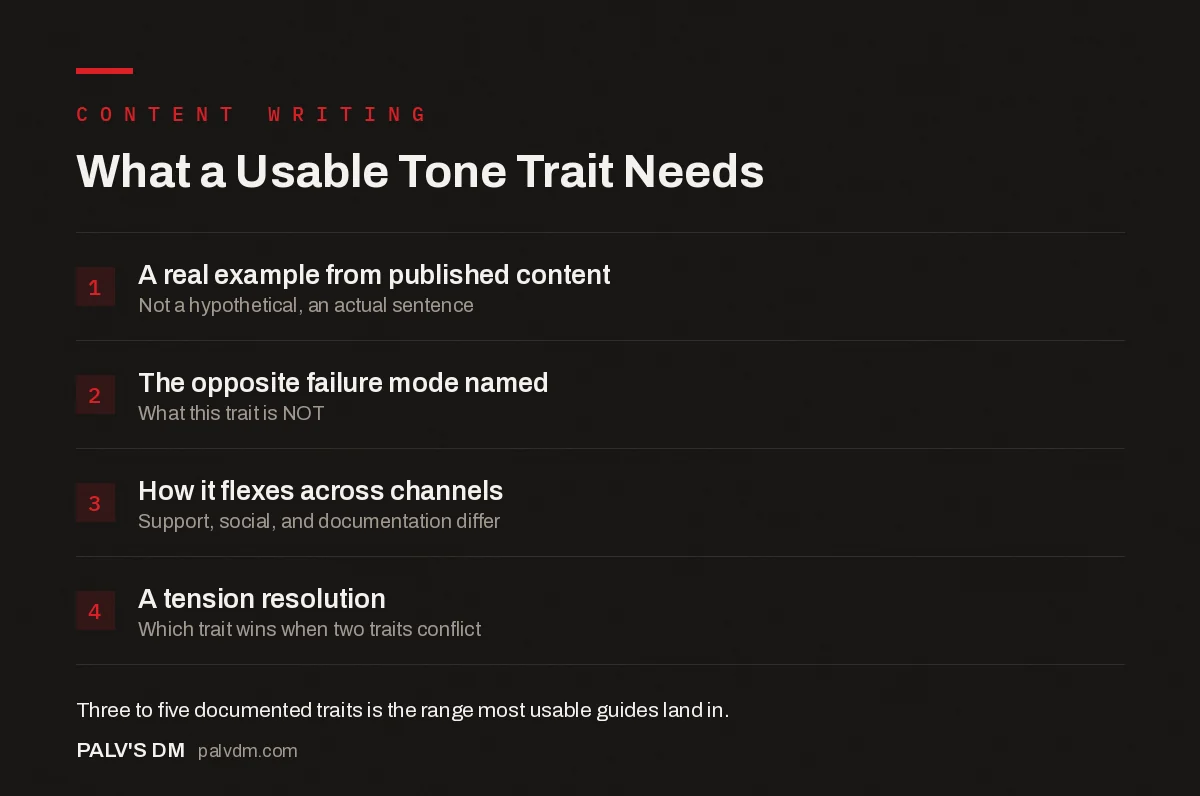
What a Usable Tone Trait Needs
- A real example from published content. Not a hypothetical, an actual sentence.
- The opposite failure mode named. What this trait is NOT.
- How it flexes across channels. Support, social, and documentation differ.
- A tension resolution. Which trait wins when two traits conflict.
How many voice traits should be documented?
Three to five is the range most usable tone documents land in. Fewer than three usually can’t distinguish the brand from its competitors; more than five becomes hard for a writer to hold in mind simultaneously while drafting, and the traits start to blur into each other or occasionally contradict. If a brand genuinely needs more nuance than five traits capture, that’s often a sign the traits themselves need sharper, more specific definitions rather than more of them.
How should tone shift across channels without breaking voice consistency?
Voice should hold across every channel; tone can and should flex. A useful way to document this is a simple matrix: list the brand’s core channels down one side (website, social, email, support), and note how each voice trait dials up or down in that context.
- Support responses usually need the “direct” trait paired with more warmth than a blog post would use, since the reader is often mildly frustrated already.
- Social posts can afford more personality and brevity than long-form content, without abandoning the brand’s core traits.
- Technical documentation typically dials personality down and precision up, while keeping the same underlying directness.
Without this kind of guidance, writers either apply one tone everywhere (which reads oddly stiff in casual channels or oddly casual in serious ones) or invent channel-specific tone on their own, which reintroduces the inconsistency the documentation was meant to solve.
Who should be involved in documenting tone of voice?
The people who write the most brand content day to day should be closely involved, not just leadership describing an aspirational identity from the outside. Founders and executives are useful for articulating what the brand should stand for; the writers and editors who produce content daily are usually better at identifying what actually distinguishes the brand’s existing writing from a generic competitor’s. The best tone documents tend to come from analysing real, already-published content for patterns, then confirming those patterns with leadership, rather than starting from an abstract brand workshop and hoping the writing catches up.
What common mistakes weaken a tone of voice document?
The most frequent one is picking traits that are aspirational rather than descriptive — documenting how the brand wishes it sounded rather than how it actually sounds in its best existing content. This produces a document nobody’s current writing matches, which makes every draft feel like a miss even when it’s consistent with everything the brand has published before.
A second common mistake is documenting traits without their tension points. Real voices involve trade-offs: “direct” sometimes conflicts with “warm,” and a good tone document says explicitly which trait wins when they pull in different directions, rather than leaving writers to guess. A brand that’s “direct and unhyped” needs to know whether that means blunt in a support context too, or whether warmth takes priority there specifically. Leaving that unresolved just moves the inconsistency from “does this brand have a tone” to “which version of the tone applies here.”
How do you document tone for a two-person team versus a large agency roster?
A two-person team can often get away with a lighter document, since tone drift is easier to catch informally when both writers talk daily. Even then, writing it down protects against the founder leaving, a long absence, or simply forgetting the reasoning behind a rule six months later.
A larger roster of writers, especially freelancers rotating in and out, needs the fuller version: explicit trait definitions, tension resolution, channel-by-channel guidance, and ideally a short onboarding exercise where a new writer drafts something and gets it checked against the document before working unsupervised. The investment scales with how much drift is actually possible, and drift scales with headcount and rotation, not with brand size alone.
What does a complete tension-resolution example look like?
The document mentions resolving conflicts between traits, but the concept only becomes usable with a worked example. Say a brand documents two traits: “direct” and “encouraging.” Most of the time these coexist fine — “This will take about six weeks” is both direct and neutral, no conflict. The conflict shows up in a specific, recurring situation: delivering bad news, like a missed deadline or a campaign that underperformed.
A direct-first resolution reads: “The campaign missed its lead target by 40%. Here’s what we’re changing for next month.” An encouraging-first resolution softens the same information: “While this campaign had some challenges, we’re excited about the adjustments we’re making for next month.” The second version is more comfortable to write and land, but it’s also vaguer about what actually happened, and vagueness after underperformance tends to erode trust faster than a direct account would. A tone document that names this exact scenario, and states plainly “direct wins over encouraging when reporting bad news, but encouraging can lead when the news is genuinely mixed or good,” saves every future writer from re-litigating the same judgment call under deadline pressure.
The specificity matters more than which resolution a brand actually picks. Two brands can reasonably choose opposite defaults here and both be internally consistent, as long as the choice is documented rather than left to whichever writer is on the account that week.
How do you audit existing content to check if tone documentation matches reality?
Once a first draft of the tone document exists, test it against a sample of the brand’s own published content rather than assuming the document is correct because it sounds right. Pull ten to fifteen pieces spanning different formats and ages — recent blog posts, older sales emails, a support macro or two if available — and score each one against the documented traits: does this piece read as direct, as the document defines direct? Where does it diverge?
Divergence isn’t automatically a problem with the content; it can also mean the document is describing an aspiration rather than the brand’s actual, working voice. The useful question to ask for every mismatch is which one should change: does this old piece need a tone pass, or does the document need to adjust its definition to match how the brand has actually been writing successfully? Treating every mismatch as “the content is wrong” risks rewriting years of working copy to match a document that was never tested against reality in the first place.
FAQs
How is a tone of voice document different from a style guide?
Tone of voice covers personality and how it flexes by context; a style guide is broader and includes grammar mechanics, formatting conventions, and banned words alongside tone. In practice, tone documentation often becomes one section within a larger content style guide rather than a fully separate document.
Should tone of voice documentation include example sentences from competitors?
Occasionally, as contrast rather than comparison — showing what a generic industry sentence sounds like next to how the brand would say the same thing differently. This works well for illustrating the gap without naming or disparaging a specific competitor.
How often should tone documentation be revisited?
Roughly annually, or whenever the brand’s positioning shifts meaningfully. Voice tends to be more stable than strategy, but a brand that’s repositioning from budget-friendly to premium, for instance, usually needs its tone examples updated to match.
Can AI writing tools be briefed using a tone of voice document?
Yes, and a well-documented tone with concrete examples produces noticeably better AI-assisted drafts than vague adjectives alone, since the examples give the model something specific to pattern-match against rather than an abstract description it has to interpret.
What’s the fastest way to test if tone documentation actually works?
Hand it to a writer who’s never worked with the brand and ask them to draft something cold, using only the document. If the result needs heavy tone correction, the document is missing the specificity it needs; if it lands close on the first pass, the documentation is doing its job.
Where tone documentation fits in a content programme
Tone of voice documentation is the foundation a broader content style guide builds on, and it should stay consistent across every format covered elsewhere in this cluster, from how posts open to how corrections are framed. Within a wider plan, tone documentation is worth treating as infrastructure inside the overall content strategy, not a side project that only gets attention when a new writer joins.
Getting tone documentation specific enough to actually transfer between writers is harder than it sounds from the outside. PalV’s DM’s content writing service builds tone guides from a brand’s real, best-performing content rather than starting from an abstract brand workshop.