Testimonials and Proof: What Makes Them Believable
Testimonials on a website only convert if they read as real. Here is what makes a testimonial believable, where to place it, and what kills its credibility.

A testimonial only converts if it reads as something a specific person actually said: a full name, a real detail, a concrete result, not a polished one-liner that could belong to any business in any city. Most testimonial sections fail because they optimise for looking impressive instead of reading true, and visitors have gotten very good at spotting the difference.
The instinct to polish testimonials before publishing them is understandable and usually backfires. A slightly rough, specific quote beats a smooth, generic one every time, because the roughness is what signals a real person wrote it. This covers what actually makes a testimonial believable, where to put it, and the mistakes that quietly kill its credibility.
Why do most testimonial sections fail to convert anyone?
Because they all say the same thing. “Great service, highly recommend,” “Professional and responsive,” “Would definitely use again,” these could be pasted onto any business’s website with zero edits and nobody would notice. A visitor scanning a page for proof isn’t looking for enthusiasm, they’ve seen enthusiasm before and learned to discount it. They’re looking for detail specific enough that it couldn’t have been written about a different company.
The fix isn’t more testimonials. It’s fewer, better ones. A single testimonial with a name, a company, a specific problem, and a specific outcome does more work than ten generic quotes stacked in a carousel nobody reads past the first one.
What specific elements make a testimonial read as real?
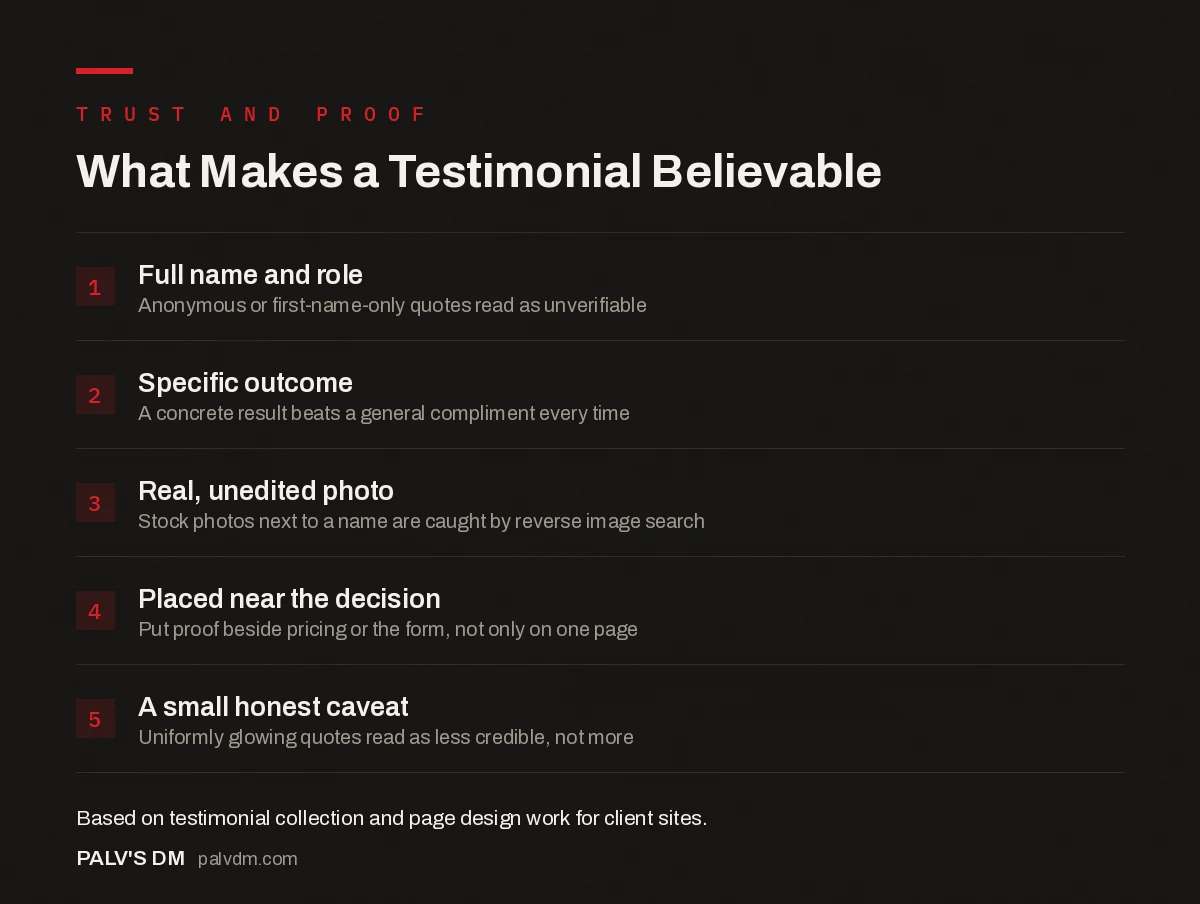
What Makes a Testimonial Believable
- Full name and role. Anonymous or first-name-only quotes read as unverifiable.
- Specific outcome. A concrete result beats a general compliment every time.
- Real, unedited photo. Stock photos next to a name are caught by reverse image search.
- Placed near the decision. Put proof beside pricing or the form, not only on one page.
- A small honest caveat. Uniformly glowing quotes read as less credible, not more.
Full name and identifiable detail top the list. “Sarah T.” reads as half-anonymous and slightly suspicious; “Sarah Thomas, Operations Manager at Kessler Freight” reads as a person who exists and has something to lose by lying. A photo helps for the same reason, it’s one more thing that would be strange to fake for a small business testimonial, so its presence quietly signals authenticity even if nobody consciously reasons through that.
Specificity beats polish every time. A testimonial that names the actual problem solved, the actual timeframe, or an actual number carries more weight than one that just expresses satisfaction. And a testimonial that includes a small, honest caveat, “it took a bit longer than we expected but the result was worth it”, reads as more trustworthy than one that’s uniformly glowing, because real experiences aren’t uniformly glowing and readers know that.
Where should testimonials actually sit on the page?
Next to the decision, not on a page about decisions. A dedicated testimonials page gets almost no organic traffic and even less attention from someone already on a service or pricing page trying to decide whether to fill out a form. Put the proof where the doubt is: a testimonial about turnaround speed belongs near the section describing your process, a testimonial about value belongs near the pricing table, a testimonial about results belongs near the case study or portfolio section it corroborates.
Repetition across a few well-chosen spots outperforms a long wall of quotes in one location. Three testimonials, each placed to answer a specific objection at the moment that objection would naturally arise, do more conversion work than fifteen testimonials nobody scrolls far enough to see.
Text, photo, or video: which format actually works best?
| Text testimonial | Video testimonial | |
|---|---|---|
| Production effort | Low, can be collected by email | High, needs recording and light editing |
| Perceived authenticity | Good, if specific and named | Higher, tone and hesitation are hard to fake |
| Best use case | Most business and service pages | High-consideration or high-price purchases |
| Scannability | Fast to read, works in a carousel | Requires a click or autoplay to consume |
| SEO value | Indexable text content, can carry keywords naturally | Needs a transcript to be indexable |
Video wins on trust for expensive, high-stakes purchases where a visitor is doing real due diligence, a website redesign, an enterprise software purchase, anything where getting it wrong is costly. For most transactional service pages, a specific, well-attributed text testimonial does nearly the same job at a fraction of the effort, and it’s the format most small businesses can actually sustain collecting on an ongoing basis.
What quietly kills a testimonial’s credibility?
- Stock photos next to a name. Reverse image search catches this constantly, and once a visitor spots one faked photo, they stop trusting the rest of the page too.
- Testimonials with no attribution at all. “Amazing team!” with no name reads as either invented or so unimportant to the business that they didn’t bother asking permission to attribute it.
- Uniformly perfect language. Real people don’t all write in the same polished marketing voice. A page where every testimonial sounds like it was edited by the same copywriter reads as exactly that.
- Testimonials with invented numbers. Never add a statistic a client didn’t actually give you. Beyond the trust risk if it’s ever challenged, several markets, including the US through the FTC, treat fabricated endorsement claims as a legal exposure, not just a marketing faux pas.
Does adding review schema actually help testimonials do more work?
It can, for the subset of testimonials that are genuine third-party reviews (Google, industry directories) rather than quotes you collected directly. Structured data that accurately reflects a real aggregate rating can qualify a page for a star rating in search results, which tends to lift click-through rate on that listing. It’s worth being precise here: this only applies to actual review data you can substantiate, and marking up self-collected testimonials as formal Review schema without the underlying rating data behind them risks a warning or removal, not the visibility boost you’re hoping for.
Treat schema as a bonus layer on top of genuinely collected proof, not a substitute for it. The testimonial still has to convince a human reading the page. The schema is what helps a search engine represent that proof accurately to someone who hasn’t clicked through yet.
How do you actually get specific testimonials instead of generic ones?
Ask a specific question, not “would you write us a review?” Most clients freeze at an open-ended request and default to the same three safe adjectives everyone uses. Instead ask what problem they had before working with you, what specifically changed, and whether there’s a number they’d be comfortable sharing. The answers to those three questions, lightly cleaned up for grammar, are a better testimonial than anything a generic request produces.
Timing matters more than most businesses account for. The best moment to ask is right after a visible win, a launched project, a resolved issue, a result the client can still describe in detail, not three months later during an annual check-in when the specifics have faded into “yeah, it’s been good.” We ask within a week of delivering something the client can point to, while the detail is still fresh enough to be specific rather than vaguely positive.
One habit that consistently produces better material: send the testimonial request with two or three of the client’s own words already echoed back, something they said on a call or in an email thread. “You mentioned the redirect issue was costing you traffic before we fixed it, would you be comfortable if we quoted that?” gets a more detailed, more specific response than a blank request, because you’ve already shown them what kind of detail you’re looking for.
Does the number of testimonials matter, or just the quality?
Quality first, but volume signals something too, mainly that the business has an ongoing track record rather than two happy customers from three years ago. A page with one testimonial reads as thin. A page with thirty undifferentiated testimonials reads as noise nobody will actually read through. Somewhere in between, five to ten well-chosen, specific, varied testimonials covering different services or objections, does the most work without asking too much of a visitor’s attention.
Variety matters as much as count. Five testimonials that all praise the same thing (friendliness, say) leave every other objection unanswered. Five testimonials that each address a different concern, price, speed, communication, results, technical quality, cover far more ground even at the same total length.
Frequently asked questions
What makes a testimonial believable instead of generic?
Specific, verifiable detail: a full name, a job title or company, a photo, and a concrete outcome rather than a vague compliment. “Great service, highly recommend” is skippable. A testimonial naming the actual problem solved and the actual result reads as written by someone who was actually there.
Should testimonials include numbers and specific results?
Yes, where you can back the number up. A specific figure, a timeframe, a before-and-after, makes a testimonial far more persuasive than a general compliment. Only include numbers the client actually gave you or that you can verify; an invented statistic is a legal and trust risk if it’s ever challenged.
Where should testimonials be placed on a website for the best effect?
Close to the decision point, not only on a separate testimonials page. Near a pricing table, beside a service description, or just above a contact form works better than a testimonial nobody scrolls far enough to see. Repetition across a few strategic spots outperforms one long list on one page nobody visits.
Are video testimonials worth the extra effort over written ones?
For high-consideration purchases, generally yes, because tone of voice and unscripted hesitation are harder to fake convincingly, which reads as more credible to a skeptical visitor. For lower-stakes purchases, a well-written, specific text testimonial with a real name and photo does most of the same job for far less production effort.
Is it legal to edit a customer’s testimonial before publishing it?
Light editing for length and clarity is standard practice, but changing the substance of what someone said, or publishing a quote they didn’t actually give, crosses into misleading advertising territory that regulators including the FTC in the US have taken action on. Get explicit permission and keep the wording close to what the customer sent you.
Sources
- FTC: Endorsement Guides, what people are asking
- Google Search Central: Review snippet structured data guidelines
- Local SEO: The Complete Guide for Service Businesses
- Trust Signals That Work in the Indian Market
- Exit-Intent Popups: When They Help, When They Repel
- Above-the-Fold Elements Every Service Page Needs
Want this done on your site?
Every PalV’s DM engagement starts with a free audit of your actual website — a 12-point
crawl covering what is blocking indexation, on-page gaps against your primary keywords, speed
findings, and the three to five fixes worth making first. Delivered in two working days. No
payment details, and the findings are yours whether you hire us or not.
Get your free SEO audit
See web development plans and prices