Why ‘Request a Quote’ Costs You Qualified Leads
Request a quote forms convert lower than most CTAs on your site. Here is what the form-conversion data actually shows and what to use instead.
“Request a quote” isn’t wrong for every business, but for most service businesses it quietly filters out buyers who are ready to act, and lets through mostly the ones patient enough to tolerate not knowing the price. That’s not the same as filtering for quality. It’s filtering for patience, and patience isn’t a proxy for budget or fit. Swapping a bare quote form for a starting-at price or a scoped estimator recovers leads a vague CTA was silently losing.
The claim behind “request a quote” sounds reasonable: custom work needs a custom number, and asking first protects your sales team from wasting time on people who were never going to buy. That reasoning holds for genuinely bespoke work. It gets copied onto services that aren’t bespoke at all, because “request a quote” became the default pattern rather than a deliberate choice, and nobody went back to check whether the assumption behind it still applied.
Where did the “request a quote” default actually come from?
It made sense originally. Commercial construction, custom manufacturing, enterprise software with per-seat and per-integration pricing: these genuinely can’t post one number, because the price depends on details only a scoping conversation surfaces. A quote request in that context isn’t friction, it’s the only honest option available.
The pattern spread past its original use case because it’s easy to install and hard to second-guess. A web development agency, a marketing consultancy, a local service business: none of these necessarily have the pricing variance that justifies hiding the number, but “request a quote” got treated as the professional default rather than a decision made on purpose.
What does the conversion data actually show?
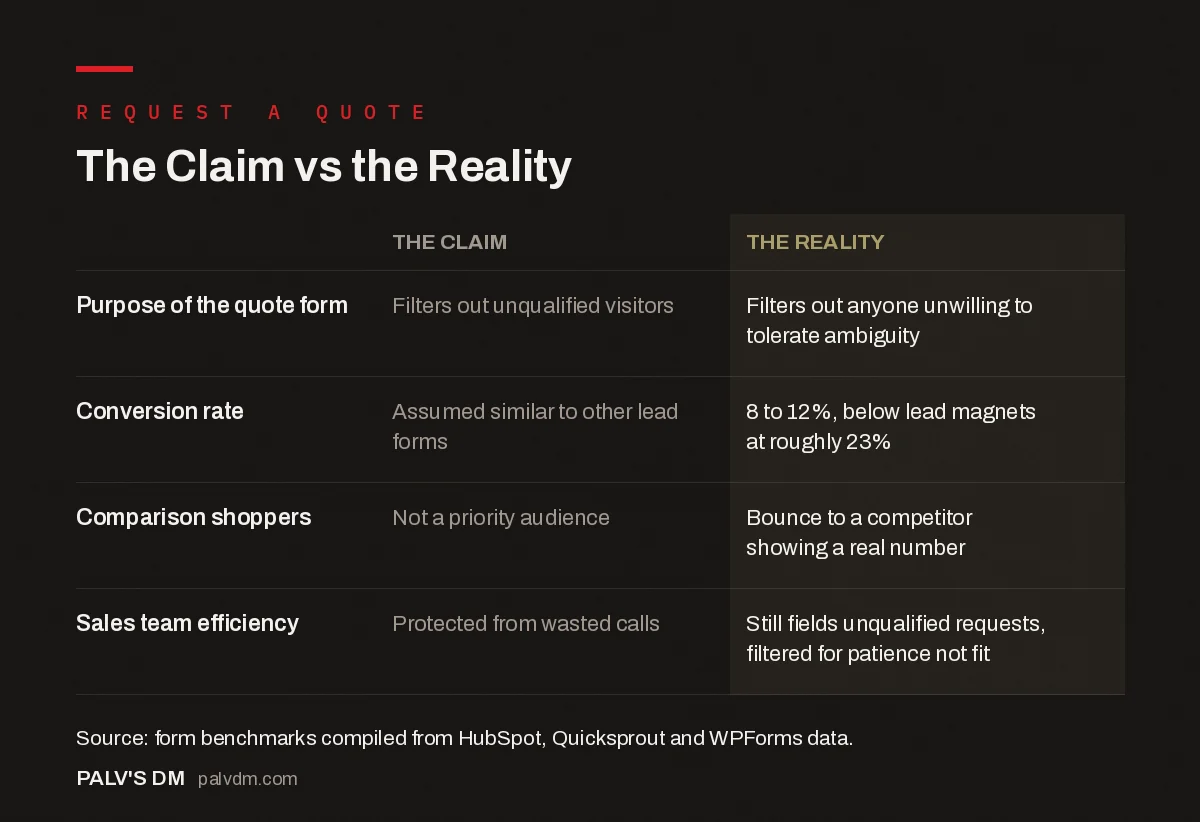
The Claim vs the Reality
| The Claim | The Reality | |
|---|---|---|
| Purpose of the quote form | Filters out unqualified visitors | Filters out anyone unwilling to tolerate ambiguity |
| Conversion rate | Assumed similar to other lead forms | 8 to 12%, below lead magnets at roughly 23% |
| Comparison shoppers | Not a priority audience | Bounce to a competitor showing a real number |
| Sales team efficiency | Protected from wasted calls | Still fields unqualified requests, filtered for patience not fit |
Form conversion benchmarks compiled from HubSpot, Quicksprout and WPForms data put quote request forms at 8 to 12 percent conversion, well behind a checkout form (29.8 percent, but a different intent entirely) and a genuinely valuable lead magnet download (roughly 23 percent). Contact forms, the vaguest category of all, sit lower still at 1 to 3 percent. The pattern across every benchmark: the less certain a visitor is about what happens after they submit, the fewer of them submit.
Why does ambiguity cost you leads specifically?
Across form types and industries, an average of 55 percent of people who start filling out a form abandon it before finishing. That number gets worse, not better, when the visitor isn’t sure what they’re being asked to commit to. A checkout form is unambiguous: you know the price, you’re confirming a purchase. A bare quote request is the opposite. The price is unknown, the scope is unclear, and the visitor has to decide whether handing over contact details is worth an uncertain outcome.
Field count compounds the problem. Conversion sits around 25 percent at three fields, drops to about 20 percent at five, and falls to roughly 12 percent at seven or more. Most “request a quote” forms I see on client sites default to name, email, phone, company, project type, budget range and a message box, seven fields deep before the visitor has any idea what they’re getting in return. That’s not a form designed to qualify leads. It’s a form designed to lose them.
Is “request a quote” ever the right call?
Yes, and I’d rather say that plainly than pretend every business should publish a price list. If your pricing genuinely varies by an order of magnitude depending on scope, a commercial fit-out, a large custom software build, an enterprise contract with per-seat licensing, a quote request is the honest format. The visitor understands why a number can’t be given up front, and the form isn’t hiding information that should have been public.
Where I’d push back hard: any service with a repeatable delivery model and a definable starting price. Most web development, SEO, and marketing services fall into this category whether the business wants to admit it or not. If you can quote a rough range in a sales call within the first two minutes without seeing anything about the specific project, you already know the number closely enough to publish a starting figure. Hiding it isn’t protecting anyone, it’s just costing you the leads who wanted that number before they’d bother filling in a form.
What should you use instead?
- Publish a starting-at price or typical range. Even a wide range (“projects typically run ₹40,000 to ₹1,50,000 depending on scope”) gives a comparison shopper enough to decide whether to keep reading.
- Use a scoped estimator instead of an open quote form. Two or three qualifying questions (site size, current platform, timeline) followed by an instant range does more filtering than a blank message box ever will.
- Cut the form to three or four fields. Name, email, and one qualifying detail is enough for a first touch. Ask for the rest on the call.
- Break longer forms into steps with a progress bar. Multi-step forms with visible progress produce meaningfully higher completion than the same fields shown all at once.
- Put trust signals next to the form, not just above the fold. Client logos, a testimonial, or a security note placed close to the submit button measurably lifts completion, because that’s the exact moment a visitor is deciding whether to trust you with their details.
How does this play out for web development and agency pricing specifically?
Web development and marketing services are a near-perfect example of the “false custom” category. Ask most agency owners what a five-page brochure site or a WooCommerce build typically runs, and they’ll give you a number in under a minute. That number exists. It’s just not on the website, because “every project is different” gets treated as a reason to hide pricing rather than a reason to publish a range and explain what moves the number up or down.
The visitors this actually costs are the ones furthest along in comparing options. Someone who has already looked at three agencies and hit “request a quote” on all three isn’t going to wait a week for callbacks before deciding. They’ll go with whoever responded first or whoever showed a number that fit their budget without a conversation. A published starting price doesn’t stop you from scoping the real number on a call. It stops you from losing the comparison shopper before that call ever happens.
What’s actually holding businesses back from making the switch?
Usually not data, since almost nobody running a “request a quote” form has looked at its conversion rate against alternatives. It’s a fear that publishing a number invites lowballing, or that a competitor will undercut a visible price. Neither concern survives contact with reality for most service businesses. Competitors who wanted to undercut you were already guessing your price range from your positioning and your client list. The number you’re hiding is one Google search away from being estimated anyway. What you’re actually protecting by staying vague is a sales conversation you’d rather have in person, not genuinely sensitive information.
Frequently asked questions
Should every business publish its prices online?
Not every business, but most can publish more than they think: a starting price, a typical range, or a scoped estimate for common package types. True custom pricing (large enterprise contracts, bespoke construction) is the exception, not the default most businesses assume it to be.
Why do quote request forms convert lower than expected?
Quote request forms average an 8 to 12 percent conversion rate, well below a lead magnet download at roughly 23 percent, because the visitor doesn’t know what they’re about to be asked for or what they’ll get back. That uncertainty is friction, and friction is what conversion rate measures.
Is “request a quote” ever the right choice?
Yes, for genuinely bespoke work where scope varies too much for any single number to be meaningful, like commercial construction or a large enterprise software contract. It’s the wrong default for services with a definable starting price band, which describes most small business services.
How many fields should a quote form have?
As few as the request genuinely needs. Conversion rate drops from roughly 25 percent at 3 fields to about 12 percent at 7 fields. If a form must collect more than five fields, breaking it into a multi-step flow with a progress bar recovers much of that lost conversion.
What can I do instead of a bare “request a quote” button?
Publish a starting-at price or typical range next to the CTA, add a short scoped estimator that asks two or three qualifying questions before the contact form, or add trust signals like client logos and testimonials near the form itself. Any of these reduces the ambiguity that’s currently costing you conversions.
Sources
- Form Conversion Rate Benchmarks 2026, Foundry CRO
- Should You Publish Prices on Your Website?, Communica PRO
- Why We Publish Our Prices Instead of Sending Custom Quotes
- Should You Publish Your Prices? The Data and the Trade-Offs
- Pricing Page Design: Structure, Anchoring, Clarity
- Writing CTAs People Actually Click
Want this done on your site?
Every PalV’s DM engagement starts with a free audit of your actual website — a 12-point
crawl covering what is blocking indexation, on-page gaps against your primary keywords, speed
findings, and the three to five fixes worth making first. Delivered in two working days. No
payment details, and the findings are yours whether you hire us or not.
Get your free SEO audit
See Web Development plans and prices