Semrush vs Ahrefs in 2026: Which One Should You Actually Buy?
Semrush vs Ahrefs compared on real August 2026 pricing, backlink depth, keyword tracking and AI visibility, with a straight verdict.
Ahrefs is the stronger default for SEO-focused work, particularly backlink analysis, and its entry plan is marginally cheaper. Semrush is the better buy if you need one platform covering content, social and PPC alongside SEO, not just search. Both are excellent tools with real, current gaps between them, not just different marketing copy over the same feature set.
We run both, on different client accounts, depending on scope. Here’s what actually separates them in August 2026, verified against each vendor’s own pricing pages rather than repeating whatever comparison-post consensus has calcified around them.
Neither company has stood still. Both rewrote their pricing structures within the last year specifically to fold in AI search visibility, which means a comparison post from 2024 or even early 2025 is describing tools that no longer match what you’ll see on either sign-up page today. Treat any comparison older than a few months with a bit of suspicion, this one included, and check the vendor pricing pages directly before you commit to an annual plan.
What’s the quick verdict?
If your work is SEO first, especially link building, technical audits and rank tracking, start with Ahrefs. Its Site Explorer and backlink index are what most working SEOs reach for first, its pricing is simpler to reason about, and its entry tier gives a solo consultant or small agency everything needed for one to five client sites. If you’re running a broader marketing function, content production, social scheduling, competitive research beyond SEO, or a bigger team that wants one login for everything, Semrush’s wider tool suite earns its slightly higher entry price.
How does entry-level pricing actually compare?
Both companies restructured pricing within the past year to bundle in AI search visibility features, which makes older comparison posts unreliable on this point. Here’s what’s live on each vendor’s pricing page as of August 2026.
| Feature | Ahrefs Lite | Semrush SEO |
|---|---|---|
| Price (monthly billing) | $129/mo | $139/mo |
| Websites/projects | 5 | 5 |
| Keywords tracked | 750, updated weekly | 500, updated daily |
| Historical data | 6 months | Not specified on entry tier |
| AI visibility included | 5 tracked AI prompts | AI search performance and sentiment tracking included |
| Included users | 1 (add more at $40/mo each) | 1 (add-on pricing from $45/mo) |
| Site crawl | 100,000 crawl credits/mo | Site Audit included |
The one number worth sitting with: Ahrefs updates rank tracking weekly across every tier, including its $1,499/month Enterprise plan. Semrush tracks keywords daily starting on its cheapest plan. If day-to-day rank movement matters to how you report to clients, that’s a real functional gap, not a marketing detail, and it’s one most comparison posts don’t mention because it’s easy to miss buried in a features table.
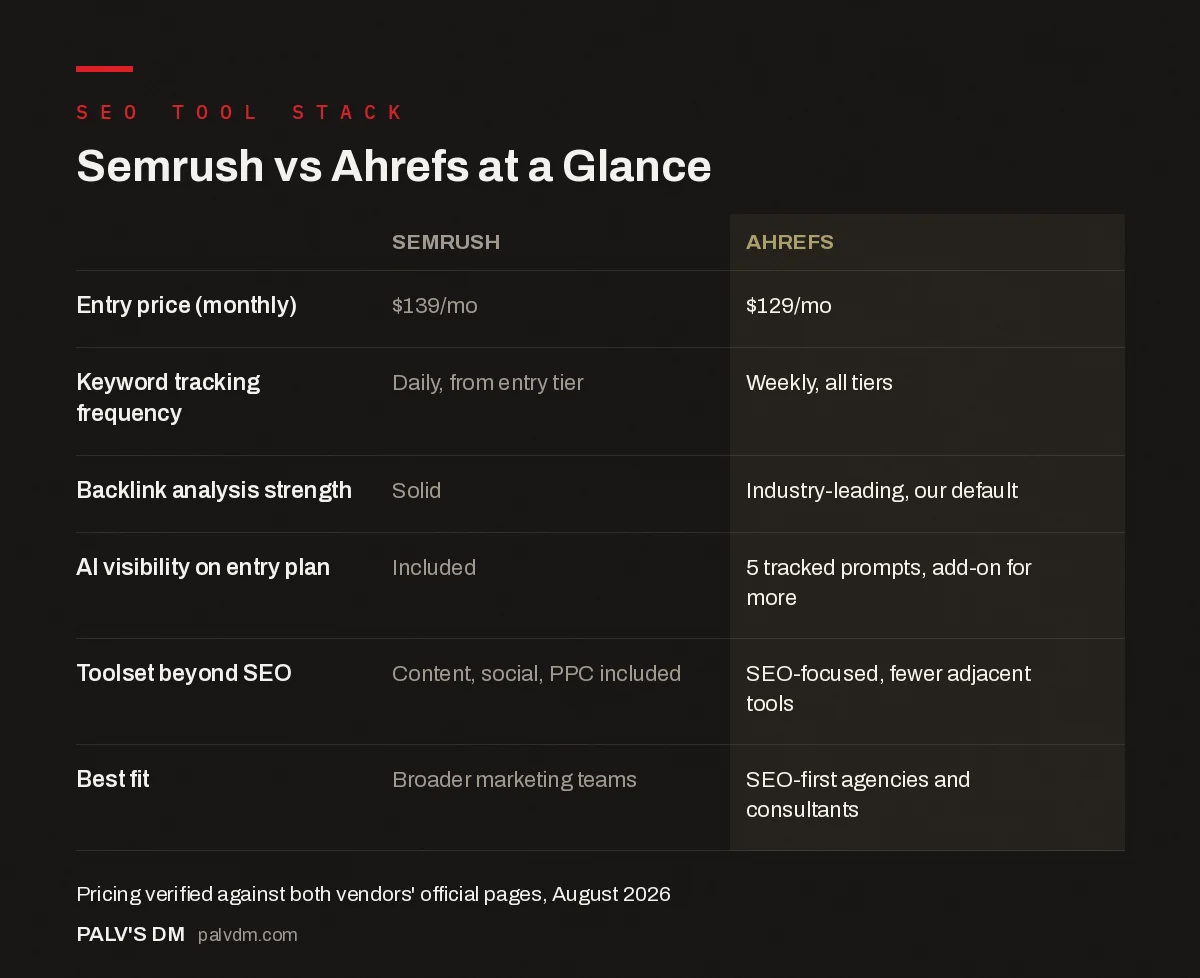
Semrush vs Ahrefs at a Glance
| Semrush | Ahrefs | |
|---|---|---|
| Entry price (monthly) | $139/mo | $129/mo |
| Keyword tracking frequency | Daily, from entry tier | Weekly, all tiers |
| Backlink analysis strength | Solid | Industry-leading, our default |
| AI visibility on entry plan | Included | 5 tracked prompts, add-on for more |
| Toolset beyond SEO | Content, social, PPC included | SEO-focused, fewer adjacent tools |
| Best fit | Broader marketing teams | SEO-first agencies and consultants |
Where does Ahrefs actually win?
- Backlink analysis. Ahrefs built its reputation here and it still shows. Site Explorer’s broken-link and lost-link reports are clean, and its crawler is one of the more active ones indexing the web, which matters for catching new links faster.
- Pricing clarity. Four tiers, clearly laid out limits per tier, no confusing sub-bundles. Semrush’s SEO + AI Search pricing page has more moving parts to compare.
- Site Audit depth. Ahrefs’ crawl credit system scales cleanly from a five-page brochure site to a large ecommerce catalogue without forcing a plan jump as fast as some competitors.
- Unlimited personal sites on one Pro-tier login (via add-ons). Useful if you or your agency run several owned sites rather than client sites specifically.
Where does Semrush actually win?
- Breadth beyond SEO. Content optimisation tooling, a social media manager, PPC competitive analysis and market research tools all sit inside the same login, which matters if your team touches more than search.
- Daily keyword tracking on the entry tier. Ahrefs holds rank tracking to weekly updates even on its priciest plan; Semrush tracks daily from the cheapest tier up.
- AI visibility baked into the base plan. Semrush’s $139 entry tier already includes AI search performance and sentiment tracking. Getting comparable depth on Ahrefs means adding the separate Brand Radar product.
- Agency-facing extras. White-labelled reporting add-ons and an agency partner directory listing are built for firms that resell access or reporting to clients.
How do the AI visibility tracking features actually compare?
Both vendors clearly saw the same shift coming and moved fast, but they built it in differently. Semrush folded AI search tracking directly into its main SEO plan: even the $139/month tier reports on AI search performance and monitors brand sentiment across AI platforms, no separate purchase required. Ahrefs took a more modular route: Lite includes five tracked AI prompts, enough to get a feel for how your brand shows up, but real depth requires its standalone Brand Radar product, priced from $199/month with its own tiered check allowances.
Neither approach is wrong. Semrush’s bundling suits a team that wants one number to budget against. Ahrefs’ modularity suits an agency that wants AI tracking for two client brands and traditional SEO tooling for twenty, without paying for AI depth across accounts that don’t need it yet.
What should a solo consultant or small agency actually pick?
If you’re a solo consultant managing three to five client sites and your work is primarily SEO (audits, keyword research, link building, rank tracking), Ahrefs Lite covers that ground for less money and without paying for tools you won’t open. If you’re running a small agency that also handles content calendars, social posting, or PPC reporting for clients, Semrush’s single login for all of it usually beats paying for Ahrefs plus two or three separate point tools to cover the same ground. We’ve made both calls for different client engagements, and the deciding question is never “which tool is better,” it’s “what is this team actually doing every week.”
What’s actually different day to day for a working SEO?
Keyword research feels similar in both, though Semrush’s Keyword Magic Tool and clustering are generally considered stronger for building out large topic maps quickly, while Ahrefs’ Keywords Explorer leans on click and CPC data some practitioners trust more for commercial intent. Site audits in both catch the same core technical issues (broken links, missing tags, duplicate content, crawl errors), and neither is meaningfully better at finding the problems that actually matter; the difference is more in how the findings get presented and prioritised.
Rank tracking is where the daily-vs-weekly gap actually shows up in practice. Reporting to a client on Monday about a ranking change that happened Wednesday feels stale with a tool that only refreshed over the weekend. That’s the specific reason a couple of our client accounts run Semrush despite Ahrefs handling backlink audits for the same clients.
Does either tool handle Indian search data any better?
Both index Google India’s results and report local search volume, and neither publishes a detailed breakdown of how confident that Indian volume data actually is compared to their US and UK numbers, which is a fair criticism of both. In practice, we cross-check volume estimates against Google Keyword Planner and Search Console’s own query data before trusting either tool’s number for a client proposal, the same way we’d treat any third-party estimate for a market outside the tool vendor’s home base. Neither tool is unreliable here, but neither should be your only source for an Indian keyword volume figure you’re putting in front of a client.
Frequently asked questions
Which is cheaper, Semrush or Ahrefs?
Ahrefs Lite starts at $129/month, Semrush’s SEO plan starts at $139/month, both billed monthly as of August 2026. Semrush’s entry plan tracks more keywords daily (500 vs Ahrefs’ 750 tracked weekly), so the comparison isn’t purely apples to apples once you look past the headline number.
Which tool has better backlink data?
Ahrefs has the stronger reputation here and it’s the tool we reach for first when auditing a backlink profile. Its crawler is one of the most active on the web and its Site Explorer surfaces broken and lost backlinks clearly. Semrush’s backlink data is genuinely usable, but Ahrefs is the default choice for link-focused work.
Can I use just one of these tools, or do I need both?
One is enough for most small businesses and solo consultants. Agencies running both SEO and broader digital marketing (content, social, PPC) alongside it tend to get more use out of Semrush’s wider toolset; agencies doing SEO and link building specifically lean on Ahrefs and often don’t need a second platform at all.
Does either tool track AI search visibility now?
Yes, both added this in the past year. Semrush bakes basic AI search tracking into its entry SEO plan. Ahrefs includes a small number of tracked AI prompts on its Lite plan and sells deeper AI brand tracking as a separate Brand Radar add-on starting at $199/month.
Is there a free version of either tool?
Ahrefs Free gives limited access to Site Explorer and Site Audit data for your own verified site, no time limit. Semrush offers a free tier with 10 reports a day across its tools and a separate 7-day free trial of paid plans. Neither free tier replaces a paid subscription for regular use.
Sources
- Ahrefs Plans & Pricing (official)
- Semrush SEO & AI Search Plans and Pricing (official)
- Link Building in 2026: What Still Works
- Keyword Tools Compared on Indian Search Volume Accuracy
- Rank Tracking Tools Compared for Indian SERPs
- Comparing Backlink Databases: Why the Numbers Never Agree
Want this done on your site?
Every PalV’s DM engagement starts with a free audit of your actual website — a 12-point
crawl covering what is blocking indexation, on-page gaps against your primary keywords, speed
findings, and the three to five fixes worth making first. Delivered in two working days. No
payment details, and the findings are yours whether you hire us or not.
Get your free SEO audit
See one-time SEO project plans and prices