Comparing Backlink Databases: Why the Numbers Never Agree
Why Ahrefs, Semrush and other backlink tools report different numbers for the same site, and how to use that data without getting misled.
Backlink tools disagree because each one runs its own web crawler, on its own schedule, with its own index composition, none of which matches Google’s actual link graph. Ahrefs, Semrush, and every other backlink checker are building independent approximations of the same underlying web. They overlap heavily but never perfectly, and the gap between them is a permanent feature of how this category of tool works, not a bug in any one of them.
I’ve pulled the same client’s backlink profile from three tools in a single afternoon and gotten three different domain authority equivalents and three different referring domain counts. None of the three was “wrong.” They just crawl differently. Understanding why saves you from a genuinely common mistake: treating one tool’s number as ground truth and panicking (or celebrating) over a swing that’s actually just noise between data sources.
Why don’t the numbers match in the first place?
Three structural reasons. First, crawl coverage: no tool crawls the entire web, each one prioritizes what it discovers based on its own crawler’s path through link graphs, so they each find a different, overlapping subset of pages. Second, update frequency: a link that appeared yesterday might already be indexed by one tool and still invisible to another, purely based on how recently each one recrawled that page. Third, historical versus live data: some tools report cumulative all-time link counts that include dead links never removed from the index, others report only currently-live links, and mixing the two when comparing tools produces numbers that were never meant to be compared directly.
How different are the two biggest tools, specifically?
Here’s what each company reports about its own index, pulled directly from their own published data pages as of August 2026.
| Ahrefs | Semrush | |
|---|---|---|
| Backlink index size | 35.0 trillion external backlink records | 43+ trillion backlinks |
| Pages in index | 493.9 billion | Not separately published |
| Domains covered | 210.7 million (post-vetting) | 800 million+ |
| Update frequency | Every 15-30 minutes for the live index | New links typically reported within about 40 minutes |
| Crawl source | AhrefsBot exclusively, roughly 5 million pages crawled per minute | Proprietary crawler plus additional data providers |
Semrush’s larger raw backlink number and larger domain count partly reflect a broader data sourcing approach, blending its own crawler with third-party data. Ahrefs reports it builds its index exclusively from its own crawler, with no external data blended in, which is a deliberate design choice, not a limitation, and it’s part of why the company can speak confidently about its own crawl frequency and coverage numbers.
How should you actually evaluate the data you’re looking at?
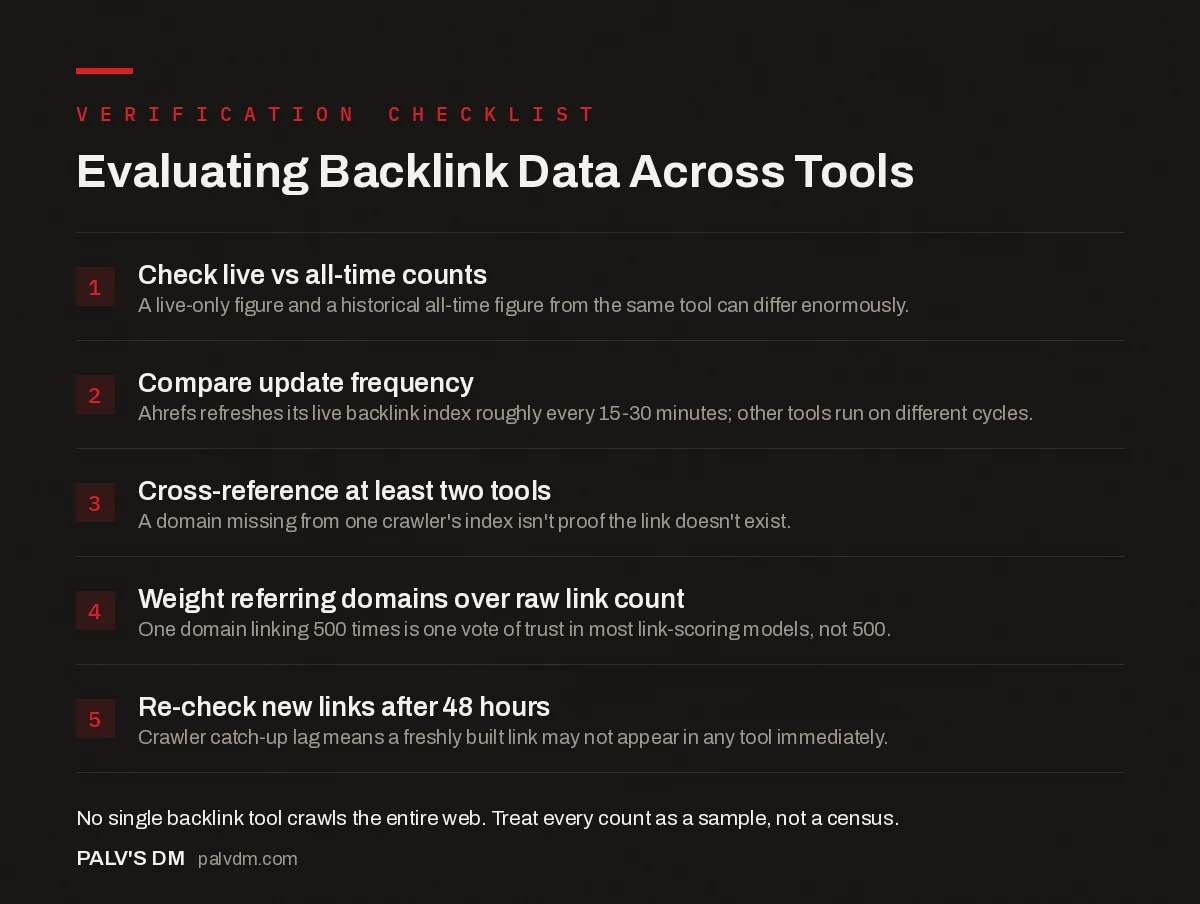
Evaluating Backlink Data Across Tools
- Check live vs all-time counts. A live-only figure and a historical all-time figure from the same tool can differ enormously.
- Compare update frequency. Ahrefs refreshes its live backlink index roughly every 15-30 minutes; other tools run on different cycles.
- Cross-reference at least two tools. A domain missing from one crawler’s index isn’t proof the link doesn’t exist.
- Weight referring domains over raw link count. One domain linking 500 times is one vote of trust in most link-scoring models, not 500.
- Re-check new links after 48 hours. Crawler catch-up lag means a freshly built link may not appear in any tool immediately.
Where does Moz fit into this?
Moz is generally the smaller of the three well-known backlink indexes by reputation among practitioners, though Moz doesn’t publish the same kind of detailed, real-time infrastructure numbers Ahrefs and Semrush do, so a direct trillion-for-trillion comparison isn’t something you can verify cleanly from primary sources the way you can for the other two. What that means practically: if a domain shows meaningfully fewer links in Moz’s Link Explorer than in Ahrefs or Semrush, that’s consistent with Moz running a smaller, more curated crawl rather than evidence that the links don’t exist. Domain Authority, Moz’s proprietary score, is also not directly comparable to Ahrefs’ Domain Rating or Semrush’s Authority Score, they’re three different formulas built on three different underlying datasets, and treating one as a universal translation of another is a mistake I still see agencies make in client reports.
Why does referring domains matter more than total backlinks?
Because a hundred links from one domain carry a fraction of the weight of a hundred links from a hundred different domains, in basically every link-scoring model, third-party or Google’s own. A site with 50,000 backlinks from 200 domains is a much weaker link profile than a site with 5,000 backlinks from 3,000 domains, even though the first number looks ten times bigger. When you’re comparing tools, or comparing your site against a competitor’s, referring domain count is the more stable and more meaningful figure. Total backlink count inflates easily (site-wide footer links, forum signatures, syndicated content) in ways that don’t reflect real authority.
What should you do when two tools genuinely disagree on something that matters?
- Check the date range and filter settings first. Most disagreements trace back to one tool showing all-time data and the other showing a live or recent snapshot, not an actual data quality problem.
- Look for the link manually if it’s a specific, high-value URL. For anything decision-critical, like confirming whether a toxic link is actually live before disavowing it, visit the source page directly rather than trusting either tool’s cached status.
- Track trend direction, not absolute numbers, over time. If your referring domain count is climbing in Ahrefs and flat in Semrush, that’s worth investigating. If both show growth at different absolute rates, that’s just normal crawler variance and not a red flag.
- Pick one tool as your system of record for a given client or project, and use a second tool only for cross-checking anomalies. Switching your primary reference tool mid-campaign makes every historical comparison meaningless.
Does any of this affect your actual SEO work?
Less than the anxiety around it suggests. None of these tools is measuring what Google itself sees, Google’s internal link graph is not published and no third-party crawler has access to it. Ahrefs, Semrush, Moz and the rest are all building independent, useful, but ultimately approximate pictures of the same web. Used correctly, that’s still valuable: for competitive research, for spotting a sudden negative SEO link spike, for tracking whether a link building campaign is actually landing links. Used incorrectly, as an exact proxy for what Google ranks on, any of these tools will mislead you eventually, and the client who asks “why did our Domain Rating drop when nothing changed” almost always has a crawler recalculation to blame, not a real loss of authority. Our broader guide on how to verify a tool’s data before you trust it covers the same principle applied beyond just backlink tools.
If you’re deciding which platform to standardize on rather than just understanding why they disagree, our head-to-head on choosing between Semrush and Ahrefs gets into feature and workflow differences beyond index size. And if crawl-based data verification is a recurring need, pairing whichever backlink tool you pick with a proper site crawler is worth the setup time; see our comparison of Screaming Frog vs Sitebulb for that side of the stack.
Frequently asked questions
Why does Ahrefs show fewer backlinks than Semrush for the same site?
Different crawlers, different crawl priorities, different index composition. Ahrefs runs its own AhrefsBot crawler exclusively and reports around 35 trillion backlink records. Semrush combines its own crawler with additional data sources and reports over 43 trillion. Neither number is wrong, they’re measuring overlapping but not identical slices of the web.
Which backlink checker is most accurate?
None of them is fully accurate in the sense of matching Google’s own index, because no third-party tool crawls the web at Google’s scale or has access to Google’s link graph. The more useful question is which tool is most consistent for tracking change over time, since relative movement matters more than any single absolute count.
Are historical backlinks counted the same as live ones?
No, and this is one of the biggest sources of confusion. A tool’s all-time backlink count includes links that existed at some point but may since have been removed or gone dead. A live count reflects only what the crawler most recently confirmed still exists. Always check which figure you’re looking at before comparing tools.
Can I use two tools’ data together safely?
Yes, and it’s often the better approach than relying on one. Cross-referencing catches links one crawler missed and helps you spot patterns (toxic link spikes, sudden referring domain drops) that show up consistently across tools rather than being an artifact of one crawler’s blind spot.
Does Google use these third-party numbers for ranking?
No. Google ranks using its own internal link graph, which no third-party tool has access to. Ahrefs, Semrush and similar tools build independent approximations by crawling the web themselves. They’re useful proxies for competitive research, not a window into what Google itself sees.
Sources
- Ahrefs’ data infrastructure and index size, Ahrefs.com
- How backlinks are updated, Semrush Knowledge Base
- Link Building in 2026: What Still Works
- SEMrush vs Ahrefs: Choosing Between Them
- Screaming Frog vs Sitebulb: Which Crawler to Learn
- How to Verify a Tool’s Data Before You Trust It
Want this done on your site?
Every PalV’s DM engagement starts with a free audit of your actual website — a 12-point
crawl covering what is blocking indexation, on-page gaps against your primary keywords, speed
findings, and the three to five fixes worth making first. Delivered in two working days. No
payment details, and the findings are yours whether you hire us or not.