Service Support — One-Time Services
When a One-Time SEO Service Beats a Retainer
Compare a one-time SEO service to a monthly retainer and see which fits your site: one time seo vs monthly, broken down by scope, cost, and implementation.

A one-time SEO service beats a monthly retainer when the problem in front of you is well-defined and finite — a technical audit, a migration, a keyword research project, a single round of on-page fixes — and you (or your team) can actually implement the findings. The “one time SEO vs monthly” decision isn’t about which model is generally better; it’s about whether what you’re buying is a project with an end date or an ongoing fight for rankings that never really stops. If it’s the former, paying for twelve months of a retainer is often just paying for eleven months of waiting.
Key takeaway
- A one-time service is the right buy when the problem is a fixed, scoped deliverable and someone on your side can implement the findings.
- A retainer earns its cost when the work is genuinely continuous — rankings you have to keep defending, content that needs a steady cadence, competitors who don’t stop.
- The two aren’t mutually exclusive: many sites are best served by stacking one-time services in sequence before ever signing a retainer.
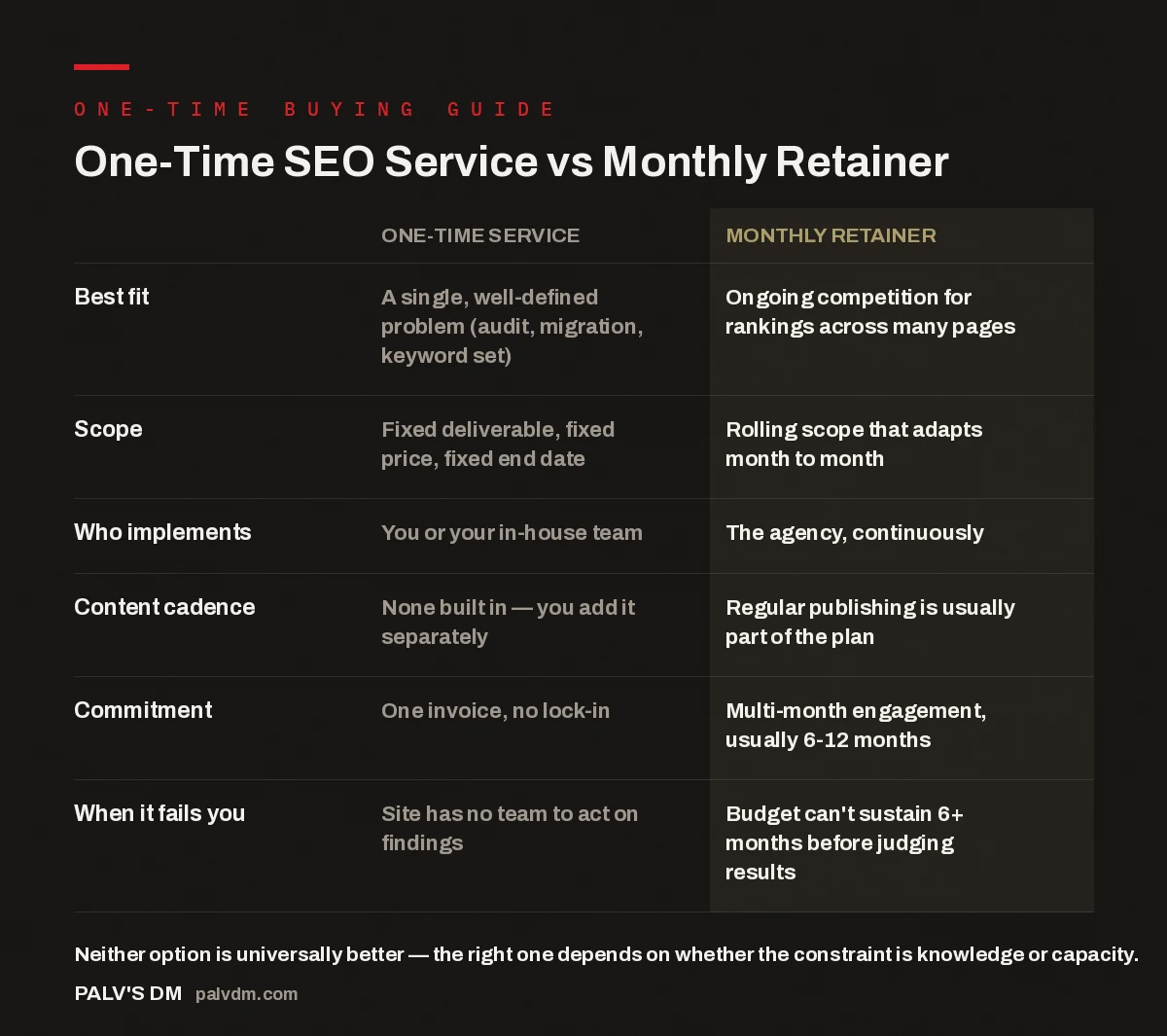
One-Time SEO Service vs Monthly Retainer
| One-time service | Monthly retainer | |
|---|---|---|
| Best fit | A single, well-defined problem (audit, migration, keyword set) | Ongoing competition for rankings across many pages |
| Scope | Fixed deliverable, fixed price, fixed end date | Rolling scope that adapts month to month |
| Who implements | You or your in-house team | The agency, continuously |
| Content cadence | None built in — you add it separately | Regular publishing is usually part of the plan |
| Commitment | One invoice, no lock-in | Multi-month engagement, usually 6-12 months |
| When it fails you | Site has no team to act on findings | Budget can’t sustain 6+ months before judging results |
What Makes a Problem “One-Time” Instead of Ongoing?
A problem is one-time when finishing it changes the state of your site permanently, rather than requiring upkeep. A technical audit that finds a broken canonical tag, a missing sitemap, and a cluster of duplicate category pages describes a fixable list — once those items are fixed, the underlying issue is gone. A migration from one platform to another has a clear before and after: the site moves, redirects are mapped, and the job is done. Keyword research for a new product line produces a list that’s valid until the product line changes, which might be a year or more away.
Compare that to ranking for a competitive commercial term. There is no state where the work is “finished” — competitors publish, algorithms shift, and a page that ranks first this month can slide by next quarter simply because someone else did more. That’s not a defect in the site; it’s the nature of a contested result. Contested, ongoing competition is what a retainer is built for. A fixable, finite list is what a one-time service is built for.
The practical test we use on new enquiries: ask whether the deliverable, once handed over, needs to be repeated next month to stay valid. A backlink audit doesn’t need repeating monthly — the link profile doesn’t reshuffle itself weekly. A content calendar does need repeating, because it’s only useful as long as someone keeps writing against it. If the answer is “repeat it or it stops working,” you’re looking at retainer work wearing a one-time label.
When Does a Monthly Retainer Actually Pay for Itself?
A retainer pays for itself when the site is in an active fight for visibility that requires continuous adjustment — not a one-off correction. That shows up in a few recognisable situations: you’re publishing content regularly and need someone tracking what’s ranking and what’s stalling; you’re in a category where competitors are actively investing in SEO and any pause lets them pull ahead; or you don’t have the internal capacity to implement anything yourselves, so you need execution, not just a report.
The other honest reason a retainer makes sense is bandwidth. A one-time audit hands you a prioritised list of fixes, but someone still has to do the work — write the meta descriptions, fix the schema, rebuild the internal linking, produce the content. If there’s no developer, no writer, and no time on your side to act on findings, a retainer that includes implementation is the only version of “SEO” that will actually move a needle, because a report nobody acts on changes nothing.
Where retainers stop paying for themselves is when the site’s problems are structural rather than competitive. If your product pages have thin content, broken internal links, and no keyword targeting, six months of ongoing “optimisation” is often just slowly fixing what a focused technical and on-page project could have fixed in a few weeks. Paying an ongoing fee to solve a finite problem is the most common way SEO budgets get wasted — not because retainers are a bad model, but because they were bought to solve the wrong kind of problem.
The question we ask every client before recommending a retainer isn’t “do you want ongoing SEO” — it’s “what happens the month after we stop.” If the answer is nothing changes, they didn’t need a retainer. If the answer is rankings start slipping within weeks, they did.
Palash, Founder, PalV’s DM
What a One-Time Service Can’t Do for You
A one-time service is honest about its limits, and it’s worth stating them plainly before you buy one. A one-time technical SEO check tells you what’s broken; it doesn’t fix it, monitor it after the fix, or catch the next thing that breaks in six months. A one-time keyword research project gives you a target list; it doesn’t write the content, track how each keyword performs once published, or adjust the list as search behaviour shifts. If your team can’t act on that kind of output — if there’s no one to actually implement the recommendations — the deliverable sits in a shared drive, and the money spent on producing it is close to wasted regardless of how good the findings are.
This is also where a lot of “we tried a one-time audit and it didn’t work” complaints actually come from. The audit did its job — it identified the problems — but nobody implemented the fixes, so nothing changed on the site, and by extension nothing changed in rankings. That’s not a failure of the one-time model; it’s a mismatch between the deliverable bought and the resourcing available to act on it — and if that’s the situation you’re in, it’s still possible to get value from an audit you can’t implement right away by treating it as a prioritised backlog rather than a document you buy and forget. Before buying a one-off deliverable, it’s worth being honest about who on your side will actually do the implementation work once it lands.
Can You Combine One-Time Services and a Retainer?
Yes, and for a meaningful share of sites this is the more sensible path than jumping straight into either model. A common, low-risk sequence: buy a one-time technical and on-page check first, so you know exactly what’s broken before spending anything on ongoing work. Use the findings to decide whether the work required to fix everything is something your team can genuinely execute, or whether it needs sustained outside help. There’s a reasonably sensible order to buy one-time services in if you’re stacking more than one — diagnostics before content, content before link building. Only sign a retainer once you can name specifically what it needs to deliver month over month — content production, link building, continuous monitoring — rather than “general SEO,” which is vague enough to justify almost any invoice.
Sites with a small but capable in-house team often do best by stacking several one-time services into a DIY SEO programme — an audit, a keyword research project, a content strategy deliverable — and executing the work themselves over a few months, checking back in with paid deliverables only when they need fresh outside eyes. Sites with no internal SEO capacity at all tend to get more consistent results from a retainer from day one, because the alternative is a stack of reports nobody implements. Neither path is more “correct” — the deciding factor is genuinely just who is going to do the implementation work, not which model sounds more serious.
Not sure which one fits your site?
Our standalone services are built to be bought individually, without a retainer attached — you get the deliverable, we tell you honestly if a retainer would actually help, and you decide from there.
Frequently Asked Questions
Is a one-time SEO service cheaper than a monthly retainer overall?
Per invoice, yes — a one-time service is a single payment versus a recurring one. But cost per outcome depends on scope: if the problem needs ongoing work to stay fixed, a string of one-time purchases can end up costing more than a retainer over the same period, because you’re paying setup costs repeatedly instead of once.
Can a one-time audit replace an SEO retainer entirely?
Only if your site’s problems are genuinely finite and someone on your team can implement the findings. An audit replaces the diagnostic part of a retainer; it doesn’t replace ongoing content production, link building, or continuous monitoring if your site actually needs those.
How do I know if my SEO problem is one-time or ongoing?
Ask whether the deliverable needs repeating next month to stay valid. A technical fix or a keyword list, once produced, holds its value for months. A ranking position in a competitive category has to be actively defended, which makes it ongoing by nature.
What happens if I buy a one-time service but can’t implement the findings?
You get an accurate report and no change in rankings, because nothing on the site actually changed. This is the single most common reason one-time services get blamed for “not working” — the diagnosis was correct, but the fixes were never applied.
Should a small business start with a retainer or a one-time service?
Most small sites are better off starting with a one-time technical and on-page check to find out what’s actually wrong before committing to a monthly spend. If the findings show problems that need continuous work — or the team has no time to implement fixes themselves — that’s the point to consider a retainer.
Short version: buy a one-time SEO service when the problem is finite, well-scoped, and someone on your side can act on the findings. Buy a retainer when the work is genuinely ongoing — active competition, continuous publishing, or no internal capacity to implement anything at all. The two aren’t rivals; for a lot of sites, one or two one-time services followed by an honest look at what’s still missing is the most sensible way to spend the first part of an SEO budget, whether or not a retainer ever gets signed after that.