Service Support — One-Time Services
What Happens in an SEO Training Session
SEO training for teams: what a scoped, hands-on session covers, who should attend, and what your team should walk away able to do.

An SEO training session is a structured, paid one-time engagement where a practitioner walks a marketing or content team through how search — and increasingly AI-driven discovery — actually works for their specific site, then hands the team a repeatable process they can run without an agency doing it for them every month. It typically runs two to four hours, sometimes split across two shorter blocks, and it covers the site’s own pages and data rather than generic slides. If you’re weighing seo training for teams against an ongoing retainer, the practical difference is this: a retainer does the SEO work for you month after month; a training session teaches your team to do a defined slice of that work correctly, on your own pages, starting the same week.
Key takeaway
- A real SEO training session is scoped to your site’s actual pages and data, not a generic slide deck — expect two to four hours, sometimes split into two blocks.
- It’s built for teams that want to run a defined slice of SEO in-house — on-page checks, content briefs, basic technical fixes — without buying a retainer for everything.
- The output isn’t just a workshop. It’s a documented, repeatable process the team keeps, plus a clear list of what’s still worth outsourcing.
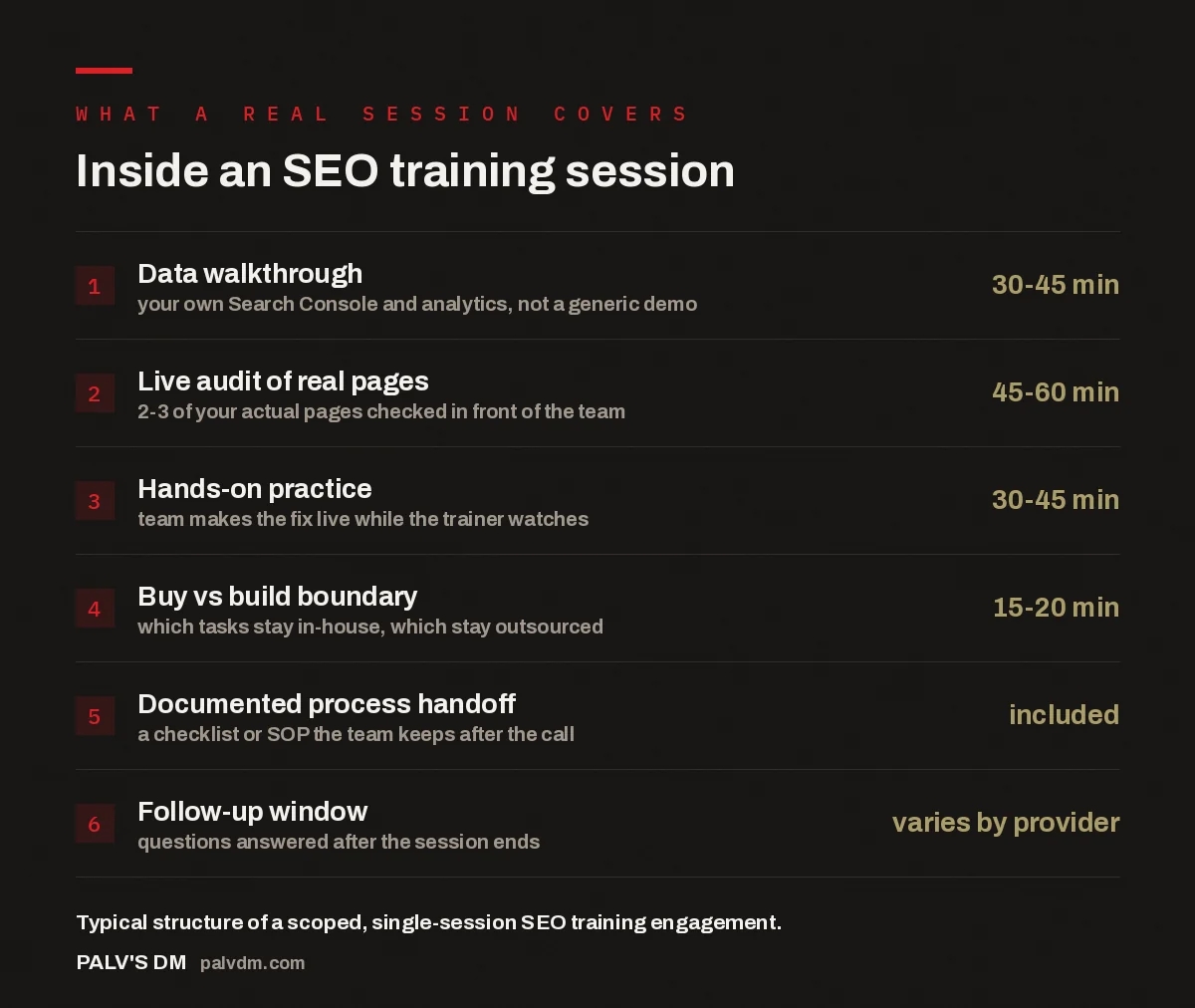
Inside an SEO training session
- Data walkthrough — 30-45 min. your own Search Console and analytics, not a generic demo.
- Live audit of real pages — 45-60 min. 2-3 of your actual pages checked in front of the team.
- Hands-on practice — 30-45 min. team makes the fix live while the trainer watches.
- Buy vs build boundary — 15-20 min. which tasks stay in-house, which stay outsourced.
- Documented process handoff — included. a checklist or SOP the team keeps after the call.
- Follow-up window — varies by provider. questions answered after the session ends.
Who actually needs an SEO training session?
The teams that get the most out of this are ones that already have someone doing the work — a content writer, a website manager, a marketing coordinator — but no formal SEO background. They’re publishing pages already; they just don’t know which checks matter or in what order. That’s a different starting point from a founder who has no time to execute anything themselves, or a site with no one on staff who’ll actually open the CMS after the call. For those cases, a one-time audit or a retainer does more good than a training session, because there’s no one to hand the process to.
A training session also fits teams that inherited an SEO backlog from a previous agency and want to understand what they’re looking at before deciding what to do next, and in-house teams that publish regularly but keep repeating the same on-page mistakes because no one ever explained the reasoning behind the checklist, only the checklist itself.
What happens before the session starts?
A properly scoped session starts with a short intake, not a calendar invite. The provider asks what the team already knows, which 2-3 pages or topics to focus on, and requests screen-share access to Search Console and analytics ahead of time so the session isn’t spent setting up logins. The agenda gets sent in advance, built around the team’s actual site rather than a reusable deck. If a provider skips this and jumps straight to a generic walkthrough of “how Google works,” it isn’t training — it’s a webinar with your company’s name on the invite.
What gets covered during the session itself?
The session usually opens with a live walkthrough of the team’s own Search Console data: which queries the site already shows up for, which pages get impressions but almost no clicks, and which pages have essentially no visibility at all. Seeing this on real numbers, rather than a hypothetical dashboard, is what makes the rest of the session land.
From there, the trainer runs a live audit of two or three real pages the team picked in advance, applying the same checklist an agency would use internally — title tags, headings, internal links, basic technical hygiene — out loud, so the reasoning is visible and not just the verdict. The team then does the hands-on part: someone on the call makes an actual edit, live, while the trainer watches and corrects. This is the step most webinars skip, and it’s the one that actually builds the muscle memory that outlasts the call. The session closes with the boundary conversation — which tasks are worth doing in-house from now on, and which ones are still better bought externally, because they need tooling or time the team genuinely doesn’t have.
What should a team walk away with?
Three things, at minimum. First, a documented checklist built for the team’s own CMS and workflow, not a generic PDF that assumes a different platform. Second, a written or recorded record of the session itself, so the reasoning survives past the meeting and can be handed to whoever writes the next blog post. Third, a clear next-few-weeks plan — which pages get the new checklist applied first, and by when — because a session that ends with “great, thanks” and no follow-through timeline tends to evaporate within a month.
The value of a training session isn’t the two hours in the room — it’s whether someone touches a page a month later and still remembers exactly what to check. If the whole thing evaporates once the call ends, it wasn’t training, it was a demo.
Palash, Founder, PalV’s DM
How does training compare with buying an audit or a retainer?
A retainer buys ongoing execution — the agency keeps finding and fixing issues every month, which makes sense when there’s no in-house capacity to take work on. A one-time audit buys diagnosis: the agency finds and prioritises the issues, and either the team or the agency fixes them afterward. Training buys something different again — capability transfer. It’s the right pick once a team has some capacity to execute but not the judgment yet to know what’s worth doing first, which is a distinction worth sitting with before choosing between a one-time service and a retainer.
Training also tends to sit at a specific point in the order in which one-time SEO services are worth buying — usually after an initial audit has already surfaced what’s broken, so the session has real, prioritised problems to work through rather than starting from a blank page. Teams that stack training with other one-off services, rather than buying either training or a retainer in isolation, are effectively building a DIY SEO programme out of one-time engagements, and the session is what makes the rest of that stack usable instead of just a pile of reports nobody acts on.
The boundary conversation that closes most training sessions — what to keep in-house versus what to keep buying — is worth taking seriously rather than treating as a formality, because it’s the difference between a team that gets faster over time and one that quietly falls back into outsourcing everything within a quarter. It maps closely to what an in-house team should buy versus do themselves, and a good trainer will draw that line based on your actual team’s bandwidth, not a generic rule of thumb.
How do you know if the session actually worked?
The real test isn’t how the room felt at the end of the call. It’s whether, a few weeks later, the team can run the agreed checklist on a new page without asking the trainer to just do it for them. Watch whether the documented process actually gets opened again, whether newly published pages start showing fewer of the same recurring mistakes, and whether anyone can explain the reasoning behind a check, not just recite the step. If the team is still asking the original trainer to make the edits themselves a month on, that’s a sign the engagement should have been scoped as ongoing support rather than a single session — not a failure of training as a format, just a mismatch in what was bought.
Ready to scope one
If your team needs a single, scoped session rather than an ongoing contract, we can build it around your own site and data.
How long does an SEO training session usually run?
Most sessions run two to four hours, sometimes split into two shorter blocks across a week rather than one long sitting. Length depends on how many topics the team wants covered — on-page basics alone versus on-page plus technical checks — and how many people need hands-on practice time, since a group session slows down once everyone takes a turn.
Can an SEO training session cover AI visibility alongside traditional SEO?
Yes, if the team asks for it explicitly during scoping, since a lot of what makes a page visible to AI answer engines overlaps with the same on-page and content discipline that governs traditional search. A session that only covers classic Google ranking factors can leave a gap in how the team thinks about being cited by AI tools, so it’s worth raising before the session is booked, not during it.
Do we need to share Search Console access before the session?
Not strictly, but sessions built around the team’s real Search Console and analytics data teach far more than generic examples, because the team watches its own underperforming pages get diagnosed live instead of a hypothetical one. Screen-shared access during the call is usually enough — a separate login for the trainer isn’t necessary for a single session.
Is one training session enough, or does it need repeating?
One well-scoped session is usually enough to transfer a defined, narrow skill, such as running on-page checks on new blog posts before they publish. Teams that later want to add a second skill — technical monitoring, or writing content briefs — often book a second focused session months afterward rather than trying to cram everything into one long meeting.
Who from the team should actually attend?
Whoever will run the checklist afterward — usually the content writer or website manager, not only a manager who won’t be the one opening the CMS. Sessions with two to four hands-on participants tend to work better than large audiences, because the hands-on practice segment needs each person to actually make an edit, not just watch someone else make it.
The short version: an SEO training session is a scoped, hands-on engagement built around your own pages and data — not a generic workshop — that ends with a documented process your team can repeat and a clear line between what to keep doing in-house and what to keep buying. Judge it by what the team can do unsupervised a month later, not by how the room felt on the day.