Service Support — One-Time Services
Buying a Single Do-Follow Link: What to Expect
Planning to buy dofollow backlink placements? Here's what a legitimate single-link purchase includes, what it costs, and what risks to check for first.
Buying a single do-follow link means paying for one placement on one external website that passes SEO value through to a page on your site — not a package, not a subscription, just one link, delivered once. Expect to specify the target URL and anchor text, pay somewhere between a few thousand and tens of thousands of rupees depending on the site’s authority and niche, and receive a live URL within one to three weeks. What you should not expect is a guaranteed rankings jump from that one link alone.
Key takeaway
- A single link purchase is a scoped, one-off transaction — relevance, placement and do-follow status should be confirmed in writing before you pay, not discovered afterward.
- Price mostly tracks the linking domain’s authority and traffic, not the length of the article it sits in — a short, relevant placement on a strong site beats a long one on a weak site.
- One link rarely moves a competitive keyword by itself; the pattern that shows up repeatedly is that it works as one input alongside content and technical fundamentals, not as a substitute for them.
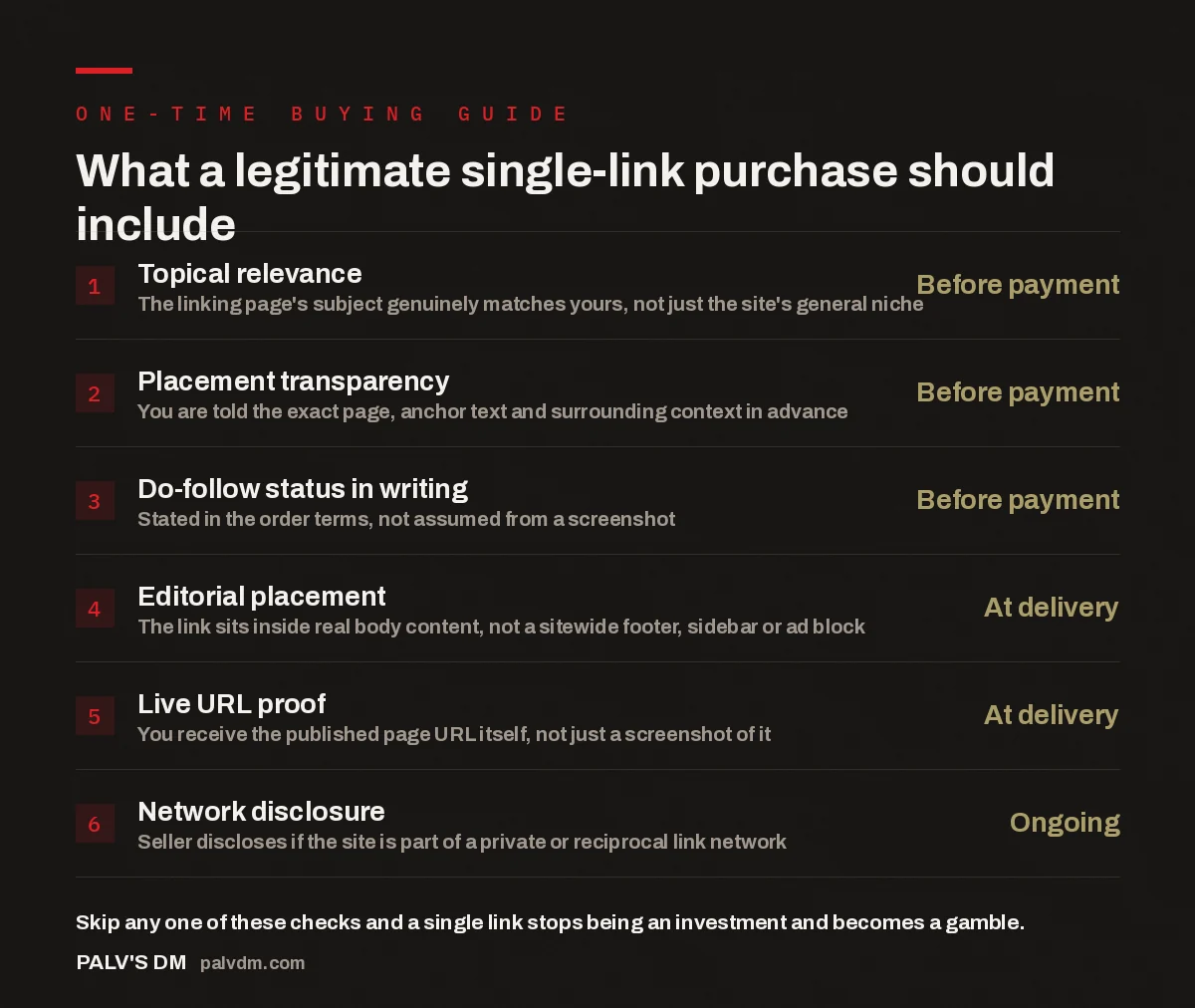
What a legitimate single-link purchase should include
- Topical relevance — Before payment. The linking page’s subject genuinely matches yours, not just the site’s general niche.
- Placement transparency — Before payment. You are told the exact page, anchor text and surrounding context in advance.
- Do-follow status in writing — Before payment. Stated in the order terms, not assumed from a screenshot.
- Editorial placement — At delivery. The link sits inside real body content, not a sitewide footer, sidebar or ad block.
- Live URL proof — At delivery. You receive the published page URL itself, not just a screenshot of it.
- Network disclosure — Ongoing. Seller discloses if the site is part of a private or reciprocal link network.
What exactly are you buying when you buy a dofollow backlink?
You are buying a hyperlink from someone else’s page to a page on your site, coded without a rel="nofollow" or rel="sponsored" attribute, so search engines treat it as a normal editorial endorsement rather than a flagged paid or untrusted link. That distinction is the whole point of paying for it: a nofollow link can still send referral traffic and brand exposure, but it is not intended to pass ranking signal, while a dofollow link is. The seller is usually offering one of two things — a slot inside an existing published article (a “link insertion”) or a brand-new article written around your link (a “guest post”). Both count as a single link purchase; they just differ in how much new content comes with it.
What you are not buying, no matter what the seller implies, is a guaranteed ranking outcome. A single backlink is one ranking factor among many Google evaluates for a given query, alongside content relevance, page experience, and the rest of your site’s existing link profile. Treat the purchase as adding one data point to your off-page profile, not as a lever that moves a keyword by itself.
How much should a single link actually cost?
Price is driven overwhelmingly by the linking site’s authority, organic traffic and niche relevance — not by article length or how nicely it’s written. A site with real organic traffic in your industry, an editorial process, and a clean link profile of its own will cost more than a site that publishes anything for a fee and calls itself a “guest posting service.” That’s expected: you’re paying for the trust the domain has accumulated, and trust doesn’t come cheap. Be wary of the opposite pattern too — a suspiciously low price on a site that claims high authority metrics is one of the clearest signs that the metrics are inflated or the site is part of a link farm.
Ask for the site’s actual organic search traffic, not just a third-party authority score, before agreeing to a price. Authority scores from SEO tools are estimates built from crawled link data; they can be gamed by sites that exist purely to sell links to each other. Real organic traffic is harder to fake and a better proxy for whether the site has actual readers, which is what makes an editorial mention meaningful in the first place.
How does the buying process usually work?
- You (or your agency) shortlist a linking site. Relevance to your industry and genuine traffic matter more than any single metric.
- You agree the target page and anchor text in writing. Vague anchor text like “click here” wastes the placement; overly exact-match anchor text on every link looks manipulative to Google over time, so anchor variety matters even within a single purchase.
- You confirm do-follow status and placement type before paying. Sidebar widgets, footer links and “resource page” dumps are lower value than a link inside the body of a relevant article.
- The seller drafts or inserts the content. For guest posts, insist on reviewing the draft — you’re partly responsible for what your brand is associated with.
- The link goes live and you get the URL. Check it yourself in an incognito browser window; don’t rely solely on a screenshot.
- You recheck periodically. Paid links occasionally get quietly switched to nofollow, edited, or removed months later without notice — a spot-check every few months protects the investment.
The clients who get burned on link buying almost never got burned on the link itself — they got burned on skipping the relevance check because the price looked good.
Palash, Founder, PalV’s DM
What risks come with buying a single link?
Google’s guidelines treat buying links specifically to manipulate rankings as a violation, and sites caught operating obvious link schemes have had their search visibility affected. The practical risk for a buyer isn’t that one link, bought sensibly, triggers a penalty — it’s the accumulation pattern: dozens of links bought quickly from clearly low-quality or interlinked sites, all with the same exact-match anchor text, on a site that has little else going for it. In the accounts we work on, isolated, relevant, editorially-placed links have never been the problem; anchor-text stuffing and obvious link farms have been.
A second, more common risk is simply wasting the money. A link on an irrelevant, low-traffic, or barely-indexed site passes little to no meaningful signal, no matter what the seller’s dashboard claims. Before you buy, check that the site itself is actually indexed and ranking for its own relevant terms — a site with no visible organic presence isn’t a domain worth an editorial link from, regardless of its stated authority score.
When does buying one link make sense on its own?
A single link purchase fits a narrow, specific need rather than a broad growth goal. It makes sense when you’ve identified one genuinely strong, relevant publication you want a mention from and you’re buying that placement directly rather than waiting for organic outreach to land it. It also fits when you’re testing a new link-building vendor with a small, low-risk order before committing to a larger campaign, or when you need to round out an otherwise thin backlink profile for one specific page that’s close to ranking but under-linked relative to competitors.
It makes less sense as your only off-page activity if the target page still has real content or technical gaps, or if you’re hoping one placement compensates for a site with no link profile at all. A single link is a precise tool for a specific gap — not a foundation you build a strategy on.
Before you buy
If you want a link-buying decision reviewed against your actual link profile and target page — not sold to you — that’s exactly what a one-time off-page check is for.
FAQ
Is it safe to buy a dofollow backlink?
Buying one link from a relevant, editorially-run site with real traffic carries low practical risk. The risk rises sharply with volume and pattern — many links bought quickly from low-quality or interlinked sites, especially with repetitive exact-match anchor text, is the pattern that draws attention, not a single well-chosen placement.
How do I know if a link is actually dofollow?
View the page’s source code (or use a browser extension built for this) and check the anchor tag for your link. If it has no rel attribute, or a rel value other than “nofollow”, “sponsored” or “ugc”, it’s dofollow. Don’t take a seller’s word for it — verify the live page yourself after it publishes.
Should I use exact-match anchor text for a purchased link?
Occasionally, yes, but not as your default. A link profile made up mostly of exact-match keyword anchors looks unnatural because real editorial links rarely use precise keyword phrases as anchor text. Branded anchors, the URL itself, or descriptive phrases are safer choices for most single-link purchases.
Will one backlink improve my rankings?
Rarely on its own for a competitive keyword. A single relevant link is one input into a much larger equation that includes content quality, technical health, and your site’s existing authority. It’s more realistic to expect a small, cumulative contribution than a standalone rankings jump.
What’s the difference between a link insertion and a guest post?
A link insertion adds your link to an already-published, already-indexed article, which is usually faster and cheaper. A guest post is a new article written specifically to include your link, which costs more but lets you control the surrounding context and topic fit more precisely.
Related reading
If you’re deciding between placement types before you buy, see link insertion vs guest post: which to buy. If you’re not sure a single link is the right first move at all, the order to buy one-time SEO services in covers where link buying typically fits relative to an audit or technical check. And if you want to understand what your existing backlink profile looks like before adding to it, what an off-page check reveals about your link profile explains what that service covers.
Short version: buying a single dofollow link gets you one editorial-style hyperlink from an external page to yours, with the do-follow attribute intact so it can pass ranking signal. Expect to confirm relevance, placement and do-follow status in writing before paying, expect price to track the linking site’s real authority and traffic, and expect the link to be one modest input into your off-page profile rather than a standalone fix for a ranking problem.