Service Support — One-Time Services
Using a One-Time Audit to Evaluate Your Current Agency
How to use an independent seo audit to evaluate your current SEO agency: what to check, what counts as a real red flag, and what to do with the findings.
An independent SEO audit works as an agency evaluation tool when you use it to check three things: whether the technical and content issues your agency should have caught are actually fixed, whether their reporting matches what an outside set of eyes finds, and whether any gap between the two is explained by a legitimate priority call or by work that simply wasn’t done. Commission the audit from someone with no financial stake in your current contract, give them access without first telling them what your agency claims is working, and read the results against your last two or three monthly reports side by side. That comparison — not the audit on its own — is what tells you whether to renew, renegotiate, or replace.
Key takeaway
- An independent seo audit is only useful for evaluating an agency if it’s read alongside that agency’s own reports, not in isolation — the comparison is the point, not the audit by itself.
- Most findings that look like proof of a bad agency turn out to be a priority call you were never walked through, not neglect — sort for that before you react.
- The audit should inform your decision to renew, renegotiate scope, or switch agencies — it shouldn’t make that decision for you on its own.
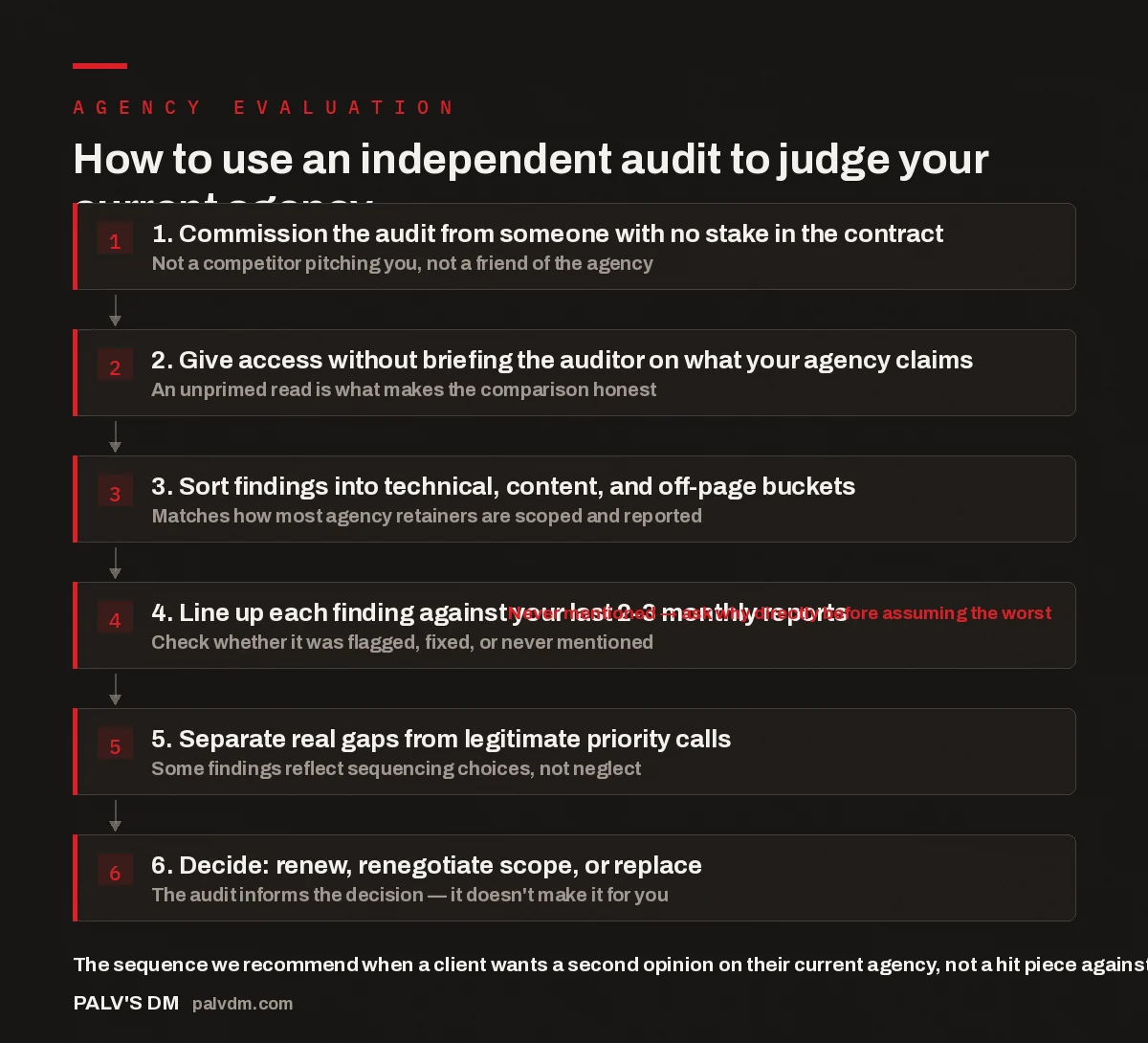
How to use an independent audit to judge your current agency
- 1. Commission the audit from someone with no stake in the contract. Not a competitor pitching you, not a friend of the agency.
- 2. Give access without briefing the auditor on what your agency claims. An unprimed read is what makes the comparison honest.
- 3. Sort findings into technical, content, and off-page buckets. Matches how most agency retainers are scoped and reported.
- 4. Line up each finding against your last 2-3 monthly reports. Check whether it was flagged, fixed, or never mentioned. Never mentioned → ask why directly before assuming the worst
- 5. Separate real gaps from legitimate priority calls. Some findings reflect sequencing choices, not neglect.
- 6. Decide: renew, renegotiate scope, or replace. The audit informs the decision — it doesn’t make it for you.
What should an independent audit check before you judge your current agency?
The audit needs to cover the same three areas most SEO retainers are scoped around, or the comparison won’t hold up: technical health, content quality, and off-page signals. On the technical side, that means indexing status, crawl errors, site speed, structured data, and whether pages that should be indexable actually are. On content, it means checking whether published pages match real search intent, whether there’s obvious thin or duplicated content, and whether the site’s internal linking makes sense or is scattered. On off-page, it means a read of the backlink profile — not just link count, but where those links come from and whether any look purchased, spammy, or otherwise risky.
An audit that skips any of these three areas gives you a partial picture, and a partial picture is exactly what lets a genuine agency problem hide. If you’re commissioning a one-time audit specifically to evaluate an existing engagement, say that upfront to whoever you hire and ask them to cover all three areas at a comparable depth — not just the one they happen to specialise in.
It also matters who does the audit. An agency actively pitching you to switch has an incentive to find more problems than are actually there, and a friend of your current agency has the opposite incentive. Neither gives you a clean read. An independent auditor working on a paid, one-time basis — with no stake in what you decide afterward — is what makes the findings usable as evidence rather than as a sales pitch in either direction.
How do you compare audit findings against your agency’s own reporting?
Pull your last two or three monthly reports before you read the audit, and go through both documents side by side, finding by finding. For every issue the audit raises, ask one question: did the agency already flag this, fix it, or never mention it at all? Those three answers point to three different situations, and treating them the same is the most common mistake in this kind of review.
If the agency flagged the issue and it’s still open, that’s usually a resourcing or sequencing conversation, not evidence of dishonesty — ask why it hasn’t moved yet and whether the timeline they gave you still holds. If the agency reported it as fixed and the audit shows it isn’t, that’s worth a direct conversation, because either the fix didn’t hold, the report was inaccurate, or the two audits are measuring the same thing differently — all three are possible, and you want to know which one before assuming bad faith. If the issue was never mentioned in any report, that’s the finding worth the closest look, because it means either the agency missed something a general audit caught, or it fell outside what they were actually scoped to check.
This is also where scope matters more than most clients expect. An agency retained purely for content won’t have been checking your crawl budget or your structured data, and an audit that flags technical issues doesn’t mean that agency failed — it means the audit covered ground outside their contract. Read your original scope of work alongside the audit and the reports before drawing conclusions about who was responsible for what.
Which audit findings are genuine red flags, and which are normal SEO trade-offs?
Not every gap the audit surfaces is a sign the agency is failing you. SEO work involves constant prioritisation — an agency working through a finite number of hours each month has to choose what gets fixed first, and reasonable people can disagree on that order. A slower-than-ideal fix on a low-traffic page, a content calendar that’s behind by a few weeks, or a technical issue that’s been deprioritised in favour of a bigger one are usually sequencing decisions, not neglect. Ask the agency to walk you through their reasoning before treating any of these as a red flag on their own.
The findings worth treating seriously look different. A backlink profile with links you can’t explain and the agency can’t either. Reports that describe work in vague terms — “optimisation performed,” “content improved” — without specifics that match what the audit actually finds on the site. Technical issues that have appeared in report after report as “in progress” with no visible change across several months. Content that reads as if it were produced to hit a page count rather than to answer a real query, especially at volume. Any one of these on its own might have an explanation. Several of them together, on the same account, is the pattern that tends to indicate the account genuinely isn’t being worked the way it’s being billed.
The distinction between a trade-off and a red flag usually comes down to whether the agency can explain the gap clearly when you ask, and whether that explanation matches what you can independently verify. An agency that welcomes the question and walks you through their reasoning is behaving differently from one that gets defensive or vague when the same question is asked directly.
Clients rarely come to us wanting a hit piece against their current agency. They want to know if what they’re paying for matches what’s actually happening on the site — and an independent audit is the only way to answer that without just trusting the same source you’re trying to evaluate.
Palash, Founder, PalV’s DM
What should you do once you’ve read the audit against the reports?
Bring the findings to your agency directly before deciding anything. Frame it as a comparison, not an accusation — share the specific gaps you found between the audit and their reporting, and ask them to walk you through each one. How they respond tells you almost as much as the audit itself. A clear, specific explanation for most of the gaps is a good sign, even if a few genuine misses turn up. Defensiveness, vague answers, or an unwillingness to engage with specifics is a different signal entirely.
From there, you’re generally choosing between three paths. Renew with the same scope if the gaps were minor and well explained, and the relationship is otherwise working. Renegotiate scope or cadence if the agency is doing real work but the account has grown past what the current arrangement covers, or if reporting needs to get more specific going forward. Replace the agency if the pattern points to work not being done as billed, or if trust has broken down to the point where you can’t get a straight answer to a direct question. None of these decisions should rest on the audit alone — they should rest on the audit plus how the conversation with your current agency actually goes.
Next step
If you want an honest, independent read on what your current agency is actually doing, a one-time standalone audit gives you that without committing to anything further.
FAQ
Should I tell my current agency I’m getting an independent audit?
Not before the audit is done. Telling them in advance can change what they prioritise in the short term, which defeats the purpose of getting an unbiased read. Once you have the results and want to raise findings, that’s the right time to bring your agency into the conversation directly.
What access does the auditor actually need?
Read-only access to Google Search Console and Google Analytics covers most of what’s needed, plus a crawl of the live site itself, which doesn’t require any account access at all. You generally don’t need to hand over CMS or hosting credentials for a standalone evaluation audit — flag that upfront if an auditor asks for more than that.
How often should I get an independent audit while an agency is under contract?
Once a year is reasonable for most accounts, or sooner if something specific triggers the question — a traffic drop you can’t explain, reporting that’s gotten vaguer, or simply not having had one in a while. Doing it more often than that rarely surfaces new information and mostly just adds cost.
What if the audit and my agency’s reports genuinely disagree on the same metric?
Check the measurement window and data source before assuming either side is wrong — different date ranges, sampling methods, or tools can produce different numbers for the same underlying reality. Ask both parties what specifically they measured and how. Genuine disagreement after that comparison is a smaller, more specific conversation than it first appears.
Is a one-time audit enough, or do I need an ongoing second opinion?
A one-time audit is enough to answer the specific question of whether your current agency’s recent work and reporting hold up. If the relationship survives that check, you don’t need an ongoing parallel review — just a repeat audit on the same cadence, roughly annually, unless something specific prompts an earlier look.
Short version: an independent seo audit evaluates your current agency when you commission it from someone with no stake in the outcome, read the findings against your own last two or three reports, and separate genuine gaps from reasonable priority calls before you react. Bring what you find to your agency directly and judge their response as much as the findings themselves. For related reading, see what the free audit covers and where a paid one goes deeper, what a paid technical SEO check actually covers, how to get value from an audit you can’t implement right away, and how to turn any audit into a prioritised action plan once you’ve decided on next steps.