Service Support — One-Time Services
What Backlink Lead Lists Are Useful For
A backlink prospect list explained: what a usable backlink prospect list contains, who needs one, and how to check it's worth buying before you pay for it.
A backlink prospect list is a spreadsheet of websites that are realistic candidates for getting a link to your site — sorted by relevance, authority, and how you’d approach each one. It doesn’t get you links by itself. It replaces the weeks you’d otherwise spend manually searching, checking metrics, and ruling out sites that would never say yes, so that whoever does the outreach (you, your team, or an agency) starts from a working target list instead of a blank page.
Key takeaway
- A backlink prospect list is research, not links — it tells you who to approach and why, not a guaranteed placement.
- A usable list is filtered by topical relevance and realistic authority, not just a raw metric like Domain Rating sorted high to low.
- The list is only worth what happens after it — outreach, follow-up, and content the site actually wants to link to.
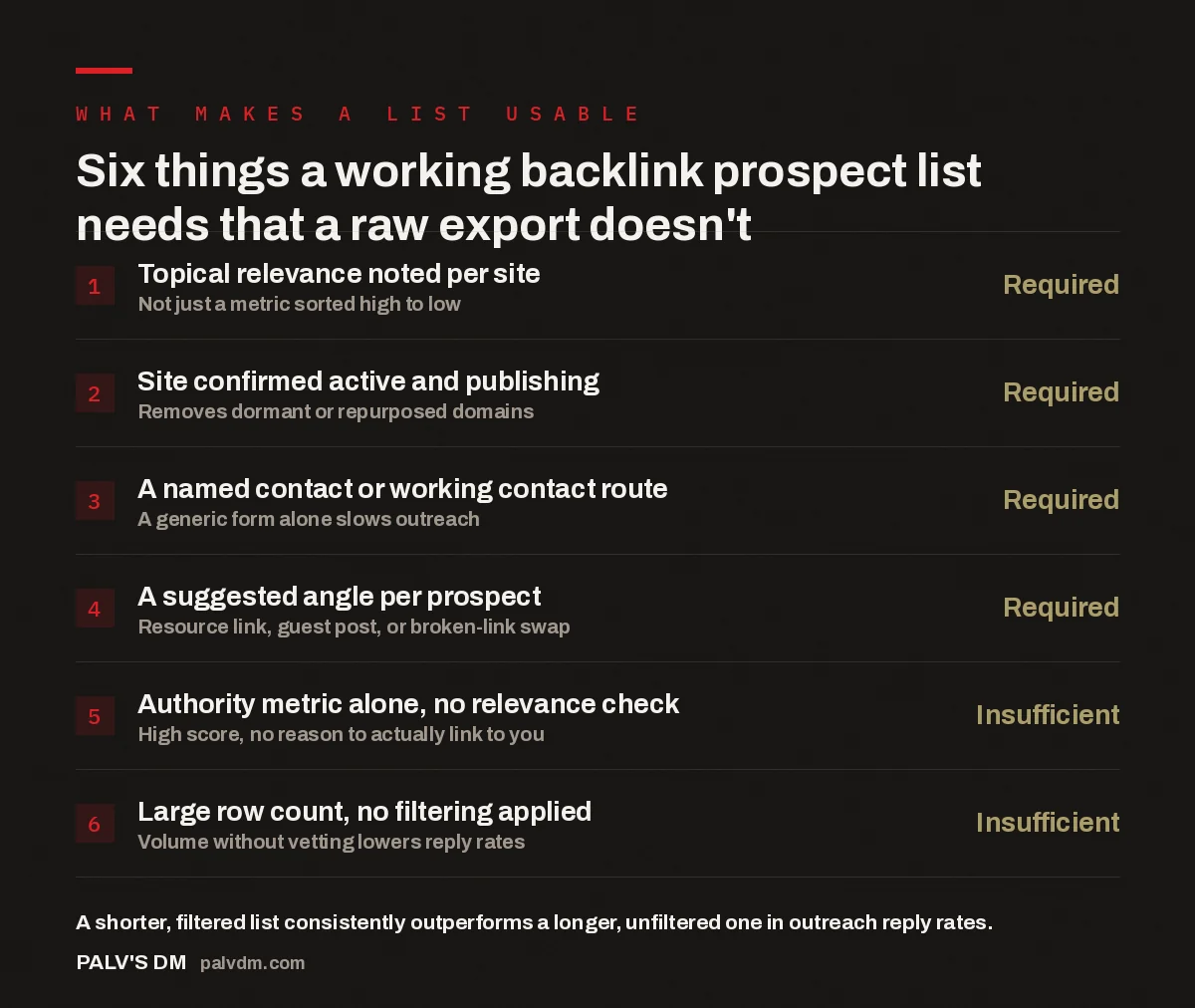
Six things a working backlink prospect list needs that a raw export doesn’t
- Topical relevance noted per site — Required. Not just a metric sorted high to low.
- Site confirmed active and publishing — Required. Removes dormant or repurposed domains.
- A named contact or working contact route — Required. A generic form alone slows outreach.
- A suggested angle per prospect — Required. Resource link, guest post, or broken-link swap.
- Authority metric alone, no relevance check — Insufficient. High score, no reason to actually link to you.
- Large row count, no filtering applied — Insufficient. Volume without vetting lowers reply rates.
What exactly is in a backlink prospect list?
A working list is a spreadsheet, not a report. Each row is one candidate site, with columns that answer the questions someone doing outreach actually needs answered before they write an email. At minimum: the domain, a relevance note (why this site would plausibly link to you), an authority indicator, the contact route (a named editor, a contact form, a guest-post page), and a suggested angle — resource link, guest post, broken-link replacement, or mention in an existing article.
What it isn’t: a list of every domain that ranks near you, sorted by a single metric. Metrics tell you a site has authority; they don’t tell you it has any reason to link to you. A list built purely from a tool export, without anyone checking whether the site’s content actually connects to yours, tends to convert at close to zero regardless of how high the numbers look.
Who actually needs one?
Three situations come up repeatedly in the one-time-service accounts we work on. First, a site with an in-house content or growth person who can write outreach emails but doesn’t have the hours to build the target list — the research is the bottleneck, not the writing. Second, an agency or freelancer doing outreach on retainer for a client who wants the prospecting done separately, often to compare vendors or keep the research reusable across campaigns. Third, a business preparing a specific push — a product launch, a new location page, a piece of original research — that needs a fresh, topically matched list rather than reusing whatever targets were used last time.
If none of that describes your situation — if you don’t have anyone to do the outreach once the list exists — buying the list alone usually isn’t the right move. The list is only valuable as an input to a process; on its own it sits in a folder.
How is a good prospect list actually built?
- Start from your actual content, not a keyword. The pages, data, or expertise you have to offer determine which sites are realistic targets — a list built before anyone looks at what you can actually link to tends to over-promise.
- Pull a wide candidate pool. Competitor backlink profiles, resource and “best of” pages in your niche, sites that have linked to similar content before, and any broken-link opportunities in your space go into one working sheet.
- Filter for topical fit before authority. A mid-authority site squarely in your niche is usually a better prospect than a high-authority site with no topical connection to what you do.
- Check the site is actually live and active. Recent posts, a working contact route, no obvious sign the domain is a dormant or repurposed one — this step alone removes a meaningful share of raw exports.
- Note the angle, not just the contact. “Resource page — add under ‘tools’ section” is a usable instruction. “Has a contact form” is not.
None of this requires exotic tooling. It requires someone spending the time to look at each candidate site rather than trusting an exported number, which is exactly the part most in-house teams don’t have spare hours for.
The list isn’t the deliverable people think it is. It’s the thing that makes the actual work — the emails, the follow-ups, the content — possible to start on Monday morning instead of two weeks later.
Palash, Founder, PalV’s DM
What should you check before buying one?
A few questions separate a usable prospect list from an export dressed up as a service. Ask what data source it’s built from and whether a person reviewed each site individually, or whether it’s a raw pull sorted by one metric. Ask whether the list includes a suggested angle per site, or just contact details. Ask how recently the sites were checked — a list built six months ago against sites that no longer publish is close to useless. And ask what happens with sites that don’t fit any category cleanly; a list with zero exclusions usually means nothing was filtered out.
It’s also worth being honest about volume. A list of 200 “high DR” domains sounds more impressive than a list of 30 genuinely relevant ones, but outreach against the second list will get more replies. In the accounts we’ve built lists for, a tightly filtered list in the dozens consistently outperforms an unfiltered list in the hundreds, because the reply rate — not the row count — is what determines whether any of this turns into links.
Where does the prospect list fit next to other one-time services?
A backlink prospect list pairs naturally with an off-page check that looks at your existing link profile — the audit tells you where the gaps and weaknesses are, and the prospect list gives you the targets to close them. If you’re deciding between formats once you have a list, link insertion versus a guest post is the next practical decision, since the two approaches suit different types of sites on the same list. And if this is one of several one-time services you’re considering stacking together, the order to buy one-time SEO services in covers where prospecting research fits relative to audits and content work.
If you’re weighing whether to buy the research and run outreach yourself versus handing the whole thing to an agency, that’s the same decision covered in when a one-time SEO service beats a retainer — a prospect list is one of the clearest cases where a bounded, one-time purchase makes more sense than an ongoing contract, because the research itself doesn’t need to repeat monthly.
Key takeaway
- A prospect list is research that feeds outreach — it doesn’t replace outreach, and it isn’t a link guarantee.
- Relevance filtering matters more than raw authority metrics for actually getting replies.
- A smaller, well-checked list consistently beats a large, unfiltered export.
Frequently asked questions
Does a backlink prospect list guarantee links?
No. It’s a researched target list, not a placement. Whether any given site links to you still depends on outreach quality, the content you’re offering, and the site’s own editorial judgment. A good list improves your odds by removing irrelevant or dead sites before you spend time on outreach — it doesn’t replace the outreach itself.
How many prospects should be on a usable list?
There’s no fixed number that works for every site, but a tightly filtered list of a few dozen genuinely relevant prospects typically outperforms a raw export of a few hundred. The right size depends on how narrow your niche is and how much outreach capacity you actually have to work through the list.
Can I build a backlink prospect list myself instead of buying one?
Yes, if you have the time and access to a backlink or SEO tool to pull candidate sites from. The work itself — checking topical fit, confirming sites are active, finding a contact route — is not specialised, it’s time-consuming. Buying the list mainly saves the hours, not the skill.
What’s the difference between a prospect list and a link-building campaign?
A prospect list is the research phase — identifying and vetting target sites. A link-building campaign includes the list plus the outreach, follow-up, and negotiation needed to actually secure placements. Some buyers want only the list because they have someone in-house to run outreach; others want the full campaign because they don’t.
How often does a backlink prospect list need refreshing?
A list is a snapshot — sites shut down, change ownership, or stop publishing, and content on your side changes too. If you’re not working through a list within a few months of receiving it, treat it as a starting point for re-checking rather than a ready-to-use file, since the sites most worth reaching out to may have changed.
Short version: a backlink prospect list is a filtered, researched set of realistic link targets — built for topical relevance first and authority second — that turns “we should do some link building” into a working spreadsheet someone can start emailing from today. It’s most useful when you already have a way to run outreach and just need the target research done; on its own, without follow-through, it’s just a list.