Content Quality vs Quantity: Where the Line Actually Sits
Quality sets the floor, volume sets the ceiling. See what the evidence actually shows about publishing frequency, thin content, and site-wide quality signals.
Published: August 2026
Quality sets the floor and volume sets the ceiling – a single excellent post can rank, but a business trying to dominate a category needs enough posts to cover the full topic space. The myth is that these two are opposites you must choose between. They aren’t. A site publishing frequently but shallowly gets flagged through content decay signals; a site with one perfect post but no supporting cluster never builds the topical authority that makes a category winnable. The real question isn’t quality or quantity, it’s whether your quantity is quality, consistently.
Is it true that Google prefers fewer, better posts over many average ones?
Partly true, and the part that’s true matters more than the part that isn’t. Google evaluates sites holistically now, not post by post in isolation. A site where a large share of pages are thin or generic drags down how the whole domain gets assessed – including the genuinely strong pages on it. That’s real, and it’s why publishing 15 rushed posts a month to “beat” a competitor publishing 4 well-researched ones usually backfires within two or three quality-focused algorithm updates.
What’s not true is that quantity itself is a negative signal. A site with 40 well-researched, genuinely useful posts covering a topic in depth will outperform a site with 4 excellent posts on the same topic, because the 40-post site demonstrates broader coverage and topical authority the 4-post site can’t match, however good those 4 posts are.
What does the actual evidence say?
| Claim | Reality |
|---|---|
| “More posts always means more traffic” | False. Traffic follows relevance and depth, not post count. Thin posts often generate impressions with near-zero clicks. |
| “One great post beats a whole cluster” | False for competitive topics. Topical authority comes from covering a subject from multiple angles, not from one page however well written. |
| “Publishing frequently signals site freshness to Google” | Partially true. Consistent publishing affects crawl frequency and topical authority growth, but frequency without depth doesn’t help rankings directly. |
| “A site-wide quality problem can drag down good pages” | True. Google’s helpful content systems assess quality signals at the site level, not purely per-URL. |
What’s the actual cost of getting this wrong in each direction?
Over-indexing on quantity wastes money twice: once on producing content that never earns its keep, and again on the site-wide quality damage that can drag down pages that would otherwise have performed well. The recovery path usually involves pruning, consolidating, or rewriting a chunk of the published archive, which costs more than producing it more carefully the first time would have.
Over-indexing on quality alone wastes time differently – not through wasted production, but through opportunity cost. Every month spent perfecting one post is a month a competitor spends capturing three or four adjacent long-tail queries that never get addressed. Neither mistake is more forgivable than the other; both come from treating this as a binary choice instead of a capacity-planning problem.
Why does this myth persist?
Because both extremes have visible short-term evidence supporting them. A team that publishes 20 thin posts a month sometimes sees a temporary bump in impressions as pages get indexed, which looks like proof that volume works – until those same pages plateau at position 40+ with no clicks six months later. Meanwhile a team that publishes one meticulously researched post a quarter sees that single post perform well, which looks like proof that quality alone is sufficient – until a competitor with 10x the topical coverage starts capturing the surrounding long-tail queries that single post never addressed.
Both groups are seeing real results from their approach. Neither group is seeing the full picture, because the actual driver – sustained, research-backed coverage of a topic cluster – requires both elements at once.
How do you find the right balance for your business?
- Map the topic cluster first. Count how many distinct subtopics and questions exist within your category before deciding on a monthly number.
- Set a quality floor, not a length target. Every post should fully answer its target query and include at least one thing competitors don’t cover, regardless of whether that takes 900 words or 2,500.
- Match cadence to research capacity, not ambition. A sustainable 4 posts a month beats an unsustainable 12 that collapses after two months.
- Audit existing content before adding more. If 30% of your published posts are thin or outdated, fixing those often returns more than publishing net-new content.
What does “content decay” actually mean, and how does it relate to this?
Content decay is the pattern where pages accumulate impressions in Search Console but generate few or no clicks – a sign the content is technically indexed and findable but not actually satisfying the query. It shows up disproportionately on sites that prioritised volume without a matching quality bar, because those pages get discovered, briefly considered, and then passed over in favour of more complete answers elsewhere. A rising count of decaying pages is one of the clearest practical signals that a publishing cadence has outpaced research and editing capacity.
What role does editorial review play in this trade-off?
A publishing cadence is only as reliable as the review step behind it. Teams that skip a genuine editorial pass – fact-checking claims, verifying that every section actually answers its heading, cutting padding – end up with a volume of content that looks complete but doesn’t hold up when a reader actually needs the answer. Editorial review is the mechanism that keeps a higher cadence from sliding into thin content, and it’s usually the first thing cut when a team is under deadline pressure, which is exactly backwards. Protecting review time, even at the cost of publishing one fewer post that month, is what keeps the balance intact.
Does this trade-off look different for a new site versus an established one?
Yes. A brand-new site with no existing authority benefits more from establishing a baseline of coverage across its core topic cluster, which argues for a slightly higher cadence early on, provided quality doesn’t slip. An established site with 2-3 years of published content and existing topical authority gets more return from auditing and refreshing what’s already live than from adding net-new posts at the same pace. Publishing volume isn’t a fixed target across a site’s lifetime – it should shift as the site matures from “building coverage” to “maintaining and deepening it.”
What does the right balance actually look like in practice?
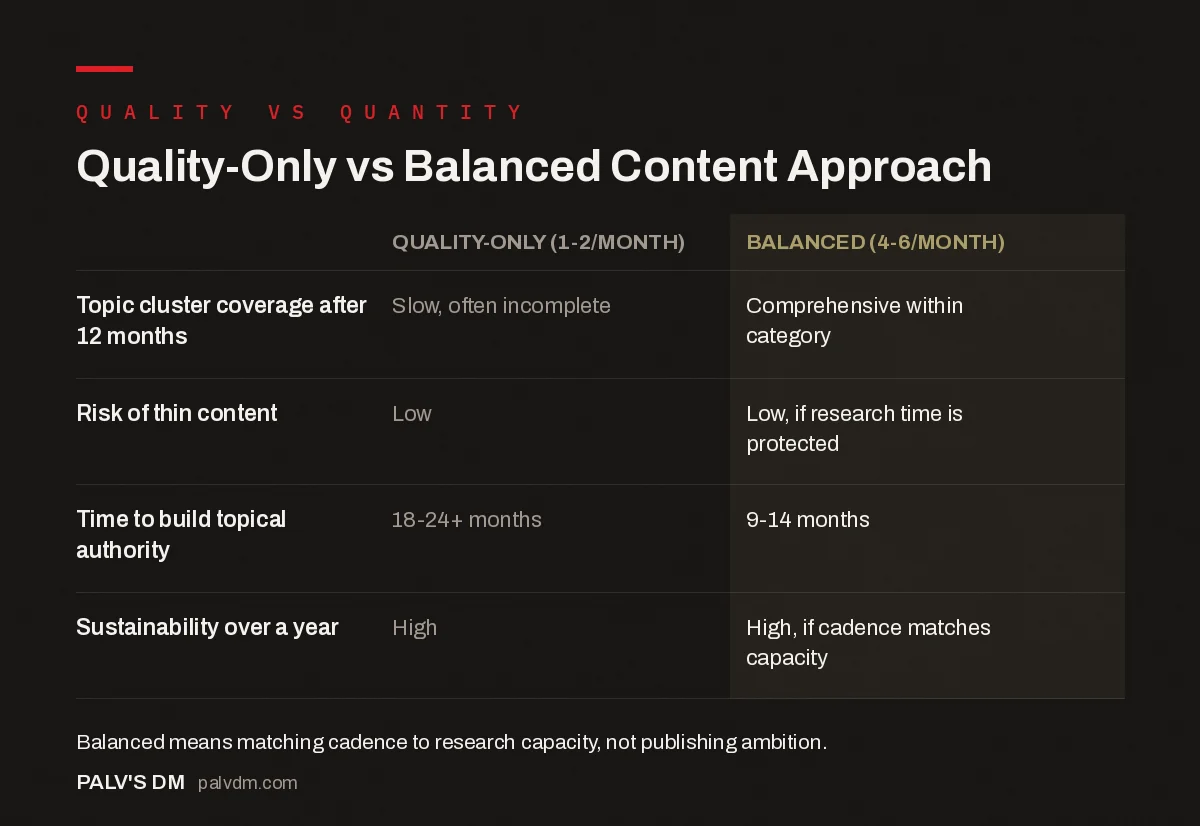
Quality-Only vs Balanced Content Approach
| Quality-only (1-2/month) | Balanced (4-6/month) | |
|---|---|---|
| Topic cluster coverage after 12 months | Slow, often incomplete | Comprehensive within category |
| Risk of thin content | Low | Low, if research time is protected |
| Time to build topical authority | 18-24+ months | 9-14 months |
| Sustainability over a year | High | High, if cadence matches capacity |
A worked example: the same topic, two different outcomes
Two competing sites in the same category illustrate how this plays out in practice. Site A published 18 posts in a quarter, each researched in roughly 3-4 hours, covering their topic broadly but shallowly – most posts restated common knowledge without adding a genuinely new angle, worked example, or specific number. Site B published 7 posts in the same quarter, each researched for 8-10 hours, with at least one thing per post – an original comparison, a specific calculation, a detail competitors had missed – that didn’t exist elsewhere on the topic.
Six months later, Site A’s posts had accumulated meaningful impressions but a click-through rate roughly a third of Site B’s, and several had already started sliding out of the top 30 as competitors published more complete answers to the same queries. Site B’s smaller output ranked more consistently and needed far less rework. Neither site was purely “quality” or “quantity” – both published more than one post – but Site B’s research-hours-per-post ratio protected it from the content decay Site A is now dealing with. The lesson isn’t “publish less.” It’s that research time per post is the variable that actually predicts the outcome, independent of the total count.
What does a practical quality floor look like, post by post?
A quality floor doesn’t need to be an elaborate rubric. Four checks catch most of the problems that turn a post thin:
- Does it fully answer the target query compared to what’s currently in the top 5 results, not just compared to a general sense of “enough words”?
- Is there at least one thing in it that a reader can’t get from three other posts on the same topic – a specific number, a worked example, a genuine opinion backed by reasoning?
- Would this post survive a fact-check on every claim, stat, and specific figure it makes, with a source that actually says what the post says it says?
- Does every heading’s content actually deliver on what the heading promises, rather than a heading followed by a paragraph that only loosely relates to it?
A post that fails any of these checks is a candidate for more research time before publishing, regardless of how it affects that month’s post count.
FAQ
Does Google penalise sites for publishing too much content?
Not directly for volume itself. The risk is indirect: a high volume of thin or low-value pages contributes to site-wide quality signals that Google’s helpful content systems weigh when evaluating every page on the domain, including the strong ones.
Is it better to have 10 great posts or 50 average ones?
Neither extreme wins reliably. 10 great posts rarely cover a topic cluster completely enough to compete for the full range of related queries. 50 average posts risk dragging down site-wide quality signals. The target is enough posts to cover the cluster, each meeting a real quality floor.
How do I know if my content is too thin?
Check Search Console for pages with meaningful impressions but a click-through rate well below your site average, and check whether the page fully answers its target query compared to what’s currently ranking. Both are stronger indicators than word count alone.
Should I delete old thin posts to improve site-wide quality?
Often yes, if a post has no meaningful traffic, no backlinks, and can’t realistically be improved into something useful. Pruning or merging thin pages into stronger ones is a standard, well-supported tactic for improving site-wide quality signals.
Can a new site with limited resources compete using quality alone?
For a narrow set of long-tail terms, yes, at least initially. But competing for the head terms in a category almost always requires building out the surrounding cluster over time, because that’s what signals topical depth to search engines.
If you’re trying to figure out where your own content sits on this spectrum, PalV’s DM’s content writing service starts with a cluster and quality audit before recommending a cadence. This post is part of our content strategy guide. Related reading: how many blog posts per month you actually need, how long new content takes to rank, and thin content: what counts and how to fix it.