
FAQ Blocks: The Single Highest-Yield On-Page Element
A well-built FAQ block answers real questions concisely, feeds both Google and AI answer engines, and takes minutes to add. Here is how to build one that earns its place on the page.
An FAQ block is the highest-yield on-page element for the effort it takes because it answers real, specific questions in a compact, extractable format that both search engines and AI answer engines can lift directly — and it takes minutes to add to a page that already exists. The yield depends entirely on using real questions with concise, standalone answers, not filler questions invented to pad a section.
Most FAQ blocks underperform because they answer questions nobody asked, or they answer real questions with vague marketing copy instead of a direct answer. Fixing both problems is mostly a discipline issue, not a technical one — the schema markup is the easy five minutes; sourcing and writing genuinely useful answers is the part that actually earns the placement.
Why do FAQ blocks matter for on-page SEO right now?
Google discontinued the FAQ rich result for most sites — the special expandable snippet in search results — keeping it only for a narrow set of authoritative government and health domains. That change removed the direct SERP-real-estate incentive that made FAQ schema popular in the first place, and it’s led some teams to conclude FAQs aren’t worth the effort anymore. That reading misses the bigger shift: FAQ blocks now do their most valuable work for AI answer engines and Google’s AI Overviews, which pull directly from clearly structured question-and-answer pairs because that format is exactly what a conversational answer needs — a self-contained question, a self-contained answer, no scrolling required to find where one starts and the other ends.
Where should the questions actually come from?
Four sources produce FAQ questions worth answering, and inventing questions to hit a target count isn’t one of them:
- People Also Ask boxes for the primary keyword — Google is already telling you what searchers ask next.
- Real customer support tickets or sales call transcripts, if the topic maps to a product or service — these surface the exact phrasing customers use, including objections.
- Forum and community threads (Reddit, niche forums, Quora) where the topic comes up organically — these often surface edge cases a keyword tool misses entirely.
- Genuine gaps in the article body — a question a careful reader would still have after finishing the main content, one the body couldn’t answer without derailing its own structure.
How long should an FAQ answer actually be?
Forty to sixty words is the working range for a reason: it’s long enough to be a complete, standalone answer and short enough that an answer engine can lift it whole without needing to trim or paraphrase. Answers that run to three sentences of throat-clearing before the actual answer force any system extracting it to do editorial work Google and AI engines generally won’t bother doing — they’ll either skip the answer or grab a competitor’s tighter one instead.
| Answer length | Extractability | Typical outcome |
|---|---|---|
| Under 20 words | High, but often incomplete | Gets lifted but may need the reader to click through for context |
| 40–60 words | High and complete | Self-contained, extractable, the target range |
| 100+ words | Low | Reads as a mini-section, not an FAQ answer; rarely lifted as-is |
How many questions should be in one FAQ block?
Three to six per page is the useful range for a standard blog post or service page. Fewer than three rarely earns a dedicated section — those questions usually belong folded into the body instead. More than six tends to duplicate ground the article already covered, and each additional question below the top few adds diminishing value while making the block harder to scan.
How do you implement FAQ schema correctly?
JSON-LD is the standard, recommended format: a FAQPage object containing a mainEntity array of Question items, each with an acceptedAnswer. Two implementation rules matter more than the syntax itself. First, the schema must match visible on-page content word for word — marking up questions that aren’t actually shown to users, or answers that differ from what’s displayed, violates Google’s structured data guidelines even where no rich result is at stake. Second, don’t use FAQ schema for promotional content dressed as a question — “Why should you choose us?” isn’t a real user question and shouldn’t carry FAQPage markup.
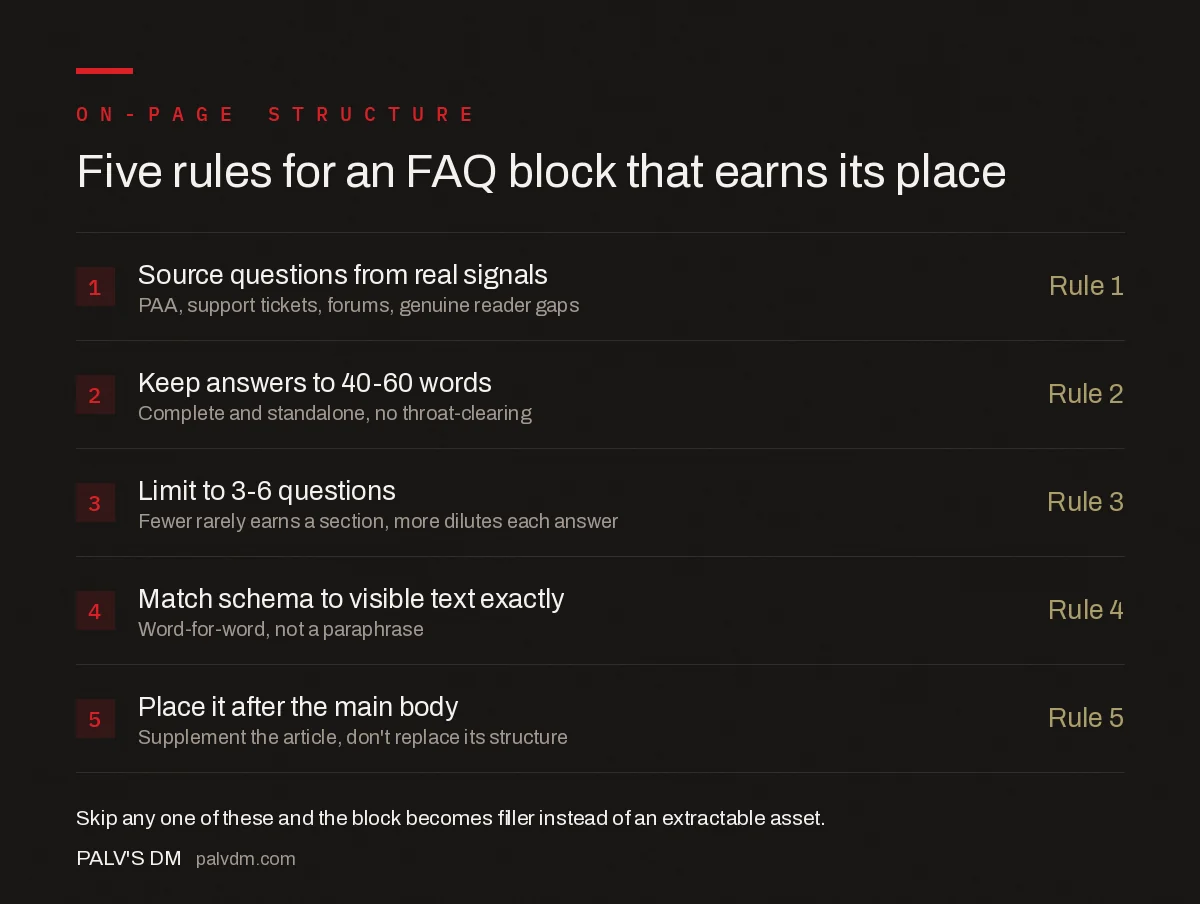
Five rules for an FAQ block that earns its place
- Source questions from real signals — PAA, support tickets, forums, genuine reader gaps.
- Keep answers to 40–60 words — complete and standalone, no throat-clearing.
- Limit to 3–6 questions — fewer rarely earns a section, more dilutes each answer.
- Match schema to visible text exactly — word-for-word, not a paraphrase.
- Place it after the main body — supplement the article, don’t replace its structure.
Where should the FAQ block sit on the page?
After the main body content, before sources and internal links, as its own clearly headed section — the pattern most SEO-focused CMS templates and this article itself follow. Placing it earlier, above the body, buries the primary answer the page exists to give under a list of tangential questions, which works against the answer-first structure Google and AI systems both reward on the page’s actual core query.
What mistakes turn an FAQ block into dead weight?
- Padding to hit a round number. A sixth question invented because five “felt short” adds nothing and can read as filler to both readers and quality-evaluation systems.
- Answers that don’t match the schema text. Editing the visible answer later without updating the JSON-LD (or vice versa) creates a mismatch that can trigger a structured data warning.
- Using FAQ schema for sales copy. Questions like “What makes us different?” aren’t genuine user queries and shouldn’t be marked up as FAQPage content.
- Duplicating the same FAQ block across many pages verbatim. Generic, copy-pasted FAQ sections signal the page wasn’t built around its specific topic, undermining the exact credibility the block is meant to build.
Frequently asked questions
Does FAQ schema still create rich results in Google Search?
For most sites, no — Google removed the FAQ rich result and its Search Console report for the majority of publishers, keeping it only for a small set of authoritative government and health sites. FAQ schema is still worth adding because other engines and AI systems still process it as a structured signal.
How many questions should an FAQ block have?
Three to six is the useful range for most blog and service pages. Fewer than three rarely justifies a dedicated section; more than six starts duplicating content already covered in the body and dilutes the value of each individual answer.
Where should FAQ questions come from?
Real sources: People Also Ask boxes for the target keyword, actual customer support tickets, sales call objections, and forum threads. Invented questions that exist only to wedge in a keyword read as filler to both readers and Google’s helpful content systems.
Should FAQ answers repeat what’s already in the article body?
They should restate the core answer concisely, not copy a paragraph verbatim. A reader scanning only the FAQ block should get a complete, standalone answer in 40 to 60 words, even if the body covers the same ground in more depth earlier in the page.
Sources
- FAQPage Structured Data — Google Search Central
- On-Page SEO: The Complete Working Checklist
- Table Snippets: Structuring Data Google Will Lift
- People Also Ask: Mining It and Ranking In It
- Above-the-Fold Content: Answering Before Scrolling
Want this done on your site?
Every PalV’s DM engagement starts with a free audit of your actual website — a 12-point
crawl covering what is blocking indexation, on-page gaps against your primary keywords, speed
findings, and the three to five fixes worth making first. Delivered in two working days. No
payment details, and the findings are yours whether you hire us or not.