The First 100 Words: The Highest-Leverage Paragraph on the Page
The first 100 words decide whether a page earns a featured snippet, an AI Overview citation, and a reader who keeps scrolling. What that paragraph needs to do, with before/after examples.
The first 100 words on a page are what Google most often pulls for a featured snippet, what an AI Overview quotes when it cites the page, and what decides whether a reader scrolls further or clicks back — so that paragraph needs to answer the core question directly, in plain language, before anything else happens on the page. Most underperforming articles don’t have a content problem; they have an opening problem. The right information exists somewhere on the page, just three paragraphs too late for either a crawler’s extraction pass or a human’s patience.
This isn’t a stylistic preference. It’s a mechanical consequence of how Google’s snippet and AI Overview systems select text, and how human readers decide in the first few seconds whether a page is worth their time.
What does the first 100 words need to accomplish?
Three things, in order: answer the query the reader typed, do it in language a machine can extract cleanly, and do it without requiring the rest of the page for context. Google’s featured snippets documentation explains that snippet text is pulled automatically from the page content itself, which means the passage has to already exist in extractable form — Google isn’t summarising your article, it’s lifting a passage close to verbatim.
The same logic extends to Google’s AI Features documentation for AI Overviews: pages get cited when they contain a clear, well-supported answer Google’s systems can attribute confidently. A buried answer, or one wrapped in throat-clearing before the substance arrives, is far less likely to get pulled cleanly into either surface.
What does a weak opening look like, versus a strong one?
| Pattern | Weak opening | Strong opening |
|---|---|---|
| Structure | Context and backstory before the answer | Answer first, context follows |
| Length of delay | Answer arrives paragraph 3-4 | Answer arrives in sentence 1-2 |
| Self-containment | Depends on reading further to make sense | Complete and accurate standalone |
| Language | Hedged (“it depends,” “there are many factors”) | Direct, with the actual answer stated plainly |
| Machine extractability | Answer spread across two paragraphs | Answer contained in one passage, 40-60 words |
A concrete before/after: a page targeting “how long does it take to recover keyword rankings after a redirect” that opens with “SEO is a constantly evolving field, and redirects are one of the more nuanced technical topics site owners face” has committed the mistake before the second sentence. The strong version opens with the actual number range and the variables that move it, in the first line.
How do you write an answer-first opening?
- Identify the exact question the primary keyword represents. Not the topic — the question. “URL structure SEO” as a keyword represents “what makes a URL good for SEO,” not a general essay about URLs.
- Write the answer in one to two sentences, 40-60 words. State the direct answer, not a preview of what the article will cover. “This article will explain…” is a preview, not an answer, and wastes the highest-leverage sentence on the page.
- Remove qualifiers that don’t change the meaning. “It’s generally considered that…” and “in most cases, typically…” can usually be deleted without losing accuracy, and every word removed makes the passage tighter for extraction.
- Check it reads as complete on its own. Copy just that first paragraph into a blank document. If it doesn’t fully answer the query without the rest of the page, it needs another pass.
- Follow with one sentence of why it matters or what’s nuanced. This bridges into the rest of the article without diluting the answer itself.
What does this look like in practice?
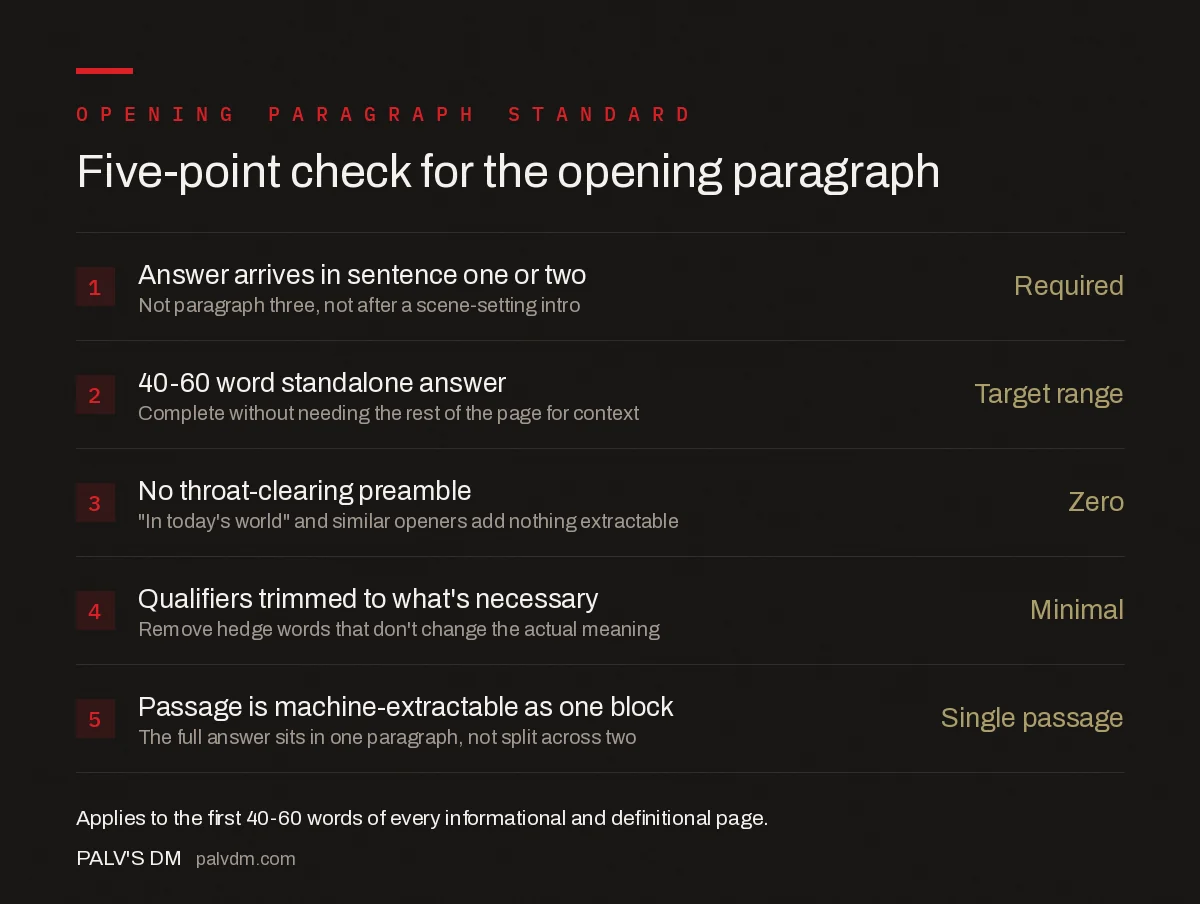
Five-point check for the opening paragraph
- Answer arrives in sentence one or two — Required. Not paragraph three, not after a scene-setting intro.
- 40-60 word standalone answer — Target range. Complete without needing the rest of the page for context.
- No throat-clearing preamble — Zero. “In today’s world,” “it’s important to note,” and similar openers add nothing extractable.
- Qualifiers trimmed to what’s necessary — Minimal. Remove hedge words that don’t change the actual meaning.
- Passage is machine-extractable as one block — Single passage. The full answer sits in one paragraph, not split across two.
Does this apply to every page, or just informational ones?
It applies most directly to informational and definitional queries, where a single clear answer exists and Google actively surfaces snippets and AI Overviews for that intent. Commercial and transactional pages benefit from the same discipline for a different reason: a visitor from a search result or an ad still decides in the first few seconds whether the page matches what they were looking for, and a slow, vague opening loses that visitor before the page has a chance to convert. The mechanism differs — one is about machine extraction, the other about human patience — but the fix is identical in both cases.
How does this interact with the rest of the page?
An answer-first opening doesn’t shrink the rest of the article; it changes what the rest of the article is for. Once the direct answer is delivered, the following sections carry the nuance, the exceptions, the “it depends” cases, and the supporting detail that a snippet or an AI Overview citation doesn’t have room for but a genuinely useful page needs. Pages that try to build suspense toward an answer instead of leading with it are optimising for a magazine-feature reading style that neither search crawlers nor time-pressed readers reward anymore. Getting the title and meta description right gets a reader to click; the first 100 words is what keeps them there and what gets the page quoted by AI systems downstream.
Frequently asked questions
Why does the first 100 words of a page matter for SEO?
It’s the section Google most often pulls from for featured snippets and AI Overview citations, and the section that decides whether a reader keeps scrolling or bounces back to the results page. A weak opening costs both machine extraction and human engagement at once.
How long should the answer be in the opening paragraph?
Roughly 40-60 words for a direct, standalone answer to the core query. Long enough to be complete without the rest of the page, short enough to fit cleanly inside a featured snippet or an AI Overview citation without needing to be trimmed.
Does Google have a minimum length for featured snippets?
No. Google’s own documentation states there is no fixed minimum length for a featured snippet, since the ideal length varies by query, language, and device. What matters more than word count is whether the passage stands alone as a complete, accurate answer.
Should the first paragraph restate the H1 or title?
It should answer the question the H1 poses, not just reword it. Restating the title without adding the answer wastes the highest-leverage sentence on the page; the opening line needs to contain the actual information a reader or an AI system is looking for.
Sources
- Featured Snippets and Your Website — Google Search Central
- AI Features and Your Website — Google Search Central
- On-Page SEO Checklist: The Complete Working List
- How to Optimise a Page for Multiple Related Keywords
- Content Readability: Writing for Scanning, Not Scoring
Want this done on your site?
Every PalV’s DM engagement starts with a free audit of your actual website — a 12-point
crawl covering what is blocking indexation, on-page gaps against your primary keywords, speed
findings, and the three to five fixes worth making first. Delivered in two working days. No
payment details, and the findings are yours whether you hire us or not.