Service Support — AI Visibility
How We Track Citations Across Five Engines Every Month
We track citations across ai engines every month using a fixed prompt set across ChatGPT, AI Overviews, Perplexity, Copilot, and Gemini. Here's the exact process.
We track citations across five AI engines — ChatGPT, Google AI Overviews, Perplexity, Microsoft Copilot, and Gemini — the same way every month, using a fixed prompt set, so we can tell a real gain from a random fluctuation. It’s a manual-plus-tooling process, not a single dashboard number, because no dashboard we’ve found tells you which page actually got cited and why. If you’re trying to track citations across AI engines for your own brand, the method below is exactly what we run for clients on retainer.
Key takeaway
- We track the same 10-30 prompts on ChatGPT, Google AI Overviews, Perplexity, Copilot, and Gemini every month — a fixed set is what makes month-over-month comparison mean anything.
- Presence isn’t enough. We log position in the answer, which exact page got cited, and whether a competitor showed up instead.
- Tracking without action is just record-keeping. Every lost citation or gap feeds straight into the next round of page work.
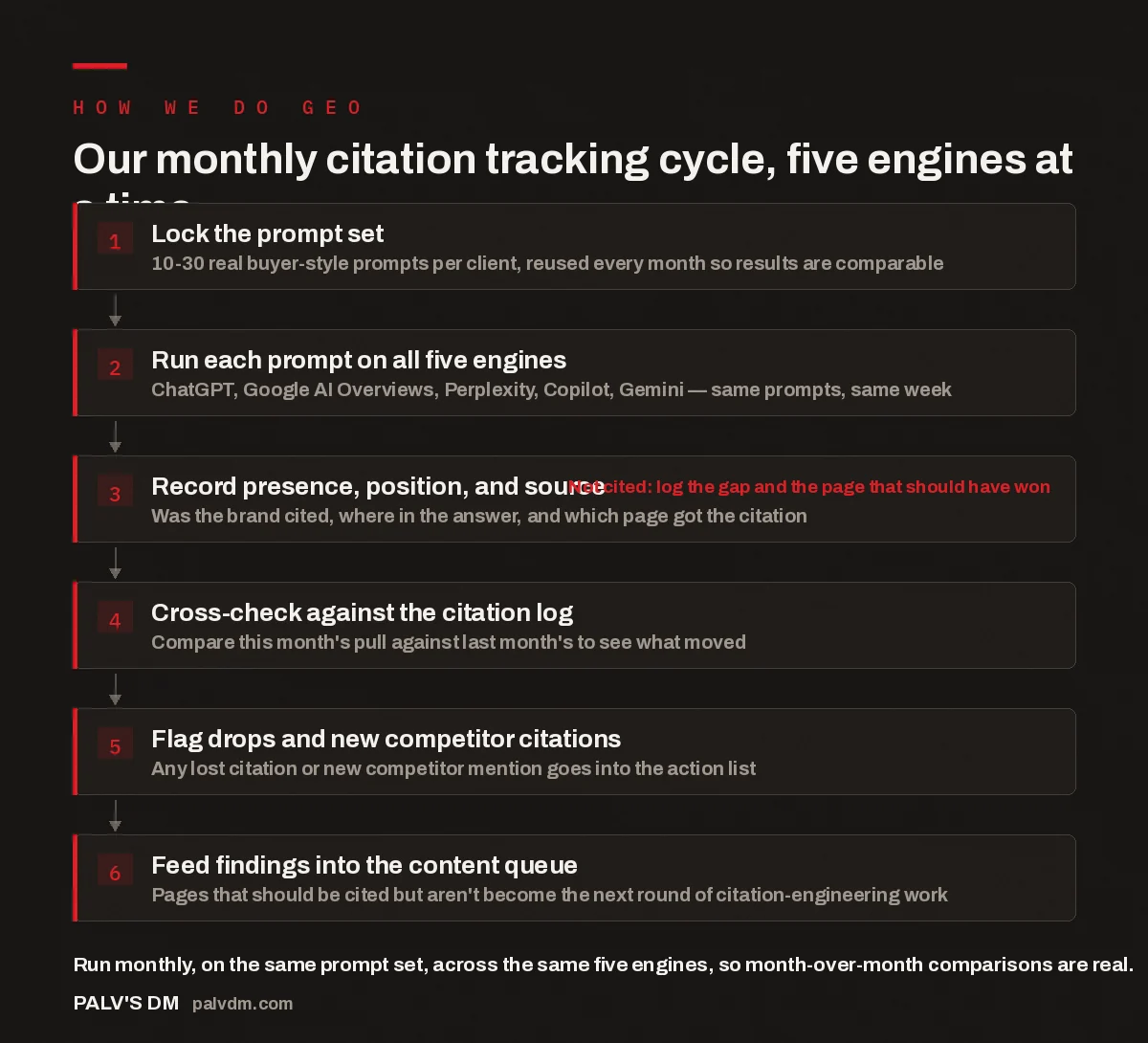
Our monthly citation tracking cycle, five engines at a time
- Lock the prompt set. 10-30 real buyer-style prompts per client, reused every month so results are comparable.
- Run each prompt on all five engines. ChatGPT, Google AI Overviews, Perplexity, Copilot, Gemini — same prompts, same week.
- Record presence, position, and source. Was the brand cited, where in the answer, and which page got the citation. Not cited: log the gap and the page that should have won
- Cross-check against the citation log. Compare this month’s pull against last month’s to see what moved.
- Flag drops and new competitor citations. Any lost citation or new competitor mention goes into the action list.
- Feed findings into the content queue. Pages that should be cited but aren’t become the next round of citation-engineering work.
Why Track Citations Across Five Engines Instead of Just One?
Because your buyers don’t ask only one assistant. In the accounts we work on, prospects mention using ChatGPT for one kind of question, Google’s AI Overviews for another (often without realising it’s a distinct surface from classic search), and a smaller but real slice reach for Perplexity or Copilot specifically because those tools show sources more visibly. Gemini shows up heavily for anyone already inside Google Workspace. If you only check one engine, you’re measuring one-fifth of the picture and drawing conclusions from it anyway.
The five engines also don’t behave the same way. ChatGPT leans on a mix of its training data and live browsing depending on the query type. Google AI Overviews draws heavily from pages that already rank well organically. Perplexity is the most citation-transparent of the five — it shows numbered sources inline, which makes it the easiest engine to audit precisely. Copilot inherits a lot of Bing’s index behaviour. Gemini pulls from Google’s index but summarises differently than AI Overviews does. Treating them as one undifferentiated “AI search” bucket hides which engine is actually worth the next round of optimisation effort.
How Do We Track Citations Across Five Engines Every Month?
The process below is the same six-step cycle shown in the graphic above, expanded with the detail that actually matters when you’re the one running it.
- Lock a fixed prompt set first. We build this during prompt research (not from scratch every month) and keep it stable at 10-30 prompts per client, phrased the way an actual prospect would type or speak them — not keyword-stuffed queries no one would ever ask an assistant.
- Run every prompt on all five engines, in the same week. Running them across a scattered timeframe defeats the point — engine outputs shift week to week, so a Tuesday result on ChatGPT and a Friday result on Perplexity aren’t a fair comparison.
- Log presence, position, and exact source URL — not just yes or no. Being cited third in a five-source answer is a different result from being the first name mentioned. And often the wrong page on your own site gets cited instead of the one you’d actually want a buyer to land on.
- Screenshot or export the raw answer. Engines change their outputs; a screenshot from this month is the only proof of what the answer actually said, and it’s what lets you show a client real before/after evidence instead of a summary they have to trust.
- Drop everything into the same citation log every month. One row per prompt per engine, tracked over time. This is the part most people skip, and it’s the part that turns five engines’ worth of scattered screenshots into an actual trend line.
- Compare against last month before doing anything else. New citation, lost citation, competitor citation, no change — each of those four outcomes tells you something different and points to a different next action.
What Do We Do When a Citation Disappears?
A lost citation isn’t automatically a problem to panic over, but it is always a prompt to look. First check whether the engine changed its answer format for that query type entirely — sometimes an engine stops citing sources for a whole category of question, and that’s not about your page at all. Second, check whether a competitor’s page now occupies the spot instead; if so, pull that page and compare it directly against yours for structure, directness of answer, and how recently it was updated. Third, check whether your own page changed — a redesign, a URL move, or content that got vaguer instead of more specific can quietly cost a citation.
The pattern that shows up repeatedly in the accounts we manage: citations are lost more often to a competitor publishing something more direct and better-structured than to any kind of algorithmic penalty. Engines cite whichever page answers the question with the least friction. That’s usually a content and structure fix, not a technical one.
Rank tracking told you where you stood once a day, on one engine. Citation tracking has to tell you where you stood on five, and it only means something if you check it the same way, on the same prompts, every single month.
Palash, Founder, PalV’s DM
Can You Automate Citation Tracking Across Five Engines?
Partially. There are tools that will run prompts against multiple engines and flag brand mentions, and we use automation to save time on the repetitive parts — firing the same prompt set across engines and pulling raw outputs. What doesn’t automate well yet is the judgment layer: deciding whether a citation is prominent or buried, whether the cited page is actually the one you want cited, and whether a competitor mention is a fluke or the start of a trend. Automated tools are good at telling you “cited: yes/no.” They’re much weaker at telling you why, and why is the part that decides what you do next.
Our own process behind this — how we structure the prompt list in the first place — is covered in detail in our prompt research process. And if you want to see what a completed month of this tracking actually looks like once it’s logged, that’s laid out in what a monthly AI citation log looks like.
Where Does Citation Tracking Fit Into a Broader AI Visibility Engagement?
Tracking on its own doesn’t move a single citation — it tells you where to point the work that does. Before we start tracking anything, we run a baseline check across the same five engines, which is what the AI visibility audit we run before anything else is for. From there, the monthly log feeds directly into page-level fixes — rewriting or restructuring the specific pages that should be winning a citation and aren’t. If you want the full picture of what sits around the tracking itself, month to month, what an AI visibility engagement actually involves walks through the rest of it.
The five engines will keep changing how they summarise, cite, and rank sources — that’s a given, not a risk to plan around defensively. What stays constant is the discipline of checking the same prompts, on the same engines, on the same schedule, and treating every lost or gained citation as a signal that needs a next action attached to it, not just a number that goes in a report.
Key takeaway
- Track citations across ai engines with one fixed prompt set, run on the same five engines, in the same week, every month.
- Log position and exact source page, not just whether you were mentioned — that’s what turns tracking into a to-do list.
- Want this run for your own brand instead of building the log yourself? That’s the day-to-day of our AI visibility work.
See how our AI visibility service tracks and fixes your citations
Which five AI engines do you track citations on?
ChatGPT, Google AI Overviews, Perplexity, Microsoft Copilot, and Gemini. We picked these five because they’re the ones our clients’ prospects actually mention using, not because they’re the only AI engines that exist. If a client’s audience skews toward a different tool, we adjust the set.
How many prompts should I track per engine?
We use 10-30 per client depending on how many distinct question types their buyers actually ask. Fewer than 10 and the sample is too thin to spot a real trend; much beyond 30 and the manual checking becomes unsustainable to run consistently every month, which defeats the purpose.
Do I need a paid tool to track citations across AI engines?
Not strictly. You can run the prompts manually across each engine’s free interface and log results in a spreadsheet — that’s a legitimate starting point. Paid tools mainly save time on the repetitive running-and-recording step; they don’t replace the judgment work of deciding what a lost or gained citation actually means.
How often should citation tracking run?
Monthly is the interval we’ve settled on for most clients. Engine outputs shift enough between visits that weekly checks mostly show noise rather than signal, while quarterly checks are too slow to catch a competitor overtaking a citation before real damage is done.
What’s the difference between citation tracking and rank tracking?
Rank tracking checks position on one search results page for one query. Citation tracking checks whether and how a brand is mentioned inside a generated AI answer, across several engines, for a whole set of buyer questions — position in the answer and source page matter more than a single ranking number.
Short version: pick five engines that match where your buyers actually ask questions, lock a prompt set, run it on the same schedule every month, log position and source rather than a simple yes/no, and turn every lost or gained citation into a specific next action on a specific page. That loop, repeated monthly, is what citation tracking actually is.