Service Support — AI Visibility
How Long Before AI Engines Start Citing You
How long to get cited by AI depends on your starting point: weeks for indexed sites fixing structure, months for new domains building topical history and trust.
There’s no fixed answer to how long to get cited by AI, because “citation” depends on where you’re starting from — but the honest range we see across client work is anywhere from two to three weeks for a well-indexed site that just needed technical and structural fixes, to three or four months for a new or thin domain that has to build topical history first. If someone promises you a guaranteed number of days, they’re selling something. What you can control is the list of variables that speed the process up, and that’s what actually determines your timeline.
Key takeaway
- There’s no universal timeline — an established, well-indexed domain with fixable structure can see a first citation in weeks; a new or thin domain is realistically a multi-month build.
- Crawler access and existing search indexing are prerequisites, not optional extras — AI engines mostly cite what they can already find and read.
- The fastest wins come from re-engineering pages you already have, not from publishing net-new content and waiting for it to age.
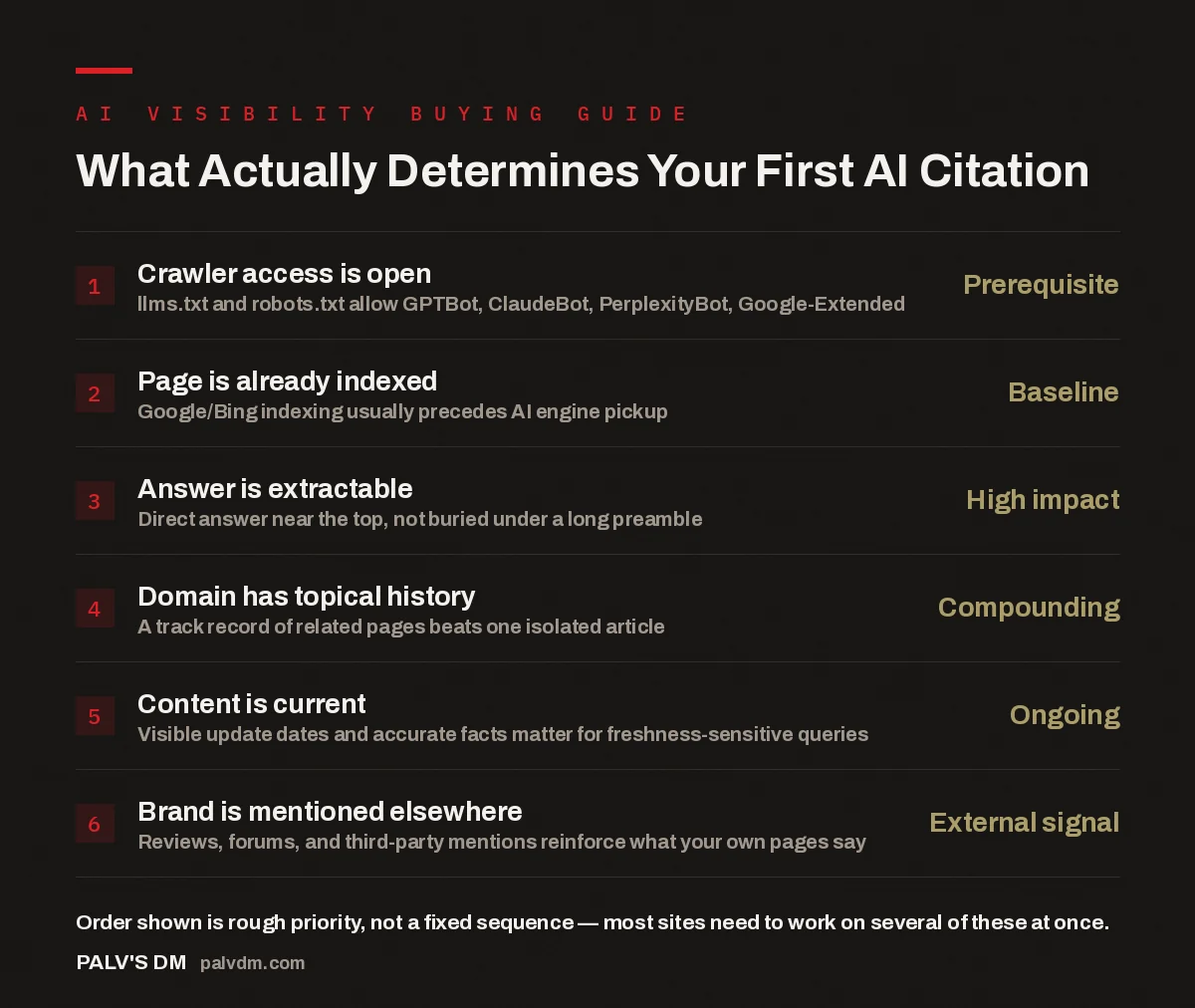
What Actually Determines Your First AI Citation
- Crawler access is open — Prerequisite. llms.txt and robots.txt allow GPTBot, ClaudeBot, PerplexityBot, Google-Extended.
- Page is already indexed — Baseline. Google/Bing indexing usually precedes AI engine pickup.
- Answer is extractable — High impact. Direct answer near the top, not buried under a long preamble.
- Domain has topical history — Compounding. A track record of related pages beats one isolated article.
- Content is current — Ongoing. Visible update dates and accurate facts matter for freshness-sensitive queries.
- Brand is mentioned elsewhere — External signal. Reviews, forums, and third-party mentions reinforce what your own pages say.
What does “getting cited” by an AI engine actually mean?
A citation is when an AI engine — ChatGPT, Perplexity, Google’s AI Overviews, Copilot, Gemini — pulls a fact, a definition, or a recommendation from your page and attributes it back to you, usually with a link or a named mention. That’s a different event from ranking on a search results page. You can rank on page one for a keyword and still never get cited, because the engine’s answer generation model chose a different source to quote, or decided your page didn’t contain a clean, extractable answer even though it covered the topic well.
This distinction matters for the timeline question specifically. Ranking improvements from a classic SEO campaign compound over months as backlinks and relevance signals accumulate. AI citation can move faster in some cases, because it doesn’t require you to out-rank ten competitors — it requires the model to judge your specific paragraph as the clearest available answer to a specific prompt. Fix the paragraph, and the citation can follow in the next crawl-and-retrain or retrieval cycle, not the next algorithm update.
What determines how fast an AI engine cites you?
Across the accounts we work on, the same handful of variables explain almost all of the timeline difference between a client who sees a citation in three weeks and one who takes three months.
- Crawler access. If GPTBot, ClaudeBot, PerplexityBot, or Google-Extended are blocked in robots.txt, or your llms.txt is missing or misconfigured, none of the rest matters. This is the single most common reason a site sees zero citations despite good content.
- Existing search indexation. AI engines that use retrieval (Perplexity, AI Overviews, Copilot’s web-grounded mode) lean heavily on what’s already indexed by traditional search. A page that isn’t indexed by Google is unlikely to show up as a citation source either.
- Answer extractability. Pages that state the direct answer in the first two or three sentences, then support it with detail, get pulled more often than pages that build up to the point after several paragraphs of context.
- Domain-level topical depth. A single well-written page on a domain with no other coverage of the topic is a weaker candidate than the same page sitting inside a cluster of related, internally linked content. Depth signals that the domain is a credible source on the subject, not a one-off.
- Off-site corroboration. Mentions, reviews, and citations of your brand elsewhere on the web give the model independent confirmation that what you’re saying on-page is accurate and worth repeating.
Of these, crawler access and indexation are binary gates — you either pass them or you don’t get considered at all. The other three are more like dials you can turn up gradually, which is why the honest answer to “how long” is “it depends which of these you’re missing.”
How long does it realistically take, by starting point?
Rather than quote a single number, it’s more useful to describe the pattern by starting condition, since that’s what we actually see repeat across engagements.
An established, well-indexed site with a technical or structural gap. If your domain already has authority and traffic, and the problem is that your pages simply aren’t structured to be quoted — no direct answers, blocked crawlers, no llms.txt — this is the fastest scenario to move. Once the fixes go live and the site gets re-crawled, we typically see the first new citations inside a few weeks, sometimes sooner on engines with shorter retrieval cycles like Perplexity.
A reasonably established site with thin or generic content. Here the technical gates are usually already open, but the content itself doesn’t give the model much to quote — vague claims, no specifics, nothing that reads as a confident, self-contained answer. This requires rewriting or replacing the underlying pages, then waiting for re-indexing and re-crawling. Realistically this is a matter of one to three months, since content has to be rewritten, published, indexed, and then picked up by each engine’s own retrieval or training cadence.
A new or low-authority domain. This is the slowest path, and it’s the one where over-promising does the most damage. A brand-new domain has no track record for a model to lean on, however well the individual pages are written. This is a multi-month build — usually three to six months of consistent publishing, internal linking, and off-site presence before citations become a repeatable pattern rather than a one-off.
A site that’s actively invisible everywhere. If a domain returns nothing across all major AI engines for its core topics, something structural is usually blocking discovery entirely — the kind of situation we walk through in more depth in what we do when a client is invisible in every AI engine. Fixing the blocker itself can happen fast; rebuilding a track record after that takes as long as the “new domain” scenario above.
Clients ask us for a date. We give them a starting-point diagnosis instead, because the honest answer to “when” is always “depends what’s broken first” — and we’d rather tell you that upfront than sell you a countdown we can’t actually control.
Palash, Founder, PalV’s DM
What slows this down more than it should?
The gap between “a few weeks” and “several months” is usually explained by one of these self-inflicted delays, not by the engines themselves being slow.
- Publishing new pages instead of fixing existing ones. A brand-new page has to earn indexation and trust from zero. An existing, already-indexed page that gets restructured keeps its history and can be re-evaluated much faster. We cover this trade-off in turning an existing blog archive into AI-citable assets.
- Treating llms.txt as optional. It isn’t a magic switch, but skipping it, or leaving robots.txt set to block AI crawlers by default, is one of the most common reasons a technically solid site sees no movement at all — see how we set up llms.txt and crawler access for clients.
- Rewriting content without checking if it’s a fit for GEO in the first place. Not every business needs the same level of urgency here — it’s worth reading do you need GEO yet: a straight answer by business type before assuming your timeline problem is a content problem.
- Not measuring at all. Without a consistent way to check whether citations are appearing, “how long is this taking” becomes a guess instead of a tracked number. We check before we start any structural work — see the AI visibility audit we run before anything else.
How do you know if it’s actually working?
You need a baseline before you can measure movement. Run a set of real prompts your buyers would actually type — not just your brand name — across the major engines, log whether you’re mentioned or cited, and repeat that on a fixed schedule. A single check tells you almost nothing; a monthly log is what actually shows the trend line, including the false starts and the engines that pick you up before others do. We run this as a standing process for clients and document exactly what the output looks like in what a monthly AI citation log looks like, and cover the mechanics of checking multiple engines consistently in how we track citations across five engines every month.
One practical note: different engines move at different speeds for the same fix. Perplexity and other engines with live web retrieval can reflect a change within days of re-crawling. Engines that rely more on periodic model updates can lag by weeks or longer, even after the underlying page is fixed. That’s not a flaw in your work — it’s a reason to track per-engine, not just “are we cited anywhere yet.”
Get a real starting-point diagnosis
If you want an honest timeline instead of a guessed one, we start with an audit of exactly which of the gates above your site is failing — crawler access, indexation, extractability, depth, or corroboration — and give you a plan based on your actual starting point.
How long does it take to get cited by ChatGPT specifically?
It depends on whether ChatGPT is using live web search for the query or drawing on its trained knowledge. For web-grounded answers, a fixed and re-crawled page can be picked up within weeks. For answers drawn from training data rather than live retrieval, changes can take much longer to reflect, since that depends on the model’s own update cycle rather than your site alone.
Can a brand-new website get cited by AI engines at all?
Yes, but it takes longer and needs more groundwork. A new domain has no topical history for a model to lean on, so the practical path is publishing a connected set of well-structured pages on the same subject, making sure crawler access is open from day one, and building some off-site presence, rather than expecting one strong article to get picked up in isolation.
Does ranking well in Google mean I’ll eventually get cited by AI engines too?
Ranking helps because it usually means you’re indexed and seen as relevant, which is a prerequisite for many AI engines’ retrieval. But ranking alone doesn’t guarantee citation — the model still has to judge your specific passage as the clearest available answer. Pages that rank well but bury the answer under a long introduction are a common example of ranking without citation.
Why did I get cited once and then disappear from that answer later?
Citations aren’t permanent placements. Engines re-run retrieval each time a prompt is asked, so a competitor’s page being updated, a new source appearing, or your own page going stale can all change the result. This is exactly why ongoing tracking matters more than a single celebratory screenshot of a citation.
Is it worth waiting for AI citations before doing anything else, or should I fix SEO first?
Don’t treat them as sequential. Indexation and crawlability, which SEO work already addresses, are prerequisites for most AI citation too, so the two efforts overlap heavily. Fixing basic SEO issues while also opening crawler access and restructuring key pages for extractability moves both goals at once instead of doubling your timeline.
Short version: there’s no single number for how long to get cited by AI. An established, well-indexed site fixing structural and technical gaps can see movement in a few weeks. A site rewriting thin content is looking at one to three months. A new or low-authority domain building a track record from scratch is a three-to-six-month project. The fastest way to find out which category you’re in is to check the gates — crawler access, indexation, extractability, depth, corroboration — rather than guess.