Service Support — AI Visibility
Standalone AI Visibility vs Bundled With SEO
Should you buy AI visibility with SEO as one bundled service or two separate contracts? A practical comparison of costs, overlap, and when standalone makes sense.
The short answer: bundle AI visibility with SEO unless your SEO is already strong, stable, and run by a team you trust — in that specific case, standalone AI visibility can work well as an add-on. AI visibility (GEO/AEO) and SEO draw on the same technical foundation, the same content, and much of the same authority signal, so running them as two disconnected engagements usually means paying twice for overlapping work — one crawl audit framed for Google, another framed for AI citations, two sets of content briefs written by two teams who never talk to each other. Getting ai visibility with SEO working as one system, rather than two competing projects, is the difference that shows up in both your invoice and your results.
Key takeaway
- AI visibility and SEO share technical audits, content production, and structured data — splitting them into separate contracts usually means duplicated work, not extra coverage.
- Standalone AI visibility makes sense mainly when your SEO is already handled well elsewhere and you just need the citation-tracking and answer-engine layer added on top.
- Bundling makes sense for most businesses still building out SEO, because one team owns the whole picture instead of two teams reporting different numbers for the same website.
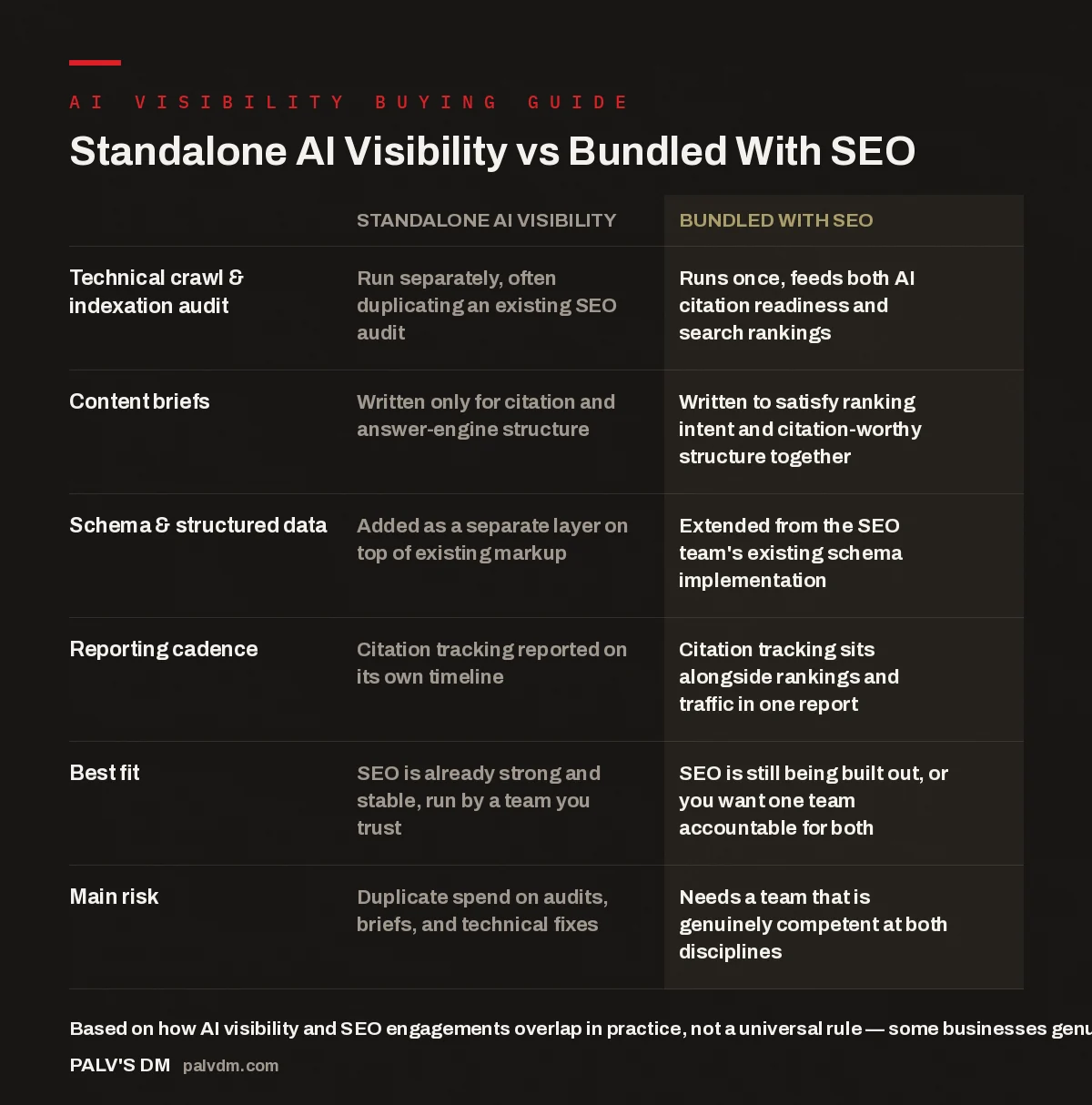
Standalone AI Visibility vs Bundled With SEO
| Standalone AI visibility | Bundled with SEO | |
|---|---|---|
| Technical crawl & indexation audit | Run separately, often duplicating an existing SEO audit | Runs once, feeds both AI citation readiness and search rankings |
| Content briefs | Written only for citation and answer-engine structure | Written to satisfy ranking intent and citation-worthy structure together |
| Schema & structured data | Added as a separate layer on top of existing markup | Extended from the SEO team’s existing schema implementation |
| Reporting cadence | Citation tracking reported on its own timeline | Citation tracking sits alongside rankings and traffic in one report |
| Best fit | SEO is already strong and stable, run by a team you trust | SEO is still being built out, or you want one team accountable for both |
| Main risk | Duplicate spend on audits, briefs, and technical fixes | Needs a team that is genuinely competent at both disciplines |
Why is this even a decision now?
Two years ago nobody asked this question, because “AI visibility” as a purchased service barely existed. Now that people search inside ChatGPT, Perplexity, Google’s AI Overviews, and other answer engines as part of their everyday research, agencies have rushed to package GEO/AEO as a line item — and plenty of them sell it as a completely separate product from SEO, with its own scope, its own retainer, and its own account manager. That’s understandable from a sales perspective: it’s a new thing, so it gets a new invoice. But it creates a real question for anyone buying the service — do you actually need two separate engagements, or one team doing one job that happens to show up in two places?
The honest answer depends on where your SEO currently stands. If you’ve already read our straight answer on whether you need GEO yet, you know the case for AI visibility work isn’t universal — it depends on your industry, your funnel, and how your buyers actually search. The bundling question sits one layer below that: once you’ve decided AI visibility is worth doing, should it be its own contract or an extension of the SEO work you’re already paying for?
What’s actually different between standalone and bundled AI visibility?
The technical work underneath both is close to identical. A crawl and indexation audit checks the same things whether you’re optimising for Googlebot or for the crawlers that feed ChatGPT and Perplexity: can the site be crawled cleanly, is content rendering without JavaScript blocking it, is there duplicate or thin content diluting authority, is the site architecture flat enough for anything to be found at all. Structured data — FAQ schema, Article schema, Organization schema — helps both disciplines read your content correctly. Content briefs that answer a question clearly, cite sources, and structure information in scannable, extractable chunks tend to perform well in both traditional rankings and AI citations, because both systems are ultimately trying to identify content that answers a question directly and credibly.
Where the two disciplines genuinely diverge is in measurement and a handful of specific tactics. SEO still cares about keyword rankings, organic traffic, and backlink profiles in a way AI visibility doesn’t directly. AI visibility work adds citation tracking across engines, llms.txt configuration, and content structuring aimed specifically at getting quoted rather than clicked. If you want the granular detail on what that second half looks like on its own, our breakdown of what an AI visibility engagement actually involves lays it out task by task. The point is that these differences sit on top of a shared foundation — they’re additions to the same work, not a parallel universe of unrelated deliverables. The prompt research and query-mapping work that decides what to target in the first place is itself part of that shared foundation, not a separate specialism bolted on afterward.
That shared foundation is exactly why running AI visibility standalone, alongside a separate SEO contract with a different agency, tends to produce friction. Two teams end up needing access to the same CMS, proposing changes to the same page templates, and sometimes disagreeing on priority — should this quarter’s dev time go to fixing a canonical tag issue for rankings, or to restructuring an FAQ page for citation extraction? When one team owns both goals, that’s a prioritisation call made once, with full context. When two teams own it separately, it’s a negotiation, and the client is usually the one stuck in the middle of it.
When does standalone AI visibility actually make sense?
Standalone AI visibility isn’t wrong in every case. It’s the right call in a fairly narrow set of situations:
- Your SEO is already strong. If an in-house team or an existing agency has your technical health, content programme, and rankings in good shape, adding AI visibility as a discrete workstream on top makes sense — there’s no foundational work to duplicate, just the citation-specific layer to add.
- You want to test one AI visibility specialist before committing further. Some businesses run a short, standalone AI visibility audit or pilot to see whether the opportunity is real for their category before folding it into a bigger contract. That’s a legitimate reason to keep it separate, at least at first — see the AI visibility audit we run before anything else for what that kind of starting point typically covers.
- Your existing SEO agency genuinely doesn’t do AI visibility work well. Some SEO agencies have bolted “GEO” onto their service list without building real capability behind it — no citation tracking, no engine-specific testing, just SEO work relabelled. If that’s what you’re facing, standalone with a specialist is better than bundled with someone faking the second half.
Outside those situations, standalone AI visibility tends to cost more for the same underlying work, because the technical and content foundation gets rebuilt or re-audited by a second team instead of extended by the first.
When does bundling make more sense?
For most businesses that haven’t already solved SEO, bundling is the more efficient path, for a few concrete reasons:
- One technical audit instead of two. The crawl, indexation, site speed, and structured-data audit that AI visibility work needs is the same audit SEO needs. Bundled, it happens once and feeds both.
- One content pipeline instead of two competing ones. Content briefs written to satisfy search intent and citation-worthy structure at the same time avoid the awkward situation of publishing near-duplicate pages — one “for Google,” one “for AI” — which itself creates a content-cannibalisation problem.
- One team accountable for the whole picture. When rankings dip and citations rise, or vice versa, you want one team that can explain why, not two teams each blaming the other’s changes.
- Budget efficiency. Paying for one technical foundation and one content operation that serves two visibility channels is close to always cheaper than paying for two of each.
The caveat is real, though: bundling only works if the agency is genuinely competent at both disciplines, not just SEO with an AI visibility label stapled on. If a prospective agency can’t clearly describe how they track citations across engines, or explain the research behind what they choose to optimise for, that’s a sign the “bundle” is really just SEO wearing a new coat.
What does a bundled AI visibility and SEO engagement look like in practice?
In a properly bundled engagement, the work doesn’t split into “SEO days” and “AI visibility days” — it’s planned as one roadmap with two measurement layers on top. The technical audit runs once and produces a single prioritised fix list, tagged by which fixes matter for crawlability generally, which matter specifically for AI crawler access (robots directives, llms.txt, rendering), and which overlap both. Content briefs are written once per topic, structured to answer the target question directly and completely — because that structure is what both a ranking algorithm and a citation-selecting AI model are looking for — rather than being split into a “ranking version” and a “citation version” of the same page.
Reporting is where the bundle earns its keep most visibly. Instead of a monthly rank-tracking report from one vendor and a separate citation-tracking spreadsheet from another, a bundled engagement reports both in the same document, on the same cadence, against the same set of target topics — a combined citation log sitting naturally next to a standard SEO rank report rather than replacing it.
Clients rarely ask us to bundle SEO and AI visibility because they read a case for it somewhere. They ask because they tried running both separately for six months, watched two agencies argue over the same page template, and decided that was a worse use of their time than just picking one team and holding it accountable for the whole result.
Palash, Founder, PalV’s DM
What should you ask an agency before you decide?
Whichever way you lean, a short set of questions will tell you whether the agency in front of you actually deserves either contract. Ask how they’d structure the technical audit — is it one audit serving both goals, or will you be paying for a second one that mostly repeats the first? Ask what specifically changes in a content brief when it’s written for AI citation versus ranking alone, and listen for a real answer rather than a vague “we optimise for both.” Ask how they track citations — which engines, how often, and what they do with a page that’s ranking well but never getting cited, a gap covered in more detail in what GEO cannot do for you, which is worth reading before you commit to either model so your expectations are set correctly from the start. An agency that can answer all three clearly, with specifics rather than buzzwords, is one worth trusting with either a standalone or a bundled contract. One that can’t is a reason to keep looking, regardless of which structure they’re pitching you.
Where to start
If your SEO is still a work in progress, a bundled AI visibility and SEO engagement will almost always get you further for the same budget than running two separate contracts. If you’re not sure which camp you’re in, an audit is the fastest way to find out.
Is AI visibility just SEO with a new name?
No, though it shares most of its foundation with SEO. AI visibility adds citation tracking across engines like ChatGPT and Perplexity, content structuring aimed at getting quoted directly rather than clicked, and crawler-access configuration such as llms.txt. The technical and content groundwork underneath both is largely the same work, which is exactly why bundling the two is usually more efficient than treating them as separate services.
Can I add AI visibility to an SEO contract I already have?
Usually yes, if your existing SEO agency has genuine AI visibility capability — citation tracking, engine-specific testing, and experience with content built for extraction, not just ranking. If they don’t, you’re choosing between asking them to build that capability, or bringing in a specialist standalone. Ask to see how they’d track citations before assuming they can simply extend the existing scope.
Does bundling AI visibility with SEO cost more than SEO alone?
It typically costs more than SEO alone, since it’s genuinely additional scope — citation tracking, engine testing, and extra content structuring work. But it usually costs less than paying for standalone SEO and standalone AI visibility as two separate contracts, because the technical audit and core content production only happen once instead of twice.
What’s the risk of keeping AI visibility and SEO as two separate agencies?
The main risks are duplicated spend on overlapping audits and content, conflicting priorities when both teams want dev time on the same page templates, and reporting that never quite reconciles because each agency measures success differently. None of these are fatal, but they add friction and slow decisions that a single accountable team could make faster.
How do I know if my current SEO is strong enough to add standalone AI visibility?
Look at whether your technical health is stable (no recurring crawl or indexation issues), your content programme is consistent rather than sporadic, and your rankings for priority terms have held or improved over the last several months. If all three are true, a standalone AI visibility layer on top is a reasonable next step rather than a duplication of unfinished work.