Service Support — AI Visibility
What a Monthly AI Citation Log Looks Like
See what a real AI citation tracking report includes: engine-by-engine status, tested prompts, competitor citations, monthly deltas, and a prioritised action list.
An AI citation tracking report is a monthly document showing which of your pages got pulled into answers on ChatGPT, Perplexity, Gemini, Copilot, and Google AI Overviews, against which prompts, compared to your competitors, and what changed since last month. It is not a rank-tracker screenshot with “AI” added to the title. If the report you’re getting doesn’t show engine-by-engine status, the actual prompts tested, and month-over-month movement, it’s not doing the job.
Key takeaway
- A real AI citation tracking report checks five engines separately, not one composite score — a page can be cited on Perplexity and invisible on Gemini in the same week.
- The report should name the exact prompts tested and show competitor citations on those same prompts, not just your own visibility in isolation.
- Month-over-month deltas matter more than any single snapshot — citation presence in AI engines shifts week to week as answers get regenerated.
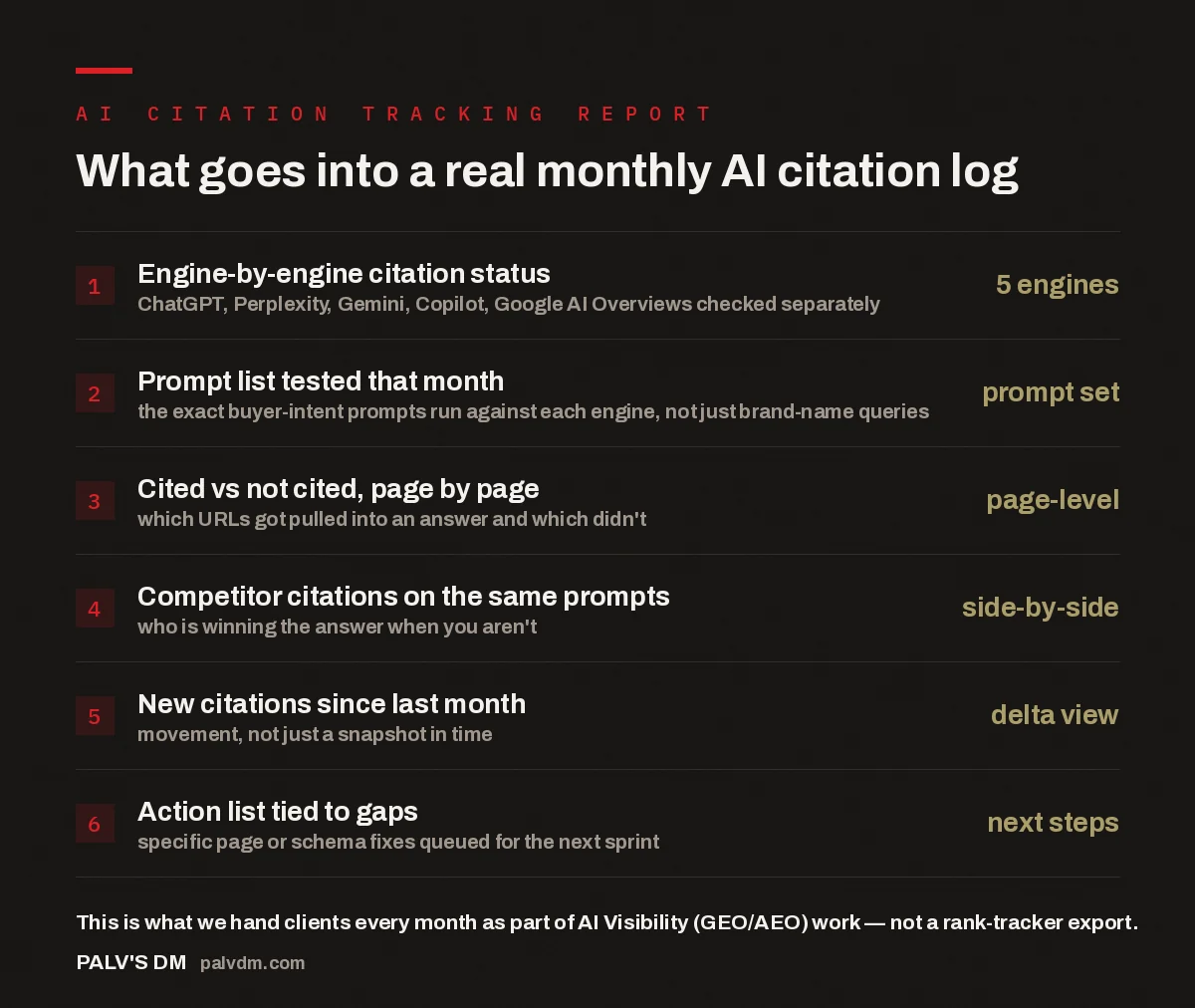
What goes into a real monthly AI citation log
- Engine-by-engine citation status — 5 engines. ChatGPT, Perplexity, Gemini, Copilot, Google AI Overviews checked separately.
- Prompt list tested that month — prompt set. the exact buyer-intent prompts run against each engine, not just brand-name queries.
- Cited vs not cited, page by page — page-level. which URLs got pulled into an answer and which didn’t.
- Competitor citations on the same prompts — side-by-side. who is winning the answer when you aren’t.
- New citations since last month — delta view. movement, not just a snapshot in time.
- Action list tied to gaps — next steps. specific page or schema fixes queued for the next sprint.
Why does an AI citation tracking report need to be per-engine, not one combined score?
Because the engines don’t behave the same way, and a blended “visibility score” hides exactly the information you’re paying for. Perplexity leans heavily on recent, well-sourced pages and tends to cite generously. Google AI Overviews draws from a narrower, more SEO-adjacent pool and is stingier about which domains it surfaces. ChatGPT’s browsing behaviour and Gemini’s grounding in Google’s index each pull from different signals again. A page can sit comfortably inside three of these answer engines and be completely absent from a fourth — and that fourth one might be the one your buyers actually use.
A single combined score averages this out and buries the gap. If your report says “AI visibility: 62%” with no breakdown, ask what that number is made of. The useful version lists each engine as its own row, with its own citation count, so you can see that you’re strong on Perplexity and invisible on Copilot — a pattern that shows up often enough in the accounts we work on that it’s become the first thing we check, not an edge case.
This is also why the reporting cadence matters as much as the reporting depth. AI engines regenerate answers frequently as they re-crawl and re-rank sources, so a citation snapshot from six weeks ago tells you very little about this week’s reality. Monthly is the shortest interval that gives you a stable enough sample to separate a real trend from noise, without drowning the client in constant micro-updates that don’t change any decision.
What prompts should actually be tracked each month?
The prompts that matter are the ones a real buyer would type when they’re close to a decision, not the ones that flatter your brand. “Best [category] for [use case],” “[Competitor] vs [you],” “how to choose a [service type],” and problem-framed questions your ideal customer would ask before they know your company name. Brand-name prompts like “tell me about [your company]” are worth checking occasionally, but they’re the easiest ones to win and the least useful signal — anyone can get cited when the prompt already contains their name.
A citation report that only tracks five or six branded prompts is optimising for a vanity metric. The report should show the non-branded, commercial-intent prompt set your prospects use before they’ve decided who to buy from — the same prompts your prompt research process should have identified during onboarding, before any tracking began. If the prompt list in your report hasn’t changed in three months, that’s a sign the tracking has gone stale, not that nothing has changed in your category.
How does competitor citation data change what you do with the report?
Competitor citation data turns a citation log from a status update into a work order. Seeing that you’re absent from an answer is useful. Seeing that a specific competitor is present on that exact prompt, with a specific page, tells you what to build or fix to close the gap — often a page structured more clearly for extraction, a stronger comparison table, or schema markup the competitor has and you don’t.
Without competitor rows, “not cited” is a dead end. With them, “not cited, and Competitor X is cited with their pricing page on this exact prompt” is a next step. This is the difference between a tracking tool export and an actual monthly report — the tool gives you the first version, an analyst gives you the second by reading the citations, not just counting them.
The single biggest tell that a client hasn’t seen a real AI citation report before is that they’re surprised the same page can be cited by one engine and completely ignored by another in the same week. Once you show them the engine-by-engine breakdown, the whole “are we visible in AI search” question stops being one number and starts being a list of specific, fixable gaps.
Palash, Founder, PalV’s DM
What should the month-over-month delta section actually show?
The delta section should isolate what’s genuinely new: pages cited this month that weren’t cited last month, pages that dropped out, and prompts where the competitive picture flipped. This is where the report earns its keep, because a static list of “currently cited pages” tells you where you stand but not whether the work is compounding. If the same three pages have been cited every month for six months with nothing new added, that’s a plateau worth flagging even if the raw citation count looks fine.
Directionally, the pattern we see is that new citations tend to cluster around content that was recently restructured for extraction — clearer headings, a direct answer near the top, a defined term stated plainly — rather than content that was simply left alone and re-crawled. The delta section is what makes that pattern visible to a client instead of asserted to them.
What does the action list at the end of the report need to contain?
The action list is where a citation report either turns into work or turns into a PDF nobody opens again. Each item should name a specific page, a specific gap (“not cited on the ‘vs’ prompts where Competitor Y is cited”), and a specific fix — restructure the intro, add a comparison table, add or correct schema, publish a page that doesn’t exist yet. Vague action items like “improve AI visibility” or “continue monitoring” mean the report wasn’t actually analysed, it was generated and forwarded.
- Named page, named gap, named fix — not a general recommendation, a queued task with an owner.
- Tied to next month’s report — so the following month’s delta section can show whether the fix worked.
- Prioritised by prompt commercial intent — a gap on a bottom-funnel comparison prompt outranks a gap on a general definition prompt.
That loop — report, action, next report showing the result of the action — is what separates AI visibility work from AI visibility monitoring. A monitoring tool will tell you the number went up or down. It won’t tell you whether it went up because of something you did.
Where this fits
- This monthly log is one deliverable inside a broader AI Visibility engagement — it’s the record of what’s changing, not the whole scope of work.
- If you’re not seeing engine-by-engine data, named prompts, or competitor rows in what you get today, that’s worth raising with whoever runs your reporting.
Frequently asked questions about AI citation tracking reports
How is an AI citation tracking report different from a normal SEO rank-tracking report?
A rank-tracking report shows where a page sits in Google’s organic results for a keyword. An AI citation tracking report shows whether that page was pulled into a generated answer on engines like ChatGPT or Perplexity, for a specific prompt — a binary cited-or-not outcome, not a position number, and it needs to be checked separately per engine.
How many prompts should a monthly citation report track?
Enough to cover your core buyer-intent questions without diluting focus — typically a set built during onboarding and expanded gradually as new commercial angles emerge. What matters more than the exact count is that the prompts represent real pre-purchase questions, not just branded searches.
Can I get this kind of report from a free AI visibility tool?
Most free and low-cost tools give you a citation count or a composite score, which is a starting point but not a working report. The parts that make it actionable — competitor citations on the same prompt, a delta section, and a prioritised action list — usually require someone reading the results, not just running the query.
Should the report include Google AI Overviews or just chatbot engines like ChatGPT?
It should include Google AI Overviews. It’s a distinct surface with its own citation behaviour, and for most businesses it carries meaningful search volume alongside the standalone chatbot engines. Leaving it out of the report understates total AI-driven visibility, since it often behaves differently from ChatGPT or Perplexity on the same prompt.
What if a page was cited last month but isn’t this month?
That’s exactly what the delta section exists to catch. It usually means the engine re-crawled and something shifted — a competitor published a stronger comparison page, the source content changed, or the answer was regenerated with a different source pool. It’s a prompt for investigation, not a reason to panic about a single month’s number.
Short version: a monthly AI citation tracking report worth reading breaks visibility down by engine, names the actual prompts tested, shows where competitors are winning the same answers, tracks what changed since last month, and ends with a specific action list — not a single score. If your current report is missing more than one of those, you’re looking at a tracking export, not an AI visibility report. Our five-engine citation tracking process and prompt research process are the two pieces that feed directly into the log described here, and if you’re deciding whether this belongs alongside your existing SEO retainer, standalone vs bundled AI visibility covers how that decision usually plays out. For a look at what’s involved before the first report ever goes out, see what an AI visibility engagement actually involves.