Service Support — AI Visibility
What GEO Cannot Do For You
GEO limitations to know before you sign: it can't fix a bad product, guarantee a citation, or replace a broken sales process. Here's the honest boundary.

GEO limitations are real, and any agency that skips past them in the pitch is setting you up for a bad renewal conversation. Generative engine optimisation can get your brand named, quoted, and linked inside AI answers — but it cannot fix a weak product, force a specific citation on demand, replace a broken sales funnel, or turn thin content into something worth citing. It is a visibility layer on top of what already exists, not a substitute for the business decisions underneath it. Knowing where that layer stops is the difference between a GEO engagement that compounds and one that quietly gets cancelled after two quarters.
Key takeaway
- GEO influences whether AI engines cite your content — it has no control over your product quality, pricing, or conversion path once someone clicks through.
- No agency, including this one, can promise a citation in a specific answer on a specific date — engines choose sources per query, and that choice shifts.
- GEO needs crawlable, factual, substantive content to work with; it cannot manufacture authority for a site that has none.
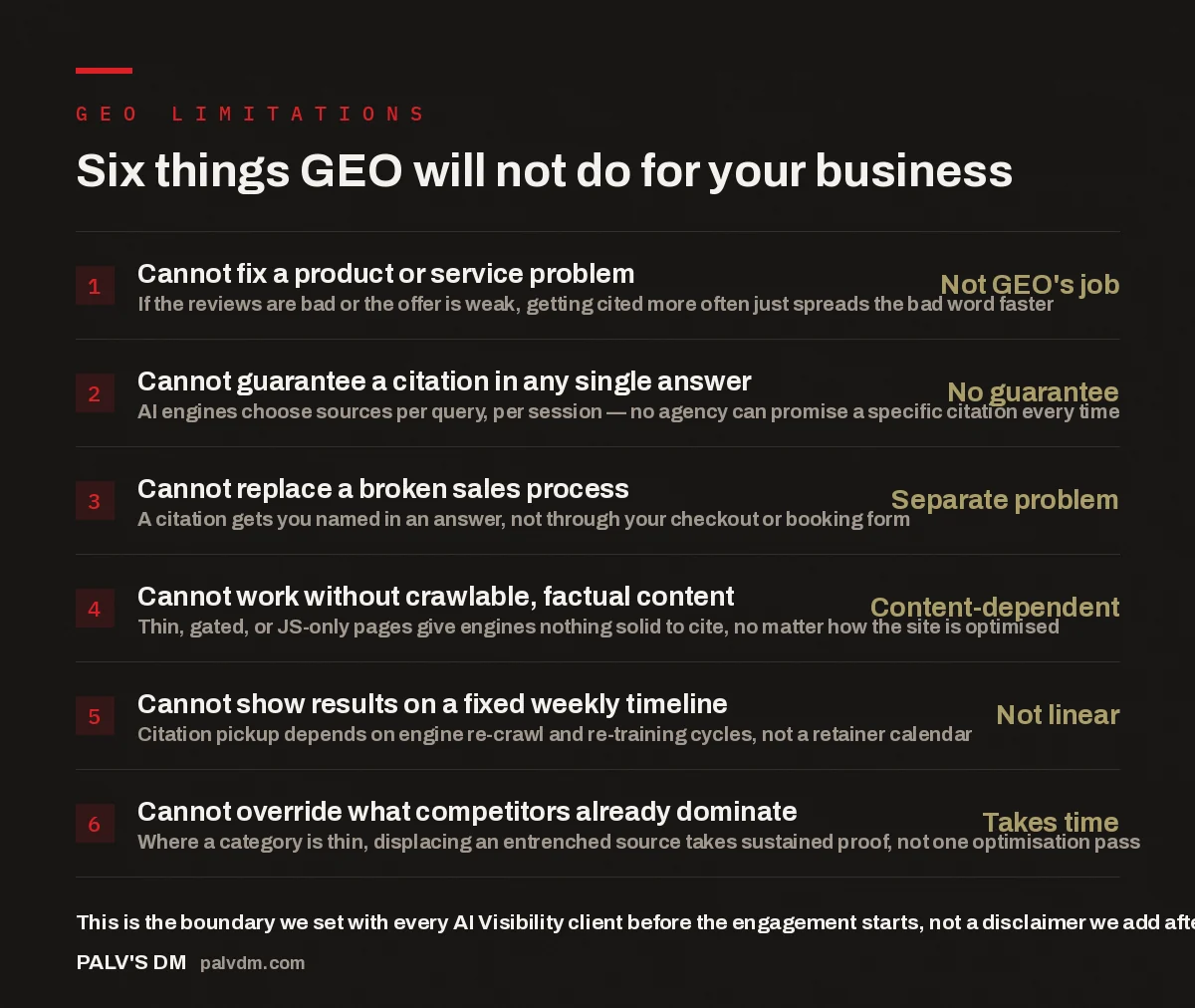
Six things GEO will not do for your business
- Cannot fix a product or service problem — Not GEO’s job. If the reviews are bad or the offer is weak, getting cited more often just spreads the bad word faster.
- Cannot guarantee a citation in any single answer — No guarantee. AI engines choose sources per query, per session — no agency can promise a specific citation every time.
- Cannot replace a broken sales process — Separate problem. A citation gets you named in an answer, not through your checkout or booking form.
- Cannot work without crawlable, factual content — Content-dependent. Thin, gated, or JS-only pages give engines nothing solid to cite, no matter how the site is optimised.
- Cannot show results on a fixed weekly timeline — Not linear. Citation pickup depends on engine re-crawl and re-training cycles, not a retainer calendar.
- Cannot override what competitors already dominate — Takes time. Where a category is thin, displacing an entrenched source takes sustained proof, not one optimisation pass.
What can GEO actually do, and where does it stop?
GEO — generative engine optimisation — is the set of technical and content practices that make a page easier for AI systems like ChatGPT, Perplexity, Google’s AI Overviews, and Copilot to find, parse, and quote. That covers structuring content so a specific claim is extractable in one paragraph, making sure crawlers can actually reach the page, publishing the kind of first-hand detail that gives an engine a reason to cite you over a generic competitor, and monitoring which prompts already surface your brand. All of that is work an agency controls. What happens after someone reads that citation and decides whether to trust, click, or buy from you is not.
| Inside GEO’s control | Outside GEO’s control |
|---|---|
| Structuring pages so claims are quotable | Whether the claim itself is any good |
| Fixing crawler access and technical readability | What happens after the click-through |
| Publishing first-hand detail engines can cite | Which exact answer an engine chooses to show, and when |
| Tracking citations across engines monthly | How fast a given engine re-crawls or retrains |
Most of the disappointment we see with GEO engagements traces back to that right-hand column being sold as if it belonged on the left. If you are still weighing whether your business needs this kind of work at all, a straight answer by business type is a better starting point than a generic pitch deck.
Can GEO fix a bad product or a weak offer?
The claim: get cited more often and the business problem sorts itself out, because more people will hear about you. The reality: an AI answer that names your brand next to a mediocre product does not make the product better — it just puts the product in front of more people who will notice it is mediocre. Citation is a distribution mechanism, not a quality filter, and in the accounts we have worked on, a spike in AI-driven mentions for a weak offer tends to surface the weakness faster, not slower, because AI answers often synthesise review sentiment alongside the brand name. If the underlying reviews, pricing, or delivery experience are the actual problem, GEO work sits downstream of that and cannot substitute for fixing it.
Can GEO guarantee a citation in a specific AI answer?
The claim: pay for GEO and you will be cited when a prospect asks ChatGPT or Perplexity about your category. The reality: no one outside the model provider controls which source an engine selects for a given query, on a given day, for a given user. Engines re-rank sources, blend multiple pages into one answer, occasionally skip citation entirely, and change behaviour after model updates that nobody outside the provider announces in advance. What GEO work can influence is the probability that your page is in the eligible pool a model can draw from — structured clearly enough, factual enough, and current enough to be a plausible source. Probability is not a guarantee, and any agency promising a specific citation on a specific date is selling something it does not control.
We tell every AI Visibility client the same thing in the first call: we can make your site the kind of source an engine would want to cite. We cannot make the engine cite it on your schedule. Anyone who promises otherwise hasn’t actually run this work.
Palash, Founder, PalV’s DM
Can GEO replace a broken sales or booking process?
The claim: more AI citations mean more revenue, full stop. The reality: a citation earns you a mention in someone’s research phase. What that person does next — whether they can find your pricing, book a call without friction, or trust your checkout — is entirely a function of your own site and sales process, not the citation that brought them there. We have seen accounts where AI-referred traffic climbed steadily while conversion stayed flat, because the citation was doing its job and the landing page or booking flow was not. Treating GEO as a growth lever without auditing what happens after the click is the fastest way to conclude, wrongly, that GEO “doesn’t work.”
Can GEO work without solid content to begin with?
The claim: technical GEO tweaks alone can get a thin site cited. The reality: AI engines cite pages that answer a question with specific, verifiable detail — a named process, a real number, a first-hand example. A page that is three paragraphs of generic marketing language gives an engine nothing worth quoting over a competitor’s page that actually answers the question. Gated content, JavaScript-rendered pages a crawler cannot parse, and duplicated boilerplate across a site all create the same outcome: nothing citable. This is why the first stage of any real GEO engagement is a content and access audit before any optimisation begins, not after — you can read what an AI Visibility engagement actually involves for the full sequence.
Does GEO produce results on a fixed weekly or monthly timeline?
The claim: pay for a GEO retainer and citations show up within a set number of weeks, the way a paid ad campaign delivers impressions the day it goes live. The reality: citation pickup depends on when an engine next crawls your pages and, for some engines, when a model is next retrained or fine-tuned — neither of which runs on a marketing retainer’s schedule. Some pages get picked up within weeks of a fix; others take longer because the engine’s crawl cadence for that domain is slower, or because the query space is more competitive. If you want a grounded sense of what “fast” actually looks like, how long before AI engines start citing you walks through the realistic range instead of a single made-up number.
Can GEO push out a competitor that already dominates a topic?
The claim: one round of optimisation displaces whichever source an engine currently favours for your category’s core questions. The reality: if a competitor, a review site, or an established publisher has been the default cited source for a query cluster for a long time, an engine has effectively learned to trust that source. Unseating it takes sustained, demonstrably better content and technical signal over time — not a single content sprint. This is closer to how organic SEO has always worked against an entrenched incumbent than it is to a quick technical fix, and it is worth setting that expectation before the engagement starts rather than after the first report.
So what should you actually expect from a GEO engagement?
Expect a partner that fixes what is genuinely fixable — crawlability, content structure, factual depth, and consistent monitoring across engines — and is upfront about what sits outside that scope. Expect citation tracking that shows movement over months, not a weekly scoreboard. Expect a conversation about whether GEO should run standalone or alongside your existing SEO work, since standalone AI visibility vs bundled with SEO changes both the cost and the pace of results. And expect the agency to say “that’s not something GEO controls” when the honest answer is no — because an agency that never says that is either not doing the work or not telling you the truth about it.
Where to start
If you want a clear-eyed view of what AI Visibility work can and cannot do for your specific site before you commit to anything, start with an audit rather than a pitch.
Is GEO a replacement for SEO?
No. GEO targets how AI engines select and cite sources, which overlaps with SEO fundamentals like crawlability and content quality but is not the same discipline as ranking in traditional search results. Most sites need both, run either bundled or as separate workstreams depending on budget and priority.
Why can’t an agency guarantee AI citations?
Because the model provider, not the agency or the site owner, decides which sources an engine cites for a given query. GEO work can make a page a stronger candidate to be cited, but it has no access to the ranking or selection logic inside ChatGPT, Perplexity, or Google’s AI systems.
What GEO limitations should I ask about before signing a contract?
Ask specifically what the agency guarantees versus what it will “work toward.” Ask how citation tracking is measured and reported. Ask whether the scope includes fixing crawlability and content gaps, or assumes your site is already citable. Vague answers to any of these are a signal to keep looking.
Can GEO help a site with almost no existing content?
GEO can guide what to build, but it cannot manufacture citable authority out of nothing — the content still has to be written, published, and made factually specific before there is anything for an engine to cite. A thin site needs a content build-out as part of the engagement, not instead of it.
Does GEO stop mattering once you get your first citation?
No. Citations shift as engines re-crawl, retrain, and change which sources they favour, so a page cited today can drop out of an answer months later if a competitor publishes something more current or specific. Ongoing monitoring and refreshes are part of the work, not a one-time project.
Short version: GEO can make your content easier for AI engines to find, parse, and cite. It cannot fix your product, guarantee a specific citation, replace your sales process, work without real content to draw from, run on a fixed weekly schedule, or instantly dislodge an entrenched competitor. Knowing that boundary before you sign is what makes the engagement that follows actually work.