Service Support — AI Visibility
Turning an Existing Blog Archive Into AI-Citable Assets
Learn how to optimize existing content for AI citation: rewrite old blog posts to answer first, fix schema and authorship, and merge thin duplicates now.

You optimize existing content for AI citation by rewriting it to answer a narrow question in the first few sentences, breaking dense paragraphs into facts an engine can quote out of context, fixing the structured data and author signals older posts usually lack, and consolidating thin duplicate posts into one page worth citing. You rarely need new content to start getting cited — you need the archive you already have rewritten so an AI engine can actually lift something from it. Most blogs built for 2018-era Google were written to rank, not to be quoted, and those are two different skills.
Key takeaway
- An archive doesn’t need a rewrite of every post — it needs the posts that already have topical authority rewritten so their best facts are extractable in one pass, not buried in paragraph four.
- The single biggest blocker we find in old archives isn’t thin content, it’s answer-last content: the useful sentence exists, it’s just three paragraphs after the scene-setting intro an engine will never read that far into.
- Retrofitting works alongside consolidation — three shallow posts competing for the same topic usually need merging into one citable page more than they need individual polish.
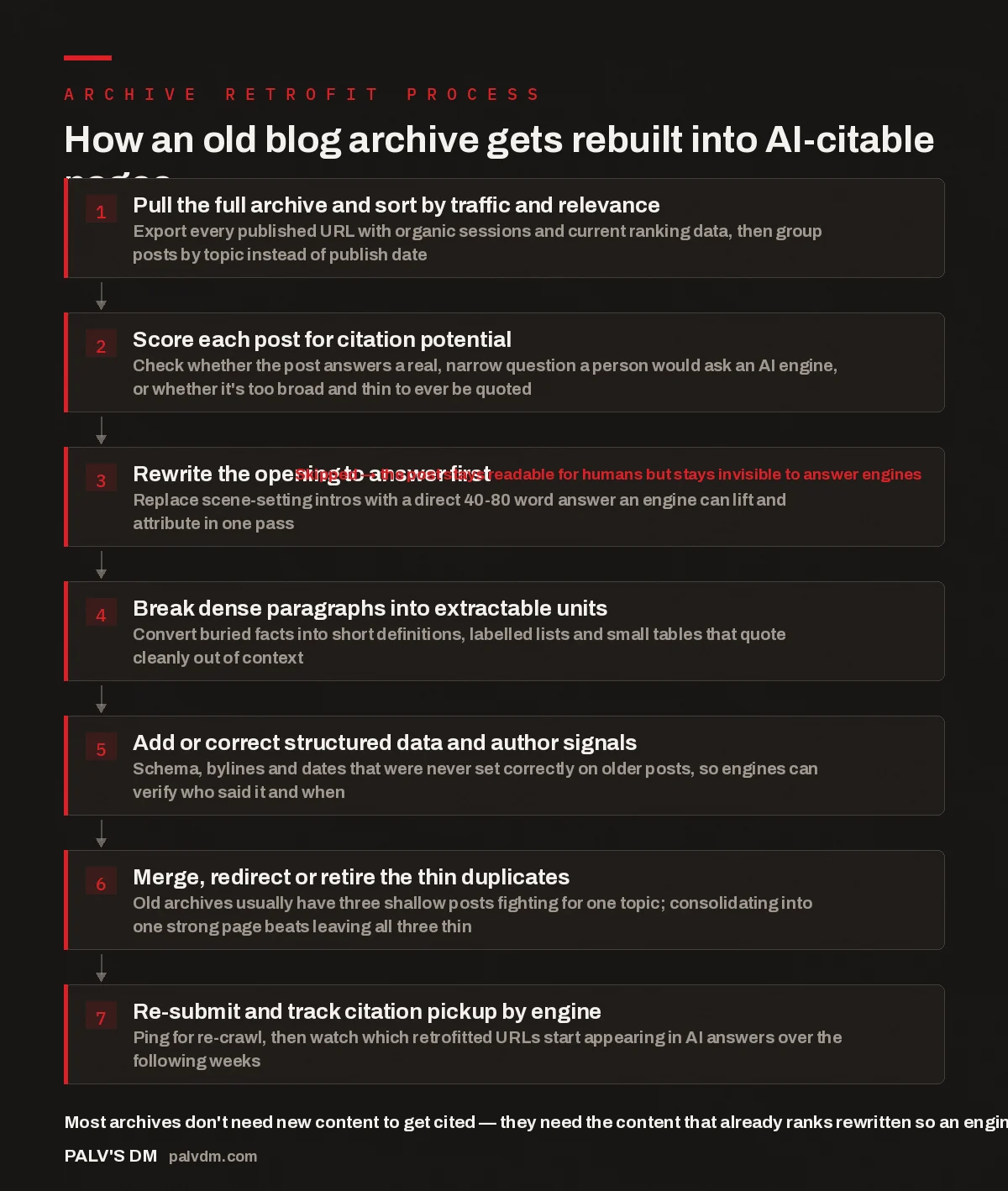
How an old blog archive gets rebuilt into AI-citable pages
- Pull the full archive and sort by traffic and relevance. Export every published URL with organic sessions and current ranking data, then group posts by topic instead of publish date.
- Score each post for citation potential. Check whether the post answers a real, narrow question a person would ask an AI engine, or whether it’s too broad and thin to ever be quoted.
- Rewrite the opening to answer first. Replace scene-setting intros with a direct 40-80 word answer an engine can lift and attribute in one pass. Skipped → the post stays readable for humans but stays invisible to answer engines
- Break dense paragraphs into extractable units. Convert buried facts into short definitions, labelled lists and small tables that quote cleanly out of context.
- Add or correct structured data and author signals. Schema, bylines and dates that were never set correctly on older posts, so engines can verify who said it and when.
- Merge, redirect or retire the thin duplicates. Old archives usually have three shallow posts fighting for one topic; consolidating into one strong page beats leaving all three thin.
- Re-submit and track citation pickup by engine. Ping for re-crawl, then watch which retrofitted URLs start appearing in AI answers over the following weeks.
Why doesn’t ranking well already mean an AI engine will cite you?
Because ranking and citing are scored differently. A page can rank on page one for years by being comprehensive, keyword-relevant, and well-linked — none of which requires the actual useful sentence to appear early or cleanly. An AI engine generating an answer isn’t ranking your page against ten competitors and letting a human scroll through it; it’s pulling a specific chunk of text that answers the query and deciding whether that chunk is trustworthy and extractable enough to quote or paraphrase with attribution. A 2,400-word post that ranks well because it’s thorough can still fail that test if its actual answer is on line 40, wrapped in three qualifying clauses, with no clear author or date attached to it. That’s the gap retrofitting closes: you’re not making the content more comprehensive, you’re making the parts that already answer the question easier for a machine to find and trust.
This is also why archive retrofitting tends to outperform writing net-new content when a site already has years of published posts. The topical authority is already there — Google has already decided these pages are relevant enough to rank. What’s usually missing is the structural work that makes a page legible to something summarizing it rather than someone reading it top to bottom.
How do you decide which posts in an archive are worth retrofitting?
Start with the posts that already have some signal, not the posts you personally like best. Pull organic sessions and current keyword rankings for the full archive, then filter for pages that are ranking somewhere on page one or two for a query type an AI engine would plausibly answer — informational or “how does X work” queries convert into AI answers far more often than deep transactional ones. A post buried on page six for a term nobody asks a chatbot about isn’t a retrofit candidate; it’s either a merge target or a page worth leaving alone. In the archives we work through, the useful subset is usually smaller than clients expect — often 15-25% of total posts carry most of the citation potential, and spreading retrofit effort evenly across the whole archive wastes time on pages that were never going to get cited regardless of how well they’re rewritten.
The scoring pass also catches posts that look strong by traffic but are structurally wrong for citation — long personal narratives, listicles with no single clear answer, or posts written entirely in second person that never state a fact plainly. Those need heavier rewriting than a post that’s already close, and it’s worth flagging that split before committing a fixed number of hours per post, because “close” posts often take twenty minutes and “structurally wrong” posts take a genuine rewrite.
Clients bring us archives assuming the fix is more content. Almost every time, the fix is making the content they already have answer the question in the first sentence instead of the fourth paragraph. That single change does more for citation than doubling the archive’s word count ever would.
Palash, Founder, PalV’s DM
What does rewriting an old post for citability actually involve?
Three changes do most of the work, and none of them require touching the post’s ranking-relevant keyword targeting. First, the opening: the first 40-80 words after the heading need to state the direct answer, not set up the topic. If the post is about a process, name the process and its outcome immediately, then explain the reasoning afterward for readers who want it — the person, and increasingly the crawler, deciding whether this page is worth citing makes that call in the first few lines. Second, extractability: dense paragraphs that bury a fact inside a longer argument get broken into short definitions, labelled bullet points, or a small table, because those formats quote cleanly out of context in a way that a sentence stitched into a paragraph of hedging doesn’t. Third, attribution signals: correct author bylines, a real publish or updated date, and schema markup that matches what’s actually on the page — a lot of older archives have these either missing or copy-pasted incorrectly from a template years ago, and an engine weighing whether to trust a source checks for exactly this kind of signal.
None of this touches the parts of the post that already work — internal links, keyword coverage, existing backlinks pointing at the URL. Retrofitting is deliberately narrow. You’re not relaunching the page, you’re re-engineering the top third and the fact density, which is also why it’s one of the faster wins available compared with net-new content production. For a closer look at exactly how a page gets engineered for citation without breaking it for the humans still reading it, our citation engineering process walks through the same rewrite mechanics in more depth.
Should thin or duplicate archive posts be merged instead of rewritten?
Usually, yes. Most archives that have been publishing for several years accumulate near-duplicate posts on the same topic written at different times by different authors under different keyword strategies — three separate 800-word posts, each half-answering the same question, each too thin individually to ever get picked up as a citation source. Rewriting all three individually is the wrong move; an AI engine choosing between competing pages on the same domain for the same query has no reason to prefer a thin one over a comprehensive one, and having three weak candidates rather than one strong candidate actively hurts your odds. The better path is consolidation: pick the post with the strongest existing signal — traffic, backlinks, ranking position — rewrite it as the definitive version using the useful material from the other two, then 301-redirect the losers into it.
| Archive pattern found | What it means | Right move |
|---|---|---|
| One strong post ranking well, answer buried | Topical authority exists, structure doesn’t | Rewrite in place, no merge needed |
| Two or three thin posts on the same query | Signal split across competing weak pages | Merge into one, 301-redirect the rest |
| Post with no clear byline or outdated schema | Trust signals missing, even if content is solid | Fix attribution before rewriting the body |
| Post ranking on page five or lower, low relevance | Unlikely to ever surface as a citation source | Leave alone or retire — not a retrofit candidate |
This is also where an honest audit of the whole archive pays for itself before any rewriting starts — the same scoring pass we use in the AI visibility audit we run before any GEO work begins is what surfaces these merge candidates in the first place, rather than discovering them one post at a time mid-project.
How long does it take to see a retrofitted post get cited?
There’s no fixed timeline, and anyone promising an exact number of days is guessing. What determines it more than anything is how often the engine in question re-crawls and re-indexes the page relative to how often it refreshes its own answer for that query — a page that gets re-crawled within days can still wait weeks to be pulled into an answer if that query’s results haven’t been regenerated recently. In the retrofits we track, older posts that already had decent domain trust and backlinks tend to show up in AI answers faster than brand-new pages would, simply because the trust signal was already established before the rewrite — the retrofit just gave the engine something worth quoting. Submitting the updated URL for re-crawl and confirming crawler access (robots.txt rules and any llms.txt setup you’re running) removes one common source of delay that has nothing to do with content quality at all.
Once a retrofitted post is live, the only reliable way to know whether the rewrite worked is to track it directly rather than guess from traffic alone, since a citation without a click won’t show up in analytics at all. That’s the same reason tracking citations across five engines every month matters as a standing process, not a one-time check right after a retrofit ships — pickup often happens on one engine weeks before it happens on another, and treating the first “yes” as the final answer misses that pattern.
Does retrofitting an archive replace the need for new content?
No, and it isn’t meant to. Retrofitting is the fastest way to convert existing topical authority into AI visibility, but it can’t manufacture authority a site doesn’t have. If your archive has no post that meaningfully covers a topic your audience is asking AI engines about, no amount of rewriting an unrelated page will make it citable for that query — that’s a content gap, not a structure problem, and it needs a new page. The two workstreams run in parallel in most engagements: retrofit the archive first because it’s cheaper and faster to see results from, then build new content for the genuine gaps the retrofit exposes once you’ve mapped what the archive does and doesn’t already cover.
Key takeaway
- Retrofit the archive before commissioning new content — it’s the faster win and it tells you exactly where the real content gaps are.
- Score, don’t guess — traffic and ranking data tell you which posts are worth the rewrite before you spend hours on the wrong ones.
Get your archive audited for AI citation potential
FAQ: Optimizing an existing content archive for AI
Do I need to rewrite every post in my archive to get cited by AI engines?
No. Most archives have a minority of posts carrying most of the realistic citation potential — the ones already ranking for informational queries an AI engine would plausibly answer. Score the archive first and rewrite that subset; spreading effort evenly across every post wastes time on pages that were never going to be quoted.
Will retrofitting an old post for AI citation hurt its existing Google ranking?
Done correctly, no. The rewrite targets the opening paragraph, fact density and structured data — it doesn’t remove existing keyword coverage, internal links, or the backlinks pointing at the URL. The risk only shows up if a rewrite strips out ranking-relevant content while chasing citability, which is why the two goals need to be handled together, not traded off.
What’s the difference between optimizing content for SEO and optimizing it for AI citation?
SEO optimization is largely about topical relevance, comprehensiveness and links — signals that help a page rank well enough for a human to scroll to it. AI citation optimization is about whether a specific chunk of that page can be lifted, trusted and quoted directly by an engine generating an answer. A page can succeed at one and fail at the other, which is exactly the gap archive retrofitting is meant to close.
Should I merge duplicate posts before or after retrofitting them for AI citation?
Merge first. If two or three posts on the same domain compete for the same query, retrofitting all three individually leaves you with several still-thin pages instead of one strong one. Consolidate into the post with the best existing signal, redirect the rest, then do the citability rewrite on the single surviving page.
How do I know if a retrofit actually worked?
Traffic alone won’t tell you — a citation without a click doesn’t show up in standard analytics. You need to check directly whether the retrofitted URL is appearing in answers across the AI engines your audience actually uses, on a recurring basis rather than a single check right after publishing, since pickup timing varies by engine.
Short version: optimizing existing content for AI means rewriting the posts that already rank so their best answer sits in the first few sentences, breaking dense paragraphs into extractable facts, fixing author and schema signals, merging thin duplicates into one strong page, and tracking citation pickup by engine afterward — not producing more content from scratch.