Service Support — AI Visibility
How We Engineer a Page for Citation Without Wrecking It for Readers
Our exact process for engineering citation optimized content: answer-first structure, self-contained sections, and real specificity AI engines can cite.
Engineering a page for citation means writing it so an AI engine can lift a clean, accurate answer out of it — without turning the page into a stripped, robotic list that no human wants to read. In practice that means answering the real question in the first two sentences, breaking the rest into self-contained, extractable blocks, and keeping the prose specific enough that both a reader and a crawler can tell exactly what you’re claiming. Citation-optimized content isn’t a different genre from good content; it’s good content written with an explicit awareness that a machine, not just a scanning human, needs to be able to parse it into a usable answer.
Key takeaway
- Citation-friendly structure and reader-friendly writing are the same goal, not a tradeoff you have to manage between two audiences.
- The order matters: answer first, then structure, then specificity — reversing that order is exactly why so much “AI-optimized” content reads as unnatural.
- A page engineered this way should pass a simple test — pull out any one paragraph and it should still stand alone as a complete, accurate answer.
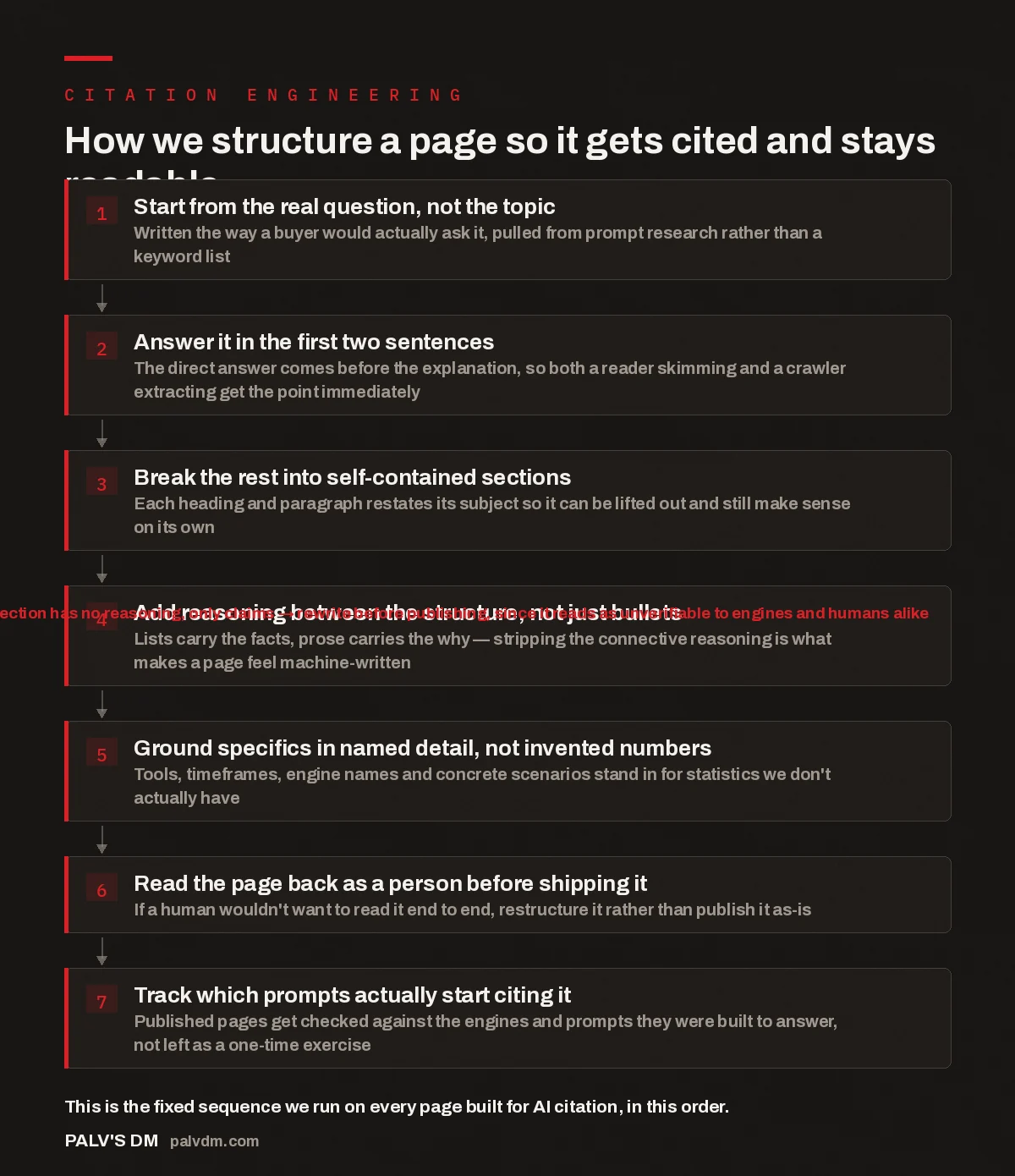
How we structure a page so it gets cited and stays readable
- Start from the real question, not the topic. Written the way a buyer would actually ask it, pulled from prompt research rather than a keyword list.
- Answer it in the first two sentences. The direct answer comes before the explanation, so both a reader skimming and a crawler extracting get the point immediately.
- Break the rest into self-contained sections. Each heading and paragraph restates its subject so it can be lifted out and still make sense on its own.
- Add reasoning between the structure, not just bullets. Lists carry the facts, prose carries the why — stripping the connective reasoning is what makes a page feel machine-written. Section has no reasoning, only claims → rewrite before publishing, since it reads as unverifiable to engines and humans alike
- Ground specifics in named detail, not invented numbers. Tools, timeframes, engine names and concrete scenarios stand in for statistics we don’t actually have.
- Read the page back as a person before shipping it. If a human wouldn’t want to read it end to end, restructure it rather than publish it as-is.
- Track which prompts actually start citing it. Published pages get checked against the engines and prompts they were built to answer, not left as a one-time exercise.
Why do most “AI-optimized” pages read badly?
The failure mode we run into most often isn’t too little structure — it’s structure applied as a costume rather than a foundation. A team hears “AI engines like lists” and converts an existing article into a stack of bullet points with the connective reasoning stripped out. The page looks optimized, but an AI engine reading it now has fragments instead of a coherent claim, and a human reading it gets an FAQ sheet where they wanted an explanation. Citation and readability fail together in that scenario, because the same thing that makes a chunk of text useless to a person — no context, no reasoning, just an assertion floating alone — also makes it a poor source for a machine to quote with any confidence.
The pattern that shows up repeatedly in the accounts we work on is that pages written purely for citation, with no regard for a human reader, tend to under-perform even on citation. Engines weigh coherence and apparent expertise, not just format — a page that reads as confidently written by someone who knows the subject gets treated as a more reliable source than a keyword worksheet with headers slapped on.
How do you answer the question before you explain it?
Every page we engineer starts from one specific question, phrased the way a person would actually ask it — “how do you engineer a page for citation,” not “citation optimization considerations.” That question comes from prompt testing, not a content calendar topic list, because the exact wording a buyer or an AI user types changes what counts as a good answer. Once the question is fixed, the opening sentences have one job: answer it directly, with no scene-setting — most web copy builds up to the point instead of opening with it, and a paragraph that starts “In today’s competitive landscape…” has already lost a skimming reader, or a snippet-extracting crawler, before it gets there.
What makes a section self-contained enough to quote?
A section is citable on its own when it doesn’t lean on anything the reader saw two paragraphs earlier. That mostly comes down to one habit: restating the noun instead of pointing back at it. “This approach also helps with…” forces a reader — human or machine — to reconstruct what “this approach” refers to. “Answer-first structuring also helps with…” doesn’t. It costs a few extra words per section and it’s the single biggest reason a page either survives being excerpted or turns into a confusing half-sentence when an engine pulls just one part of it.
The same logic applies to headings. A question-style heading like “How do you keep specificity without inventing data?” tells an engine exactly what the section beneath it answers — which is why we default to question headings over topic labels wherever the phrasing is natural.
How much structure is too much?
Structure stops helping the moment it replaces reasoning instead of carrying it. A numbered list is genuinely useful when it holds facts that are naturally list-shaped — steps in a sequence, criteria against options. It becomes a liability when a team uses it to avoid writing the sentence that explains why something is true, since that sentence is what an engine and a reader both use to judge whether the claim is trustworthy.
A useful check we apply while editing: could this bullet be defended if someone asked “why”? If the answer is buried elsewhere on the page or not written anywhere, the bullet is a fragment, not a fact — we either move the reasoning next to the claim or cut the claim.
The pages that get cited and stay readable are the ones where the structure is doing the same job the writer would do out loud — organizing an answer, not replacing one.
Palash, Founder, PalV’s DM
How do you keep specificity without inventing data?
Specificity is what separates a citable page from a generic one, and it doesn’t require statistics you don’t actually have. Naming the exact tools, engines, timeframes and scenarios involved does most of the work a fabricated percentage would otherwise be asked to do. “ChatGPT, Perplexity, Gemini and AI Overviews source content differently” is specific and true. A made-up figure like “73% of citations come from structured content” is neither — it’s the kind of number that shows up in low-quality AI-generated content because it sounds authoritative without being checkable, and it’s the fastest way to lose credibility with a reader who knows the space.
The questions themselves come from real prompt research rather than assumption — our prompt research process, step by step, is what tells us which exact phrasing to build a page’s opening answer around, instead of guessing at how someone actually asks. Naming a real process like that, rather than describing “advanced AI optimization techniques” in the abstract, is itself a form of specificity that holds up under scrutiny.
Does this replace normal SEO writing, or sit alongside it?
It sits alongside it, and for most pages it’s closer to a discipline than a separate process. A page that ranks well in classic search — clear headings, a direct answer, no keyword stuffing — is usually most of the way to being citation-engineered already. What gets added is the explicit self-containment check on every section, the deliberate front-loading of the answer, and named specificity in place of vague claims. None of that hurts classic SEO; it tends to help dwell time too, since the reader gets their answer faster. Where it differs from most content-writing guidance is the source of the structure: it isn’t built from a keyword tool’s “people also ask” list, but grounded in the research behind how these engines actually select sources, which is part of why we base our GEO method on peer-reviewed research rather than on trends.
What about content that already exists on a site?
Most sites we start with already have an archive of blog posts and service pages, none of it written with citation in mind, some of it genuinely good. Rewriting everything from scratch is rarely the right call; the more efficient path is going page by page and applying the same checks — does the opening answer the question directly, does each section stand alone, is the reasoning attached to the claims. That’s the same process covered in turning an existing blog archive into AI-citable assets, restructuring what’s already there instead of treating every page as a rewrite.
How do you know if the citation engineering actually worked?
Publishing an engineered page is the start of the process, not the end of it. We run the exact prompts a page was built to answer back through the major engines afterward and log whether it starts showing up — named, linked, or paraphrased — and how that changes over the following weeks. That’s the same ongoing check described in how we track citations across five engines every month, applied specifically to newly engineered pages so we know whether the structural changes actually moved anything, rather than assuming they did because the page looks right.
When a page doesn’t pick up a citation after a reasonable tracking window, the fix is rarely “add more keywords.” It’s usually one of the checks above being incomplete — the opening still buries the answer, a section still leans on a pronoun instead of restating its subject, or a claim is still floating without the reasoning that would make an engine trust it enough to repeat it.
Want this applied to your pages?
If your content already ranks but rarely gets cited by AI engines, the structure is usually the fastest fix — and it doesn’t require writing anything from zero.
Frequently asked questions
Does citation-optimized content mean writing shorter pages?
Not necessarily. Length isn’t the variable that matters — extractability is. A long page where every section answers one self-contained question is more citable than a short page that buries its point in a dense paragraph. Cut length only if it’s genuinely padding.
Can I engineer a page for citation without rewriting it completely?
Often, yes. If the underlying information is solid, most of the work is reordering — moving the answer earlier, restating subjects instead of using pronouns, and adding the reasoning behind claims that are currently just listed. A full rewrite is usually only needed when the content itself is thin or outdated, not because the structure is wrong.
How soon after engineering a page should I expect it to get cited?
There’s no fixed timeline — it depends on the engine, how established the domain already is, and how competitive the underlying question is. What matters more than a specific number of weeks is tracking the exact prompts the page was built to answer, so you know whether it’s moving rather than guessing.
Short version: engineering a page for citation means answering the real question first, structuring the rest into self-contained sections that restate their subject rather than leaning on pronouns, keeping reasoning attached to every claim, and grounding specificity in named detail rather than invented numbers. Done in that order, the page that’s easy for an AI engine to extract and quote is also the page a human wants to finish reading — and checking whether it worked means tracking the exact prompts it was built for.