Service Support — AI Visibility
Why We Base Our GEO Method on Peer-Reviewed Research
Our research backed GEO method is built on retrieval-augmented research, engine documentation, and logged citation data — not repeated agency opinion.

Because most GEO advice online is a guess dressed up as a framework. Our method is research backed GEO: every recommendation we make — what to write, how to structure it, what schema to add — traces back to a paper, a documented model behaviour, or a pattern we’ve verified across real client accounts, not a blog post someone wrote after reading three other blog posts. That distinction matters because AI engines are opaque systems, and opaque systems reward people who actually study how they work over people who repeat what sounds plausible.
Key takeaway
- Our GEO recommendations are grounded in retrieval-augmented generation research, published engine documentation, and verified pattern-matching across client accounts — not repackaged opinion pieces.
- Peer-reviewed and industry research explains mechanisms (how retrieval, chunking, and citation selection actually work); it does not hand you guaranteed rankings, which is why we always frame findings as directional, not promised outcomes.
- The practical output of a research-backed method is a checklist of sourcing criteria you can apply to any GEO advice, including ours, before you act on it.
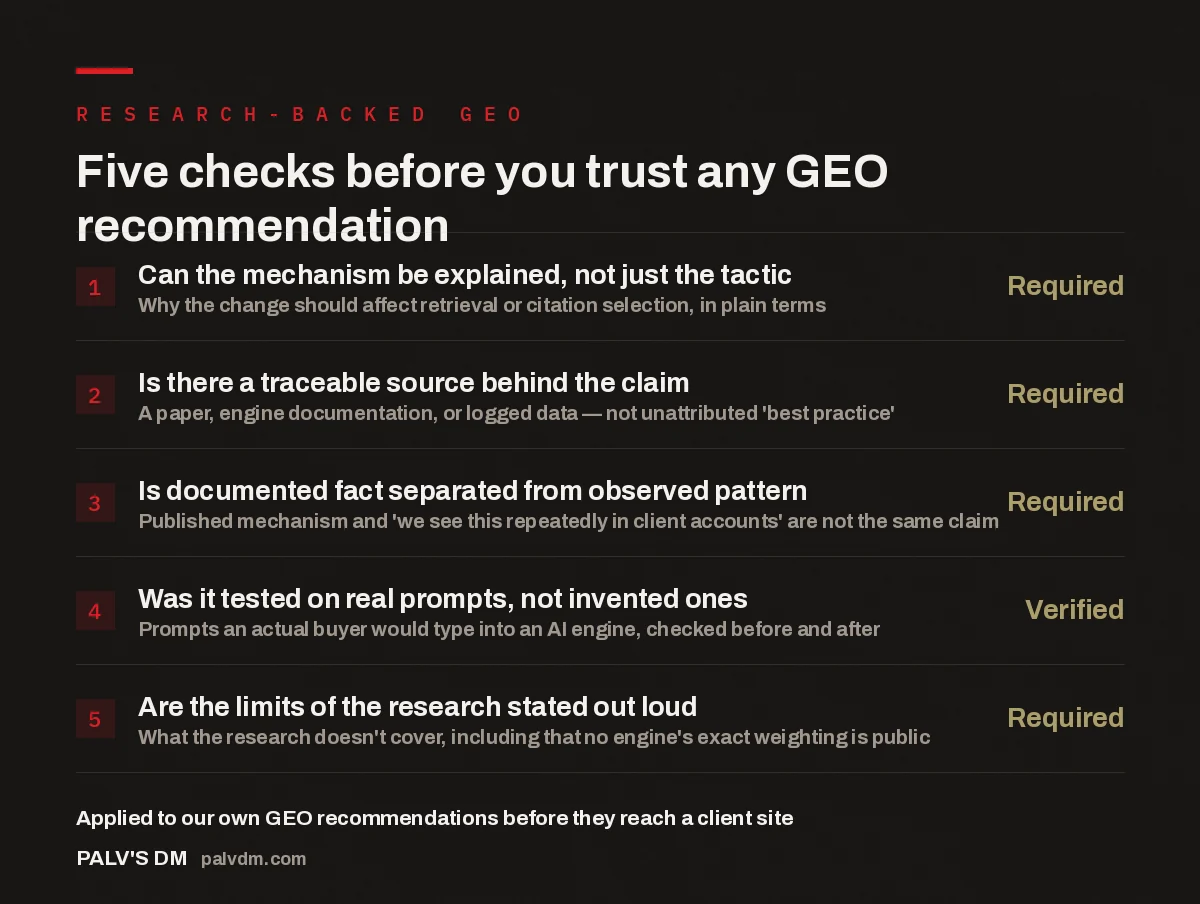
Five checks before you trust any GEO recommendation
- Can the mechanism be explained, not just the tactic — Required. Why the change should affect retrieval or citation selection, in plain terms.
- Is there a traceable source behind the claim — Required. A paper, engine documentation, or logged data — not unattributed ‘best practice’.
- Is documented fact separated from observed pattern — Required. Published mechanism and ‘we see this repeatedly in client accounts’ are not the same claim.
- Was it tested on real prompts, not invented ones — Verified. Prompts an actual buyer would type into an AI engine, checked before and after.
- Are the limits of the research stated out loud — Required. What the research doesn’t cover, including that no engine’s exact weighting is public.
What does “research-backed GEO” actually mean?
It means the working assumptions behind our GEO method come from three traceable sources, not intuition. First, published research on retrieval-augmented generation (RAG) — the architecture most AI answer engines use to fetch and cite external content — which explains, at a mechanical level, why chunking, passage structure, and semantic clarity affect whether a page gets retrieved at all. Second, documentation and technical papers that engine providers themselves publish about how their systems handle crawling, indexing, and citation selection. Third, our own logged pattern data: what we observe repeatedly across the accounts we manage when a specific structural change is made and citations are tracked before and after. None of these sources are perfect. All three are better than repeating a LinkedIn post.
The reason this distinction matters in practice: GEO is young enough that there is no settled playbook, which means the market is currently flooded with confident-sounding advice that nobody has actually tested. A research-backed approach doesn’t claim certainty either — it claims a traceable reason for the recommendation, which is a meaningfully different and more honest standard.
Why does the source of GEO advice matter this much?
Because acting on the wrong mental model wastes real budget and time. If you believe AI Overviews and chatbot answers work like classic ten-blue-links SEO — that keyword density and backlink count are the levers — you’ll optimise for the wrong thing and see no movement in citations, then conclude “GEO doesn’t work” when the actual problem was the model of how the system operates. Retrieval-based systems don’t rank a page; they retrieve passages, evaluate them against a query embedding, and select the most extractable, self-contained answer to synthesise into a response. That’s a different game with different rules, and it’s documented in the RAG literature that underpins most production AI search and answer systems today.
Once you work from that model instead of a guess, specific recommendations start making sense instead of feeling arbitrary: why a page needs a clean, quotable definition near the top instead of three paragraphs of scene-setting; why consistent entity facts across your site and third-party listings matter more than they used to; why a single well-structured FAQ block often outperforms a longer, narrative-heavy page for citation purposes. Each of those is a downstream consequence of how retrieval actually works, not a stylistic preference.
We don’t publish a GEO recommendation until we can point to why it should work mechanically, then confirm it holds up in the citation data we’re already tracking. If we can’t do both, we say so instead of guessing out loud.
Palash, Founder, PalV’s DM
How do we actually apply the research to a client’s site?
The research informs the method; it doesn’t replace the work of checking a specific site against a specific engine. In practice this looks like a repeatable loop rather than a one-off study session.
- Start from the mechanism, not the tactic. Before recommending a structural change, we can explain in plain terms why it should affect retrieval or citation likelihood — for example, that self-contained passages retrieve better than passages that depend on surrounding context the model may not fetch alongside them.
- Test the assumption on the client’s actual content, not in the abstract. We run the real prompts a buyer would type, check which pages get cited before the change, apply the structural fix, and track the same prompts afterward across the engines we monitor.
- Log the pattern instead of trusting memory. Every account we run keeps a citation log, so when a change works — or doesn’t — that result feeds back into how confidently we recommend it on the next site, rather than resting on a single anecdote.
- Separate “documented mechanism” from “our observed pattern” when we talk to clients. Some things we can point to a paper or engine documentation for directly. Others are patterns that show up repeatedly in the accounts we manage but aren’t formally published anywhere yet — we say which is which instead of blending the two into one confident claim.
This is also why our prompt research process exists as a distinct step before any content work starts — the mechanism-first approach only holds up if the prompts being tested actually reflect how real buyers query AI engines, not prompts an agency invented to make a report look tidy.
What can peer-reviewed research not tell you about GEO?
It can’t tell you your exact citation count next month, and any agency implying otherwise is not being straight with you. Research explains mechanisms at a general level — how retrieval systems tend to behave, what structural signals tend to help extractability — it doesn’t model the specific weighting a specific engine applies today, because most providers don’t publish that, and it changes without notice. That’s the honest limit of a research-backed method: it tells you why a recommendation is reasonable, not what will happen on a specific date.
It’s also worth being direct about what research-backed does not mean: it doesn’t mean slower, and it doesn’t mean academic. It means every recommendation has a “because” behind it that we can actually explain if you ask, rather than “because that’s what everyone’s doing right now.” For a fuller picture of where this approach does and doesn’t apply, our piece on what GEO cannot do for you covers the boundaries directly.
How can you tell if GEO advice you’re reading is actually research-backed?
Ask it four questions. Can the person explain the mechanism, not just the tactic — why the recommendation should work, mechanically, inside a retrieval system? Do they cite a traceable source — a paper, engine documentation, or their own logged data — rather than “best practice” with no origin? Do they distinguish documented fact from observed pattern from pure guess, out loud, instead of presenting all three with equal confidence? And do they admit the limits — what the research doesn’t cover — rather than promising certainty a young, opaque field can’t actually deliver? Advice that fails all four of those tests is opinion wearing a framework’s clothes, and it’s worth exactly as much as any other unverified opinion, no more.
This is the same standard we apply to our own AI visibility audit process — the audit exists specifically so claims about what’s working don’t have to rest on anyone’s word alone.
Short version
Our GEO method is built on retrieval-augmented generation research, engine documentation, and our own tracked citation data — not repeated opinion. That gives every recommendation a “because,” and it’s the same standard we’ll walk you through on your own site.
See how our AI Visibility service applies this method to your site
Frequently asked questions
What kind of research does research-backed GEO actually draw on?
Mainly published work on retrieval-augmented generation architecture, which underpins how most AI answer engines fetch and select content to cite, plus technical documentation that engine providers publish about crawling and indexing. We combine that with our own logged citation data from client accounts to see whether the documented mechanisms hold up in practice.
Does research-backed GEO guarantee citations in ChatGPT or AI Overviews?
No, and anyone promising a guarantee isn’t being honest with you. Research explains mechanisms — why certain structures tend to retrieve and cite better — but engine weighting changes without notice and isn’t fully published. A research-backed method gives you well-reasoned, tested moves, not a guaranteed result on a specific date.
How is this different from “SEO best practices” that agencies already claim to follow?
Most “best practice” advice in SEO and GEO alike is repeated opinion with no traceable origin. Research-backed means we can explain the mechanism behind a specific recommendation — how retrieval and citation selection actually work — and separate what’s documented from what’s an observed pattern from what’s simply untested.
Can I ask an agency to show their sources before I trust their GEO recommendations?
Yes, and you should. Ask them to explain the mechanism behind a recommendation, name a traceable source or their own logged data, and tell you plainly what the research doesn’t cover. If they can’t do any of that, the advice is opinion, regardless of how confidently it’s delivered.
Where can I see this method applied to a real GEO problem?
Our piece on how we engineer a page for citation without wrecking it for readers walks through the same mechanism-first approach applied to a single page, from structural diagnosis through the specific changes made.