Service Support — AI Visibility
What We Do When a Client Is Invisible in Every AI Engine
Site not showing in AI search anywhere? Here is the exact audit and fix process we run: crawler access checks, prompt mapping, and citable page rebuilds.
When a client comes to us not showing in AI search anywhere — no citations in ChatGPT, Perplexity, Gemini, Copilot, or Google’s AI Overviews — we don’t start by writing new content. We start by finding out why, because zero AI visibility almost always has one of three causes: AI crawlers can’t reach the site, existing content doesn’t answer the exact prompts people are asking, or the site has never built up enough indexed depth for an LLM to pull from. The fix depends entirely on which of those three it is, and mixing them up wastes weeks.
Key takeaway
- Zero AI visibility is diagnosed, not guessed — we run a five-engine audit before touching a single page.
- The most common blocker isn’t bad content, it’s blocked crawler access or a technical setup that never let AI systems in.
- Once access is fixed and pages are rebuilt around the real prompts, we re-test weekly rather than waiting for a monthly report to notice a change.
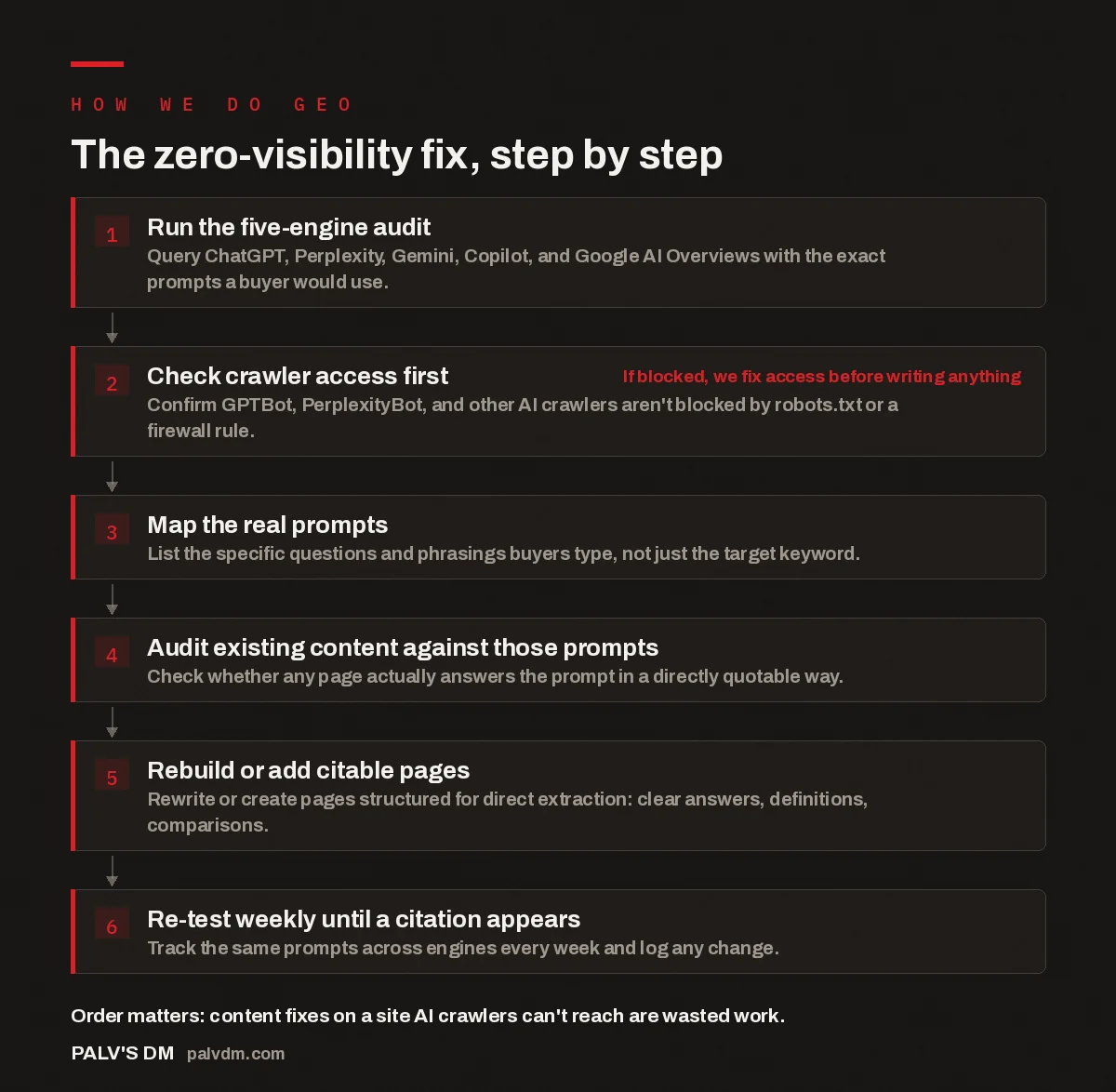
The zero-visibility fix, step by step
- Run the five-engine audit. Query ChatGPT, Perplexity, Gemini, Copilot, and Google AI Overviews with the exact prompts a buyer would use.
- Check crawler access first. Confirm GPTBot, PerplexityBot, and other AI crawlers aren’t blocked by robots.txt or a firewall rule. If blocked, we fix access before writing anything
- Map the real prompts. List the specific questions and phrasings buyers type, not just the target keyword.
- Audit existing content against those prompts. Check whether any page actually answers the prompt in a directly quotable way.
- Rebuild or add citable pages. Rewrite or create pages structured for direct extraction: clear answers, definitions, comparisons.
- Re-test weekly until a citation appears. Track the same prompts across engines every week and log any change.
Why does a site end up not showing in AI search at all?
Traditional SEO has trained most site owners to think in terms of rankings — you’re either on page one or you’re not, and being invisible usually means being outranked. AI visibility doesn’t work that way. An AI engine either finds your page, understands it well enough to pull an answer from it, and trusts it enough to cite it — or none of that happens and you simply don’t exist in the response. There’s no “position 47.” When a client is invisible everywhere, it’s rarely one weak page — it’s usually a structural problem sitting upstream of the content itself.
In the accounts we take on with this exact symptom, the pattern repeats: the domain has a reasonable amount of content and still returns nothing when you ask an AI assistant the questions its buyers actually ask. That gap between “we have content” and “the AI can use our content” is where the diagnostic work happens.
Step 1 — How do we confirm the invisibility is real?
Before we plan any fix, we run what we call the five-engine audit — the same one described in our AI visibility audit process. We take the client’s actual target prompts, not their target keywords, and run each one against ChatGPT, Perplexity, Gemini, Microsoft Copilot, and Google’s AI Overviews, logging what each engine returns and whether the client’s domain appears in the citations.
This step matters because “invisible” is a claim clients often make from a handful of manual checks with prompts that don’t match how a real buyer would ask. Sometimes the audit finds a thin sliver of visibility — a citation on a comparison prompt but nothing on a direct-answer prompt — which changes the diagnosis completely. Confirming the actual scope of the problem is what stops us from prescribing a full rebuild when a narrower fix would have worked.
Step 2 — How do we check whether AI crawlers can even reach the site?
This is the step most content-first agencies skip, and it’s the single most common cause of total invisibility we see. We check robots.txt for disallow rules against GPTBot, PerplexityBot, ClaudeBot, and other AI user agents; the CDN and firewall configuration for bot-blocking rules that were set up to stop scrapers and quietly caught AI crawlers too; and whether key pages are reachable without JavaScript rendering that some crawlers won’t execute.
If access is blocked, this gets fixed first, before a single sentence of content is rewritten. We’ve walked into accounts where a security plugin was silently returning a 403 to every AI crawler — the content was genuinely good, and none of it mattered because nothing could get in the door. Our llms.txt and crawler access setup covers exactly what we check and configure at this stage.
The number of times we’ve fixed a client’s “content problem” by editing one line in robots.txt is higher than I’m comfortable admitting. Nobody wants to hear that the fix was boring, but boring fixes are still fixes.
Palash, Founder, PalV’s DM
Step 3 — How do we find the prompts that actually matter?
Once access is confirmed clean, or fixed, the next question is what the site should actually be visible for. A target keyword like “project management software” is not a prompt. A real prompt looks like “what project management tool works best for a 10-person remote agency” — longer, more specific, phrased as a direct question with context baked in.
We build this list from actual buyer language: sales call transcripts, support tickets, and review site questions — the same process laid out in our prompt research process. It’s deliberately separate from keyword research: a page can rank for a keyword and still never get cited for the prompt a buyer actually types into an AI assistant.
Step 4 — How do we audit existing content against those prompts?
With a real prompt list in hand, we go page by page through existing content and ask one question: if an AI engine pulled a single sentence from this page to answer this specific prompt, would that sentence be correct, complete, and quotable on its own? Most content fails this test not because it’s wrong, but because it’s structured for a human reader who scrolls, not a system that lifts one paragraph out of context.
Common failure patterns: the answer is buried three paragraphs into a scene-setting intro, the claim is split across two sentences so neither is quotable alone, or the page answers a related question but not the specific one being asked. Each of these gets flagged with the exact prompt it’s failing and moves into the rebuild list.
Step 5 — How do we rebuild pages so they can actually be cited?
This is the writing work, and it comes last on purpose. For each flagged prompt, we rewrite the relevant section or, when nothing addresses the prompt at all, build a new page around it. The pattern we follow: state the direct answer in the first sentence or two, define any term right where it’s used, and use structure an extraction system can parse without ambiguity.
- Lead with the answer, not the setup — save the “why this matters” framing for after the direct answer.
- Keep each claim self-contained — a sentence should be true and complete if lifted out of the page entirely.
- Name things specifically — a tool, a step, a timeframe — rather than describing them abstractly.
- Keep the page genuinely useful to a human reader too — pages written purely for extraction tend to read badly and convert worse.
We don’t touch this step until access and prompt mapping are done — rewriting content against the wrong prompts, or on a domain AI crawlers still can’t reach, is effort spent on a page that was never going to be read by the system it’s meant for.
Step 6 — How long until the first citation actually shows up?
Once the access fix and the first batch of rebuilt pages are live, we don’t wait for a monthly report to find out whether anything changed. We re-run the same prompts across the same five engines on a weekly cadence, because AI engines refresh their indexes and retrieval on their own schedules, not the client’s. Some engines pick up a newly citable page within a couple of weeks; others take longer, and a few prompts never resolve in the client’s favour even after the technical and content work is solid, usually because a competitor’s page is simply a stronger match for that specific question.
The weekly tracking matters as much as the rebuild itself — it’s how we know which fix worked, which prompts need another pass, and whether the access fix alone was enough before any content had changed. Our five-engine citation tracking process is the same system we run ongoing once the fix is in place. For the wider context this work sits inside, see our state of search in 2026 piece.
What if the fixes don’t work right away?
Sometimes none of it moves a specific prompt, even after access is clean and the page is well-structured. That’s a real outcome, not a process failure — it usually means the prompt has a strong incumbent answer, or sits closer to a competitor’s core offering. The honest move then is to reprioritise toward prompts the client can realistically win, rather than keep rewriting a page against a query it was never going to take.
Not showing up in AI search?
We’ll run the five-engine audit and check crawler access, then tell you exactly why your site is invisible before recommending a fix.
FAQ: Fixing zero AI visibility
Why does my site rank fine on Google but never show up in ChatGPT or Perplexity?
Ranking and citation are different mechanisms. Google ranking depends heavily on links and historical signals; AI citation depends on whether a crawler can access the page and whether it contains a directly quotable answer to the exact prompt being asked. A site can rank well and still never be cited if AI crawlers are blocked or the content isn’t structured for extraction.
Is blocked crawler access really that common a cause?
It’s common enough that we check it first on every zero-visibility case, before looking at content at all. Security plugins, CDN bot-management rules, and old scraper-blocking configurations frequently catch AI crawlers by accident, since they weren’t distinguished from generic bots when those rules were set up.
Do I need to rewrite my entire site to fix AI visibility?
Rarely. Once access is confirmed clean, the fix is usually targeted at the specific pages that map to the prompts you want to be cited for, not a full-site rewrite. The prompt audit tells you which pages are failing and why, so the rebuild stays scoped to what’s actually broken.
How do you know a fix actually worked?
We re-run the same prompts against the same five engines weekly after any fix goes live and log whether the client’s domain starts appearing in citations. Waiting for a monthly report means losing weeks of information about which fix actually moved which prompt.
What if a competitor keeps getting cited instead of us even after the fix?
That’s a narrower problem, worth treating differently once your baseline access and content issues are resolved — usually by reworking the specific comparison or definition prompt where the competitor is winning, rather than rebuilding the whole site again.
Short version: a site not showing in AI search at all is a diagnosis problem before it’s a content problem. We confirm it with a five-engine audit, check whether AI crawlers can reach the site, map the actual prompts buyers ask, audit pages against those prompts, rebuild only what’s flagged, then track weekly rather than guessing. Skipping the access check and jumping straight to a content rewrite is the most common way this fix fails.