GSC Impressions vs Clicks vs Position: What Each Really Measures
What do impressions, clicks, and average position actually measure in Google Search Console? A clear breakdown of what each metric tells you and misses.
Published August 2026 · SEO team at PalV’s DM
Impressions count how many times your page appeared anywhere in a Google search results page, including positions a user never scrolled to. Clicks count how many times someone actually clicked through to your site from that result. Position is the average ranking spot across all those impressions, not a single fixed rank. The three metrics measure different stages of the same journey, appearing, being seen, and being chosen, and reading only one of them in isolation is the single most common way people misread Search Console data.
What exactly counts as an impression?
An impression is logged whenever your URL appears in a set of search results returned to a user, regardless of whether that user scrolled far enough to actually see it on screen, and regardless of whether they clicked. If your page ranks position 8 on a search where the user only looked at the top 3 results before refining their search, that’s still counted as one impression at position 8.
This matters because a page can accumulate thousands of impressions while genuinely being invisible to almost everyone who triggered them. High impressions alone don’t mean high visibility in the way most people assume.
What exactly counts as a click?
A click is logged when a user clicks a link to your page from Google Search results and lands on your site. It’s a narrower, more meaningful action than an impression, but it’s still not identical to a session in Google Analytics, some clicks don’t result in a fully loaded page (a user might close the tab immediately), and Search Console’s click count reflects Google’s server-side logging, not GA4’s client-side JavaScript-based tracking. This is the main reason Search Console clicks and GA4 sessions never match exactly.
What does “average position” actually average?
Average position takes every impression for a query or page and averages the ranking position across all of them. A page appearing at position 2 for one search and position 18 for another, both counted as impressions, would show an average position of 10, a number that describes neither actual result accurately.
| Metric | What it tells you | What it doesn’t tell you |
|---|---|---|
| Impressions | How often you appeared in results, across all positions | Whether anyone actually saw or scrolled to your result |
| Clicks | How often someone chose your result over others | What they did after landing on the page |
| CTR | How compelling your result was relative to how often it appeared | Whether that’s a good or bad number without context on position and SERP features |
| Average position | A rough directional sense of where you typically rank | Your actual rank for any single specific search |
How do these metrics relate to each other?
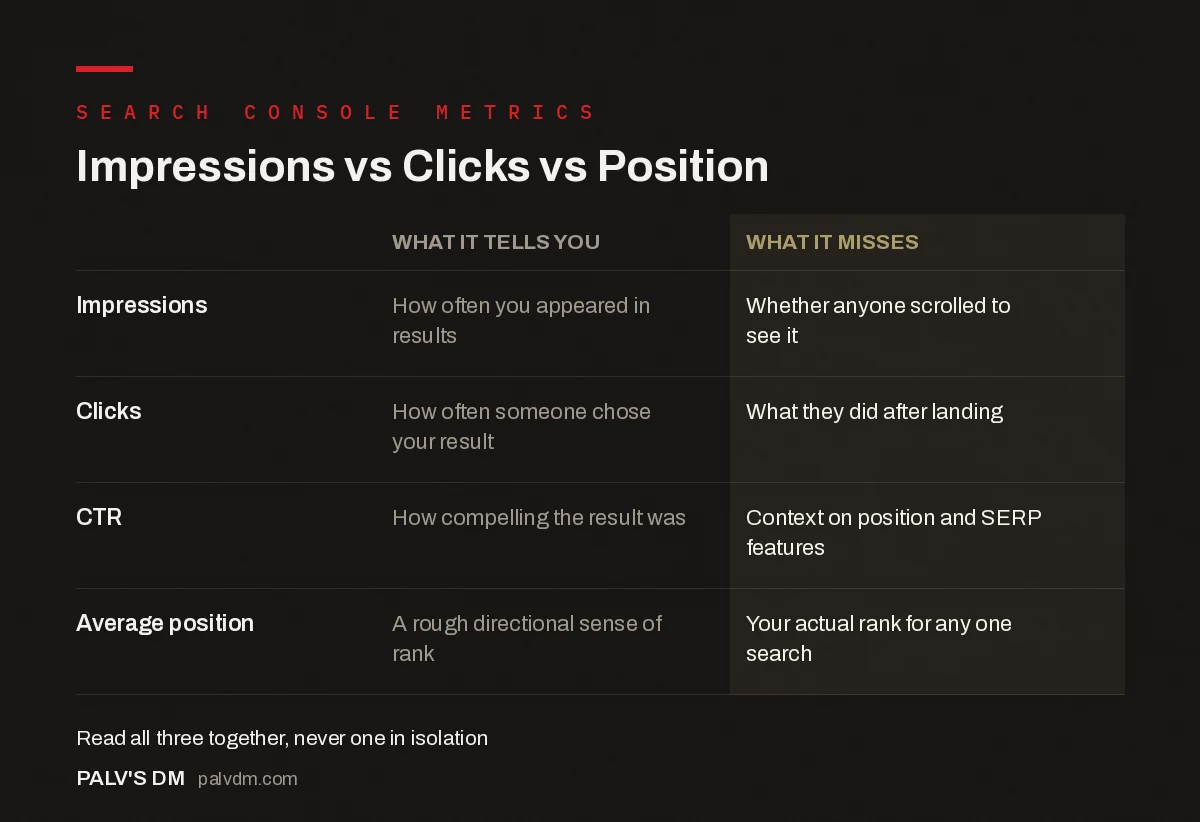
Impressions vs Clicks vs Position
| What it tells you | What it misses | |
|---|---|---|
| Impressions | How often you appeared in results | Whether anyone scrolled to see it |
| Clicks | How often someone chose your result | What they did after landing |
| CTR | How compelling the result was | Context on position and SERP features |
| Average position | A rough directional sense of rank | Your actual rank for any one search |
- Impressions rising, clicks flat: usually means visibility is expanding (more queries triggering the page) but the snippet isn’t compelling enough to convert that visibility into clicks.
- Clicks rising, impressions flat: usually means an improvement in CTR, a title or meta description change, a new rich result, or a competitor dropping out of a shared SERP feature.
- Position improving, clicks flat or falling: worth investigating for a SERP feature (AI Overview, featured snippet, ads) that’s now capturing attention even though your organic rank technically improved.
- All three flat: often means the page’s query set hasn’t changed meaningfully, which isn’t necessarily bad, stability is normal for mature content.
What’s a realistic example of these metrics moving together?
Picture a blog post that ranks around position 12 for its main keyword. Over a month of targeted internal linking and a title rewrite, position improves to around position 7. Impressions rise as more of the query’s search volume now includes the page in a visible results range. CTR improves modestly because position 7 typically earns a better click share than position 12, even though both are technically “page one” on some result layouts. Clicks rise as a combined effect of both more impressions and a better CTR, not because of either one alone. This is the normal, expected chain reaction, and it’s why treating clicks as the only metric worth checking misses the two changes that actually caused the improvement.
Now take a second example that looks similar on the surface but plays out differently. A product category page sits at position 4 for its main term and impressions are strong, but clicks have been flat for two months. A quick look at the SERP shows Google added a shopping carousel and an AI Overview above the organic results for that query, pushing the first organic result, including this one, further down the visible page even though the reported position number didn’t change. Position, as GSC defines it, only counts organic blue-link placement; it doesn’t account for how much space paid ads, shopping units, or AI-generated answers take up above it. This is why a page can hold a strong, stable position and still lose clicks over time: the position number is accurate, but it no longer means what it used to mean on that particular SERP.
What mistakes come up most often when reading these three metrics?
A handful of misreadings show up repeatedly, regardless of industry or site size:
- Reporting clicks alone as “the SEO number.” Clicks are the outcome of impressions, position, and CTR combined. Reporting only clicks to a stakeholder, without the components behind the change, makes it impossible to explain why a number moved or what to do next.
- Treating a CTR drop as automatically bad. If impressions roughly doubled because a page started ranking for a much broader set of queries, a lower CTR can still mean more total clicks. Percentage-based metrics need the underlying volume next to them, not on their own.
- Comparing CTR across very different position bands. A 3% CTR at position 9 might be strong; the same 3% at position 2 would be weak. CTR only means something in the context of the position it was earned at.
- Assuming impressions and clicks always move in the same direction. They frequently don’t, and the gap between them is usually the most informative part of the data, not noise to average away.
How should you use these three metrics together in practice?
- Start with impressions to understand reach: is the page showing up for the queries you’d expect, and is that reach growing or shrinking?
- Layer in position to see roughly where those impressions are coming from, page one or buried deeper.
- Check CTR to see whether the reach and position are converting into actual visits at a reasonable rate for that position and query type.
- Only then look at clicks as the bottom-line number, understanding it’s the product of the other three, not an independent metric to optimise directly.
FAQs
Can a page have high impressions but zero clicks?
Yes, and it’s common for pages ranking outside the top 10, or for queries where a SERP feature answers the question without requiring a click at all. High impressions with zero or near-zero clicks usually points to either a very low position or a snippet that isn’t earning attention relative to competing results.
Why does average position sometimes go up while clicks go down?
This can happen if the mix of queries triggering impressions changes, for example, gaining impressions for several low-value, high-position queries while losing impressions on a smaller number of high-value queries can average out to look like an improvement while clicks actually fall. It’s one of the clearest illustrations of why average position needs impressions and clicks as context, not as a standalone score.
Is it possible to have clicks without impressions being logged?
No. Every click in Search Console is necessarily preceded by an impression, since a click can only happen on a result that was shown. Clicks will always be less than or equal to impressions for the same query and time period.
Do impressions include results shown in Google Discover or AI Overviews?
Search Console reports Discover impressions separately in its own Discover report, not mixed into the standard Performance report’s web search data. Whether AI Overview citations count as impressions in the standard report has been a point of some ambiguity industry-wide, and Google’s own documentation is the most reliable source to check for current specifics, since this behaviour has been evolving.
Why do impressions sometimes drop even when nothing changed on my site?
Search volume for the underlying queries can fluctuate independent of anything you did, algorithm updates can change which pages get shown for which queries, and seasonal search behaviour shifts impressions naturally throughout the year. Not every impressions change traces back to a site-side cause.
Why do two pages with the same clicks number tell different stories?
Two pages can both earn 200 clicks in a month and still represent very different situations. One might get there from 2,000 impressions at a strong 10% CTR and position 3; the other from 20,000 impressions at a 1% CTR and position 14. The first page is performing close to its ceiling for that volume; the second has real room to improve through a better title, meta description, or targeted content update, even though the click totals look identical on a dashboard.
Understanding these three metrics is the foundation for reading the rest of Search Console correctly, see our guide on reading the Performance report for how to apply this in practice, and why average position specifically gets misread so often for a deeper look at that one metric. The full Google Search Console guide covers the platform’s other reports.
If your team needs these numbers translated into a clear action plan rather than just a monthly export, PalV’s DM’s SEO Growth service builds this analysis into ongoing reporting.