Information Gain: Saying Something the Top 10 Didn’t
Information gain means adding what the top 10 results don't cover. Here's how to find real content gaps without a research team or a big budget.
Information gain in SEO is the idea that Google rewards content offering something the top-ranking pages on a topic don’t already cover — a new data point, a first-hand test, a sharper explanation, or a fact the rest of page one skipped. Google filed a patent in 2022 (granted by the USPTO) called “Contextual estimation of link information gain,” describing a method for scoring how much a page adds beyond what a searcher has already seen. Nobody outside Google can confirm this exact patent runs in production ranking today, but the underlying behaviour it describes matches what working SEOs see: pages that repeat the same five points as everyone else on page one rarely outrank the pages that said something extra.
Published August 2026 — SEO team at PalV’s DM.
What does “information gain” actually mean in SEO?
It means the unique value a page adds relative to the documents Google has already indexed and shown for that query. Search Engine Land’s coverage of the patent describes it as a way for Google to measure “sameness” between a candidate page and content the user has already been exposed to, then adjust ranking to favour pages that add something new. If ten articles on “how to reduce cart abandonment” all list the same six tactics in the same order, none of them is offering much information gain relative to the other nine. The eleventh article that includes an actual abandonment-rate benchmark, a checkout-flow screenshot annotated with friction points, or a merchant’s account of what they changed and what happened next, is doing something different.
This is not a ranking factor you can toggle. It is closer to a filter that applies after basic relevance and quality are established. Your page still needs solid on-page SEO, real search intent match, and technical health. Information gain answers a narrower question: among pages that already clear that bar, which one deserves to rank above the others.
Why does duplicate content keep ranking then, if Google wants uniqueness?
Because information gain is one signal among many, not a filter that blocks duplicate-feeling content outright. A page with strong backlinks, an established domain, and decent on-page optimisation can still outrank a more original piece from a newer site. Search Engine Land’s own reporting on this topic is careful to note that Google has never confirmed it uses information gain as a live ranking signal in the way the patent describes — the patent exists, but patents describe possibilities, not confirmed production systems.
What’s observable without needing Google’s confirmation: content that reads as interchangeable with nine other pages has a harder time earning citations, backlinks, and AI-engine mentions, even when it ranks adequately in classic blue-link search. Two content sets covering the same topic rarely perform the same in referral traffic, time on page, or pickup by tools like Perplexity and ChatGPT’s browsing mode — the version with something extra tends to get quoted more often, because there’s something in it worth quoting.
How do you find the gap the top 10 results missed?
Read the top 8-10 ranking pages for your target query and build a simple coverage map before writing a word. This takes 30-45 minutes and it’s the highest-leverage step in the whole process.
- List every distinct claim or data point each top-ranking page makes, not just the headings. Headings repeat; specific claims are where gaps show up.
- Mark what’s sourced versus asserted. A shocking number of “top 10” pages state statistics with no citation. That’s your easiest gain: the same claim, properly sourced, already reads as more trustworthy.
- Note what none of them answer. Pull the “People also ask” box and the related-searches list at the bottom of the SERP. Anything appearing there that isn’t addressed on page one is an open gap.
- Check publish dates. If the newest top-10 result is from 18+ months ago, current numbers, current tool names, and current screenshots are an automatic gain.
- Identify what requires first-hand access. Anything competitors could only know by actually doing the thing (running the test, using the tool, working the client) is the hardest gap for a generic AI-assisted writer to fill and the most valuable one to own.
What counts as “new” if you don’t have a research budget?
Information gain doesn’t require a research team or a five-figure survey. It requires the writer to add at least one thing that isn’t a repackaging of what’s already ranking. In practice that’s usually one of five things:
| Type of gain | Example | Effort |
|---|---|---|
| A number nobody else cited | Pulling your own GA4 or GSC data instead of quoting an industry-wide average | Low, if you already have the data |
| A named expert’s take | A 15-minute call with someone who does the work, quoted directly | Medium — needs scheduling |
| A first-hand walkthrough | Screenshots of you actually doing the process, with real outputs | Medium — needs the task done once, on record |
| A synthesis nobody built | Comparing three tools’ documentation side by side in one table | Low to medium — desk research plus structuring |
| A corrected or updated fact | Flagging that a “best practice” every top-10 page repeats is outdated, with the current source | Low, if you check primary sources |
None of these need a lab. They need someone to stop copying the outline of whatever’s already ranking and instead ask: what do I actually know, or what can I actually check, that isn’t in these ten pages?
Does information gain matter more for AI search than classic Google results?
It’s plausibly more visible there. AI Overviews, Perplexity, and ChatGPT’s search mode tend to pull from and cite pages that state something specific and checkable — a number, a named source, a clear answer — because that’s what’s easy to lift into a synthesised answer. A paragraph that just restates a general concept in different words gives an AI system nothing distinct to attribute. This lines up with the broader pattern in AI-citation research: content built around original data and clear sourcing gets pulled into AI answers more often than content that’s well-optimised but generic. We can’t promise a specific citation-rate lift from adding original data to a given page, but the mechanism is straightforward: systems that synthesise answers from multiple sources favour sources that add something distinct to synthesise.
What should you do with a page that has zero information gain right now?
- Audit it against the top 5 ranking competitors using the coverage-map method above.
- Add at least one sourced data point, one first-hand detail, or one expert quote that none of the top 5 have.
- Cut any paragraph that only restates a competitor’s point in your own words with no new information.
- Update the publish or “reviewed” date once the content itself has genuinely changed, not just the timestamp.
- Re-check the page against the SERP again after 60-90 days — information gain is relative to what’s currently ranking, and competitors update too.
If your team doesn’t have the bandwidth to run this process across a full content calendar, that’s a resourcing problem worth solving before you publish more pages that just repeat page one. Our content writing service builds this gap-analysis step into every brief, so each piece starts with a reason to exist beyond “we needed a page on this keyword.”
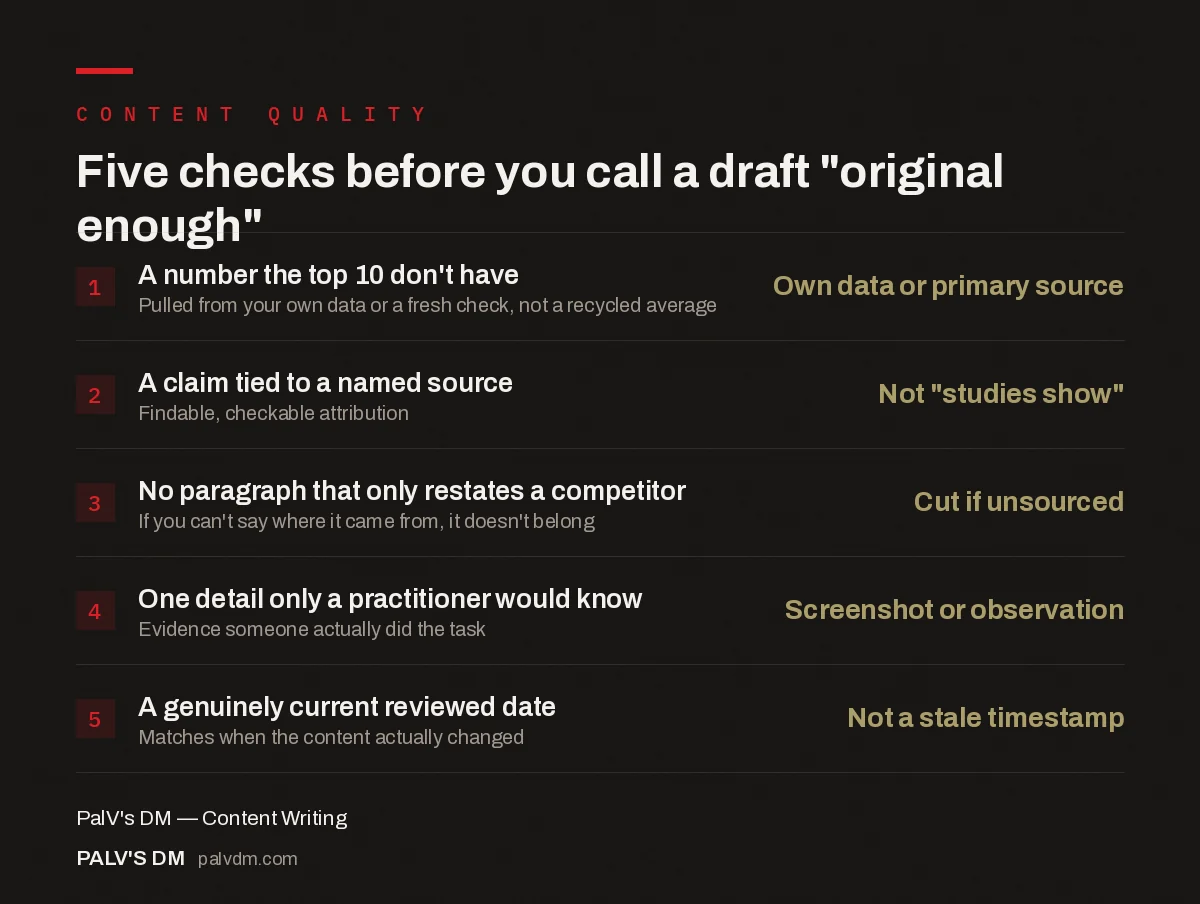
Five checks before you call a draft “original enough”
- A number the top 10 don’t have — Own data or primary source. Pulled from your own data or a fresh check, not a recycled average.
- A claim tied to a named source — Not “studies show”. Findable, checkable attribution.
- No paragraph that only restates a competitor — Cut if unsourced. If you can’t say where it came from, it doesn’t belong.
- One detail only a practitioner would know — Screenshot or observation. Evidence someone actually did the task.
- A genuinely current reviewed date — Not a stale timestamp. Matches when the content actually changed.
Where to go next on content quality
Information gain is one piece of a bigger editorial discipline. If you want the fuller picture, our content strategy guide covers how gap analysis fits into planning a whole calendar, not just one post. Two related reads worth pairing with this one: how to add original data to a post without a research team walks through the practical side of sourcing the number the top 10 don’t have, and interviewing an expert for a 20-minute quote covers the fastest route to a first-hand detail nobody else has. If your content already leans on generic AI drafts, building a content moat for AI search looks at the same problem from the citation side. And if you’re not sure your site even demonstrates the underlying expertise this is supposed to reflect, our E-E-A-T primer is the place to start.
FAQ
Is information gain a confirmed Google ranking factor?
Not officially. Google holds a patent describing the concept (granted 2022) but has never confirmed it’s an active ranking signal. Treat it as a useful editorial discipline backed by a plausible mechanism, not a guaranteed algorithmic lever you can measure directly in Search Console.
How is information gain different from E-E-A-T?
E-E-A-T is about whether the source is credible — experience, expertise, authority, trust. Information gain is about whether the content itself adds something the existing top results don’t have. A credible author can still write a page with zero information gain if it just restates common knowledge.
Can AI-written content have information gain?
Yes, if the human directing it supplies something original — real data, a genuine expert quote, first-hand testing. AI drafting tools can’t generate first-hand experience or new facts on their own; the gain has to come from what the writer feeds in, not the tool itself.
Do I need a survey or study to show information gain?
No. A single sourced statistic, one expert’s direct quote, or a genuinely fresh synthesis of existing public data can be enough. The bar is “not already said by the top 10,” not “backed by a formal research budget.”
How do I check if my existing content has information gain?
Search your own target keyword, open the top 5-8 results, and list what each one uniquely claims. If your page’s claims all appear somewhere in that list already, it has none. If at least one claim, number, or detail is missing from every competitor, it does.