Interviewing an Expert for a 20-Minute Quote That Lifts a Whole Post
One tight 20-minute interview can produce the single quote that lifts an entire blog post. Here's how to find, ask, and edit for it.
A 20-minute call with the right person, run with a tight question list, is usually enough to get one quote worth building a section around. The trick isn’t the length of the interview, it’s picking someone who’s actually doing the work today, asking questions that can’t be answered from a Google search, and pulling out the one sentence that’s specific enough to stand on its own. Most content teams skip this step because it feels like it needs an hour and a formal process. It doesn’t.
Published August 2026 — SEO team at PalV’s DM.
Why bother with a real interview when AI can generate a plausible quote?
Because a generated quote isn’t a fact, it’s a guess dressed up as one, and it’s the single easiest thing for a careful reader or an editor to catch. A genuine quote from a named, findable person carries information an AI model can’t invent: a specific number from their own work, an opinion they’d defend publicly, a detail from a project only they were on. That’s exactly the kind of content that AI search tools favour when deciding what to cite, because it’s attributable to someone real. It’s also the fastest way to add information gain to a page that otherwise just restates what’s already ranking.
Who should you actually interview for a 20-minute quote?
Someone doing the work right now, not a retired executive or a generalist with a big title and no recent hands-on experience. A practitioner who touches the specific problem weekly gives you sharper, more current answers than someone speaking from memory of how things used to work.
- A specialist inside your own company — often the fastest option, and still counts as a real, attributable source if you use their actual name and role.
- A client willing to speak on the record about a specific result, with their permission to publish specifics.
- An industry peer at a non-competing company, found through LinkedIn or a relevant community, who’s posted about the exact problem your post covers.
- A vendor or tool-maker’s team who deals with the question from a different angle than you do.
Check whether they’ve been interviewed before — someone who’s used to it gives cleaner, quotable answers and won’t need three follow-up emails to approve a rewrite.
What should you ask in 20 minutes to get one usable quote?
Three to five questions, not ten. Long question lists produce long, hedged answers that are hard to excerpt. Short, specific questions produce short, specific answers you can lift directly.
| Question type | Example | Why it works |
|---|---|---|
| Specific number | “What’s one number from your own work that surprised you on this?” | Forces a concrete answer instead of a generality |
| Direct opinion | “What’s the one piece of advice on this topic you disagree with?” | Produces a take, not a summary of common knowledge |
| Recent example | “What’s the most recent time this went wrong for you or a client?” | Anchors the answer in something real and current |
| Plain-language test | “How would you explain this to someone who’s never heard of it?” | Usually produces the cleanest, most quotable phrasing |
How do you turn a messy 20-minute answer into a clean, usable quote?
Edit for length and clarity, but never change the substance of what they said. A quote should work if it’s lifted out of the post entirely and dropped into a summary or a search snippet on its own — if it only makes sense with three sentences of setup, it’s not tight enough yet.
- Transcribe the raw answer (a free speech-to-text tool works fine for a recorded call).
- Cut filler words and false starts — “um,” “I guess,” “sort of.”
- Keep the specific number, name, or example; that’s almost always the part worth keeping.
- Trim to one or two sentences maximum. If it’s longer, you probably have two quotes, not one.
- Send the trimmed version back for a 30-second approval before publishing — this protects both of you and takes less time than it sounds.
Where should the quote go in the post?
Wherever the post is making its weakest unsupported claim. If a section says “many businesses struggle with X” with no source, that’s exactly where a named person’s direct experience with X belongs. Don’t just drop the quote at the end as decoration — it should be doing the work of proving a specific point, positioned right where a reader would otherwise be asking “says who?”
Attribute it properly: full name, actual title, and company if they’re comfortable being named. “An expert says” is nearly as weak as no attribution at all, because it’s not checkable. “Priya Nair, who leads content ops at a 40-person D2C brand, says” gives both readers and AI systems something concrete to verify and cite.
What if you can’t get a call scheduled in time?
Two fallbacks work reasonably well when a live interview isn’t possible. First, transcribe a relevant clip from a podcast or webinar where the person already spoke on the exact topic, and quote it with a link to the original — this is standard practice as long as it’s clearly attributed and not misrepresented as something said to you directly. Second, send three tight written questions by email; response rates are lower than a call, but a single good written answer is still worth more than a paraphrased summary of “common industry knowledge” with no name attached.
If your content calendar doesn’t have room for even 20 minutes of interview time per post, that’s usually a planning gap rather than a real time constraint — our content writing service builds expert quotes into the brief stage so they don’t get skipped when deadlines tighten.
How do you build a small pool of go-to experts instead of scrambling every time?
Keep a short list of five to ten people who’ve already said yes once, across the two or three topics your content calendar covers most often. A returning source is faster to schedule, already comfortable with the format, and often gives better answers the second or third time because they’ve had time to think about the topic beyond the immediate question. This is a more sustainable system than treating every post as a fresh outreach problem.
Track what each person has already said publicly, so you’re not asking the same question twice across different posts and getting a repeated answer that reads as recycled. A simple shared spreadsheet with name, role, topics covered, and the date of the last interview is enough for most small teams; it doesn’t need a dedicated tool.
Rotate sources across posts rather than leaning on the same one or two people for every single quote. A content library that quotes the same person in twelve different posts starts to look less like genuine sourcing and more like a formality, both to readers and to anyone evaluating the site’s overall credibility.
Give something back to the people who help you, even informally. A quick thank-you note, a link to their own site or profile from the published post, or simply telling them how the quote was used goes a long way toward keeping a source willing to talk to you again. Sources who feel used once and never acknowledged tend not to answer the second request.
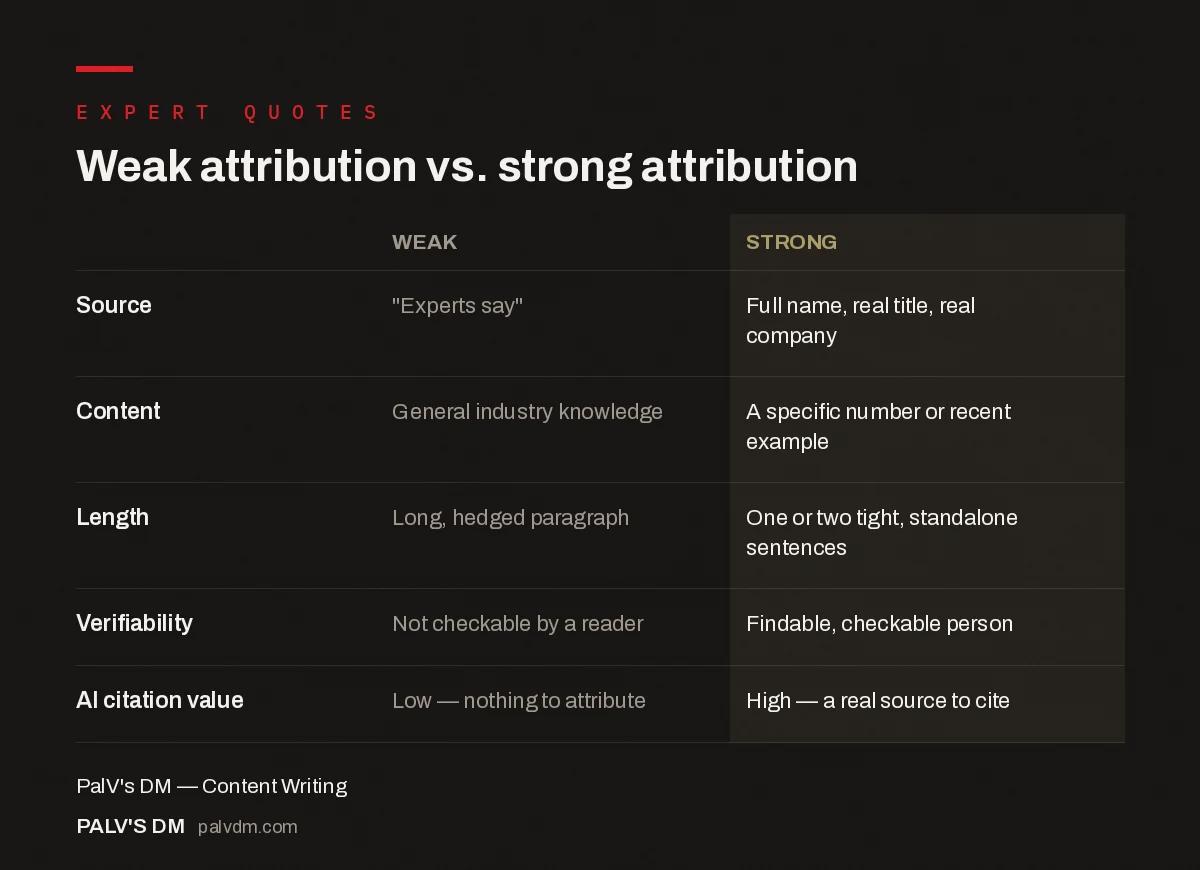
Weak attribution vs. strong attribution
| Weak | Strong | |
|---|---|---|
| Source | “Experts say” | Full name, real title, real company |
| Content | General industry knowledge | A specific number or recent example |
| Length | Long, hedged paragraph | One or two tight, standalone sentences |
| Verifiability | Not checkable by a reader | Findable, checkable person |
| AI citation value | Low — nothing to attribute | High — a real source to cite |
More on building genuinely original content
This post sits in our content strategy guide cluster on information gain. Pair it with information gain: saying something the top 10 didn’t for the bigger picture, and how to add original data without a research team if a quote alone isn’t enough for the post you’re planning. If the expert you’re quoting also touches on E-E-A-T signals for your site, our piece on how to demonstrate experience for E-E-A-T is a useful next read. And once the quote is in, run the rest of the draft through our AI-content humanising checklist so the human voice around it doesn’t undercut the credibility the quote just built.
FAQ
Do I need to record the call to use a quote?
It’s strongly recommended, both for accuracy and so you have a record if the wording is ever questioned. Ask permission at the start of the call; most people say yes, and a simple phone or laptop recorder is enough.
Can I quote someone anonymously?
You can, but it weakens the credibility benefit significantly. An anonymous quote is barely more trustworthy than no quote at all, since readers and AI systems can’t verify it. Use anonymity only when the person genuinely can’t be named, and say why.
How many expert quotes does one blog post need?
One well-chosen, specific quote does more for a post than three vague ones. Add a second only if a different section makes a separate unsupported claim that a different expert can speak to directly.
Is it okay to lightly edit a quote for grammar?
Yes, cleaning up filler words and false starts is standard practice and expected by most interviewees. Never add a number, claim, or opinion they didn’t actually say, even if it would make the quote stronger.
What if the expert asks to see the whole article before it’s published?
Reasonable requests to review their own quote in context are fine and often prevent disputes later. If they ask to review or edit unrelated parts of the post, it’s fair to say the quote review is separate from full editorial control.