How to Humanise AI-Written Copy (A Real Editing Checklist)
A practical three-pass checklist for humanising AI-written copy: strip AI vocabulary, break structural patterns, and add real, checkable substance.
Humanising AI-written copy means running a structured edit that removes AI-typical vocabulary, breaks up repetitive sentence patterns, and adds the specific, checkable detail a model can’t generate on its own. It’s not about “tricking” a detector. A properly humanised piece reads better for actual readers, which is the point AI detection tools were only ever a proxy for. The checklist below is the one we run on every AI-assisted draft before it goes anywhere near publish.
Published August 2026 — SEO team at PalV’s DM.
What actually makes AI-written copy sound like AI?
A handful of statistically overused words and a few structural habits, more than any single obvious “tell.” Certain words — delve, leverage, robust, seamless, tapestry, multifaceted — appear far more often in AI output than in typical human writing, often by a wide margin, because models learned them from a training corpus heavy on marketing and corporate copy. On top of vocabulary, AI drafts tend to repeat a narrow set of structural patterns: parallel “it’s not just X, it’s Y” constructions, groups of three (tricolons), heavy em-dash use, and a rhythm where every sentence lands at roughly the same length. None of these individually is a smoking gun. Stacked together across a whole page, they’re what makes a piece feel machine-written even when every fact in it is accurate.
What’s the full editing checklist, pass by pass?
Three passes, done in order, work better than trying to catch everything at once.
Pass 1: strip the vocabulary
- Search and remove banned words — delve, leverage, robust, seamless, unlock, harness, showcase, tapestry, landscape, multifaceted, crucial, comprehensive, utilize.
- Cut banned phrases — “in today’s fast-paced world,” “in the ever-evolving landscape of,” “unlock the potential of,” “it’s important to note that,” “at the end of the day.”
- Replace vague quantifiers with real numbers — “many businesses” becomes “63% of businesses” (if you have the source) or a specific, named example if you don’t.
Pass 2: break the structural patterns
- Scan for em-dash overuse. One or two per page is normal human writing; five or six in a row is a pattern worth breaking with periods or commas instead.
- Kill parallel negation where it’s not earning its place. “It’s not just about X, it’s about Y” is fine occasionally, exhausting on repeat.
- Vary sentence length deliberately. Count words per sentence in a section; if every sentence lands within a narrow 15-25 word band, cut some down to five or six words and let others run longer.
- Remove rhetorical question openers if every section starts with one — “But what does this actually mean?” repeated six times in one post is a dead giveaway.
Pass 3: add human texture
- Insert one specific, checkable detail per section — a real number, a named source, an actual example, not a generic illustration.
- Take an actual position. AI drafts default to balanced, hedge-everything framing; a human editor should be willing to say “this approach is usually better” and explain why.
- Use contractions. “It’s,” “don’t,” “won’t” read as natural speech; “it is,” “do not,” “will not” throughout an entire piece reads stiff and formal in a way conversational content usually isn’t.
- Cut section-ending recap sentences. AI drafts love to close every section with a summary of what it just said; readers don’t need it restated, and it’s one of the clearest structural tells.
How long does a proper humanising pass actually take?
For a 1,500-word post, budget 20-40 minutes for an editor who knows the checklist well. That’s meaningfully less time than writing the piece from scratch, which is the whole economic case for using AI drafting plus human editing rather than either extreme. The time goes mostly into pass 3 — finding and inserting the specific details a model can’t supply — since passes 1 and 2 are largely mechanical find-and-fix work that gets faster with practice.
Do AI detection scores actually tell you if a humanising pass worked?
Not reliably, and they shouldn’t be the target. AI detection tools have documented accuracy and false-positive problems that vary a lot by tool and by content type, and none of them measure the thing that actually matters — whether the content is accurate, specific, and worth a reader’s time. A detector score dropping after an edit is a weak, indirect signal at best. The better test is simpler: read the piece aloud, and ask whether it sounds like one specific person with real knowledge wrote it, or like a summary anyone could have generated about the topic in general.
What’s a fast self-check before publishing?
| Check | What to look for |
|---|---|
| Read the opening paragraph aloud | Does it sound like a person talking, or a press release? |
| Count em-dashes on the page | More than one or two per 500 words is worth trimming |
| Search for the banned-word list | Any hits at all should be replaced before publishing |
| Check sentence-length variety in one section | All sentences the same length is a tell; mix short and long |
| Count section-ending recap sentences | Zero is the target; each one found should be cut |
| Verify at least one specific, sourced fact per section | Vague generalities left unedited are the biggest quality gap |
Who should own the humanising pass on a content team?
A named human editor, every time, not a second AI pass alone. Running an AI draft through another AI “humaniser” tool can shuffle vocabulary without adding the one thing that actually matters — real, specific, checkable substance. The humanising pass is where a person’s judgment, opinion, and actual knowledge of the topic get folded in; that step doesn’t have a good automated substitute yet. If your team is publishing AI-assisted content without a defined humanising step, that gap is usually visible in the finished posts, and it’s the first thing we fix when we take over a client’s content operation. Our content writing service runs this exact three-pass checklist on every AI-assisted draft before it goes to a client.
What does a bad humanising pass look like, versus a good one?
A bad pass only touches pass 1 — swap a few banned words, leave everything else untouched. The piece technically has no “delve” or “leverage” in it anymore, but the sentence rhythm is still flat, every section still ends with a recap sentence, and there’s still no specific detail a reader couldn’t get from any other page on the topic. It reads slightly less obviously AI-generated and is otherwise unchanged in substance.
A good pass does all three, in order, and spends the most time on the third. The vocabulary and structural fixes are largely mechanical and take ten minutes once you know the checklist. The real value comes from the editor actually thinking about the topic long enough to add something — a real client detail, a genuine opinion about which approach is actually better, a number pulled from the team’s own experience. That’s the step that turns a technically-cleaned-up AI draft into something worth a reader’s time, and it’s also the step most teams skip when they’re moving fast.
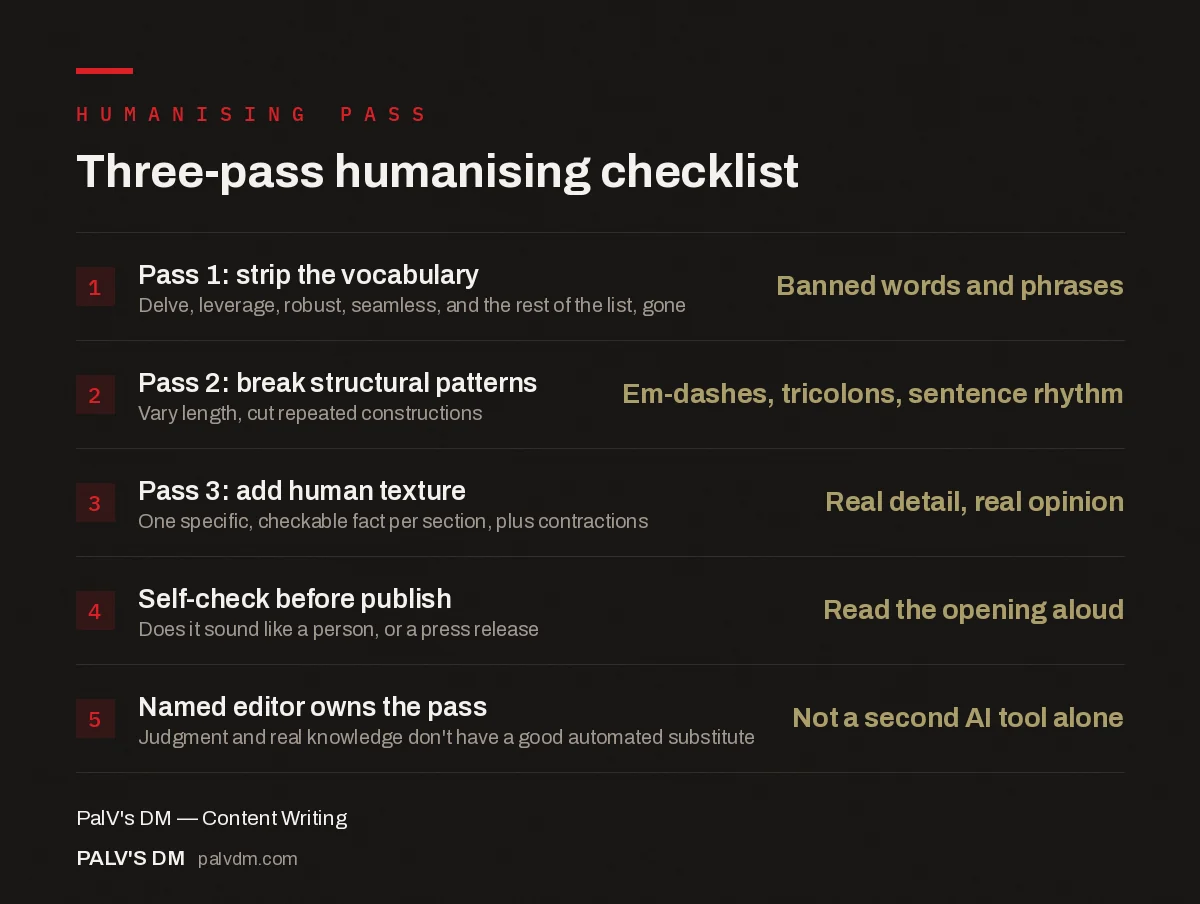
Three-pass humanising checklist
- Pass 1: strip the vocabulary — Banned words and phrases. Delve, leverage, robust, seamless, and the rest of the list, gone.
- Pass 2: break structural patterns — Em-dashes, tricolons, sentence rhythm. Vary length, cut repeated constructions.
- Pass 3: add human texture — Real detail, real opinion. One specific, checkable fact per section, plus contractions.
- Self-check before publish — Read the opening aloud. Does it sound like a person, or a press release.
- Named editor owns the pass — Not a second AI tool alone. Judgment and real knowledge don’t have a good automated substitute.
Related reading on humanising and content quality
This post pairs with the banned phrase list we edit out of every draft for the full vocabulary reference, and phrases that instantly signal AI-written copy if you want more examples of structural tells beyond vocabulary. If you’re weighing whether to use AI tools at all, start with where AI writing tools help and where they wreck quality. For the underlying editorial standard this checklist is built around, our content strategy guide covers where humanising fits in a full content process. And if you want to understand why detector scores aren’t the right target, see AI content detectors: what they measure and why it’s not quality.
FAQ
Will humanising an AI draft guarantee it passes an AI detector?
No tool can guarantee that, since detectors themselves have known accuracy limits and false-positive rates that vary by tool. A proper humanising pass improves actual quality, which is a better and more durable goal than gaming a specific detector’s score.
Is it faster to just write from scratch instead of humanising an AI draft?
Usually not, for most content teams. A solid AI first draft plus a 20-40 minute human editing pass is typically faster than writing 1,500 words unassisted, as long as the editing pass genuinely adds substance rather than just rewording.
Do I need special software to humanise AI content?
No. A checklist, a find-and-replace pass for banned words, and an editor who reads the draft carefully covers most of the work. Dedicated “AI humaniser” tools mainly reword sentences and don’t add the real, checkable substance that matters most.
How do I know if my sentence length actually needs more variety?
Pick a paragraph and count words per sentence. If most sentences land within a narrow five-to-ten-word range of each other, it likely reads monotonous. Deliberately cutting some sentences short and letting others run longer usually fixes it quickly.
Should every AI-assisted draft get the same level of humanising effort?
No. A quick internal FAQ update needs less than a flagship guide meant to rank and get cited. Match the editing depth to how much the piece needs to carry real authority and originality.