The Banned Phrase List We Edit Out of Every Draft
The exact banned-word and banned-phrase list we cut from every AI-assisted draft before publishing, and why each one signals unedited writing.
The phrases below are the ones that get cut from every draft before it goes to a client, because they’re statistically overused in AI-generated text and they signal generic, unedited writing to readers, editors, and increasingly to AI systems evaluating content quality. This isn’t a complete academic list — it’s the working list we actually use, organised by why each entry earns a place on it.
Published August 2026 — SEO team at PalV’s DM.
Why do these specific phrases keep showing up in AI-generated text?
Large language models are trained on huge volumes of text, including a lot of corporate marketing copy and formal writing, and they learn which words tend to follow which other words. Certain words and phrases became statistically dominant in that training data — formal, hedge-y, vaguely impressive-sounding constructions — and models reproduce them far more often than a typical human writer would in casual or even professional prose. None of these words are wrong in isolation. The problem is frequency: when “delve” and “leverage” and “robust” show up in nearly every AI-assisted draft regardless of topic, they stop signalling anything specific and start signalling “this wasn’t edited.”
The banned single words
- Delve — almost always replaceable with “look at,” “cover,” or “get into.”
- Leverage (as a verb) — usually just means “use.”
- Robust — vague; replace with the specific quality you actually mean (durable, thorough, well-tested).
- Seamless — another vague quality word; say specifically what works well and why.
- Unlock — overused as a metaphor for “enable” or “access.”
- Harness — same problem as “leverage,” dressed differently.
- Showcase — usually just means “show” or “demonstrate.”
- Tapestry — a metaphor that shows up constantly in AI output and almost nowhere in normal human writing about business topics.
- Multifaceted — vague; name the actual facets instead.
- Comprehensive — overused as a filler adjective; let the content demonstrate thoroughness instead of claiming it.
- Utilize — “use” is shorter and reads more natural in almost every context.
- Crucial — overused as an intensifier; often the sentence works fine without it.
The banned phrases
- “In today’s fast-paced world” and its variants (“in today’s digital landscape,” “in the modern era”) — a throat-clearing opener that adds no information and delays the actual point.
- “In the ever-evolving landscape of…” — same problem, dressed up with “landscape,” another overused word on its own.
- “Unlock the potential of…” — combines two banned words into one banned phrase.
- “It’s important to note that…” — usually the sentence is stronger with this stripped out entirely.
- “At the end of the day…” — a filler transition that rarely earns its place.
- “Let’s dive in” — a throat-clearing transition into the body of a piece; just start the body.
- “Whether you’re a beginner or an expert…” — a hedge that tries to address everyone and ends up being specific to no one.
- “Not only… but also…” (overused) — fine occasionally, exhausting when it appears in every other paragraph.
- “It’s not just about X, it’s about Y” — the parallel-negation construction that AI models default to constantly.
Which of these are actually fine sometimes?
Context matters more than a blanket ban for a handful of these. “Comprehensive” is a legitimate word if you’re specifically contrasting a thorough resource against a shallow one and the contrast is the point. “Crucial” is fine once in a 2,000-word piece if the thing genuinely is more important than everything around it. The banned-word discipline isn’t about never using a word again — it’s about noticing when a word or phrase has become a reflex rather than a choice, which is almost always what’s happening when three or four of these show up in the same 500-word section.
How do you actually enforce a banned phrase list on a real content team?
| Method | How it works | Best for |
|---|---|---|
| Find-and-replace pass | Search the draft for each banned word before final edit | Solo writers, small teams |
| Shared style-guide doc | A living list every writer and editor references | Teams with more than 2-3 writers |
| Editor checklist at sign-off | A final gate before publish, separate from the writer’s own pass | Any team publishing at real volume |
| Automated linting (custom script or plugin) | Flags banned terms automatically in a CMS or docs tool | Larger teams with dev resources |
What should replace these words?
Usually something shorter and more specific, not a fancier synonym. “Leverage our expertise” becomes “we’ve done this for 40+ client sites.” “Robust SEO strategy” becomes “an SEO strategy that covers technical fixes, content, and links, in that priority order.” The pattern across almost every fix on this list is the same: trade a vague, impressive-sounding abstraction for something a reader can actually picture or verify. That’s not just a style preference — specific language is also what gives readers and AI systems something concrete to act on or cite, where vague language gives them nothing.
If your team is publishing content that reads generically despite good research and real expertise behind it, a banned-phrase pass is one of the fastest, lowest-cost fixes available. Our content writing service runs every draft through this exact list before anything goes to a client, as one part of a broader humanising process.
How do you build your own list instead of just using this one?
Start by reading back through your last ten published posts and circling every word or phrase that shows up more than twice across the set. Most teams find their own small cluster of overused constructions this way, separate from the generic AI-associated list, because writers develop personal verbal tics whether or not AI is involved in the drafting. A content lead at a mid-sized team might notice “at scale” or “moving the needle” creeping into nearly every post; neither of those is on a generic AI-phrase list, but both deserve the same treatment once the pattern is visible.
Keep the list somewhere every writer and editor can see and edit, not buried in a single person’s notes. A shared document that anyone can add to when they spot a new recurring offender keeps the list current as writing habits and AI-model tendencies shift over time. Review it every quarter rather than treating it as a one-time exercise; language habits drift, and a list built in early 2025 will already be missing some of what shows up in drafts a year later.
Involve the whole team in maintaining the list rather than having one editor impose it top-down. Writers who understand why a phrase is banned, not just that it’s banned, are more likely to catch it themselves during drafting instead of relying entirely on an editor to strip it out later. A five-minute team discussion of “what did we cut this month and why” once a quarter keeps the list a living tool rather than a rule nobody remembers the reasoning behind.
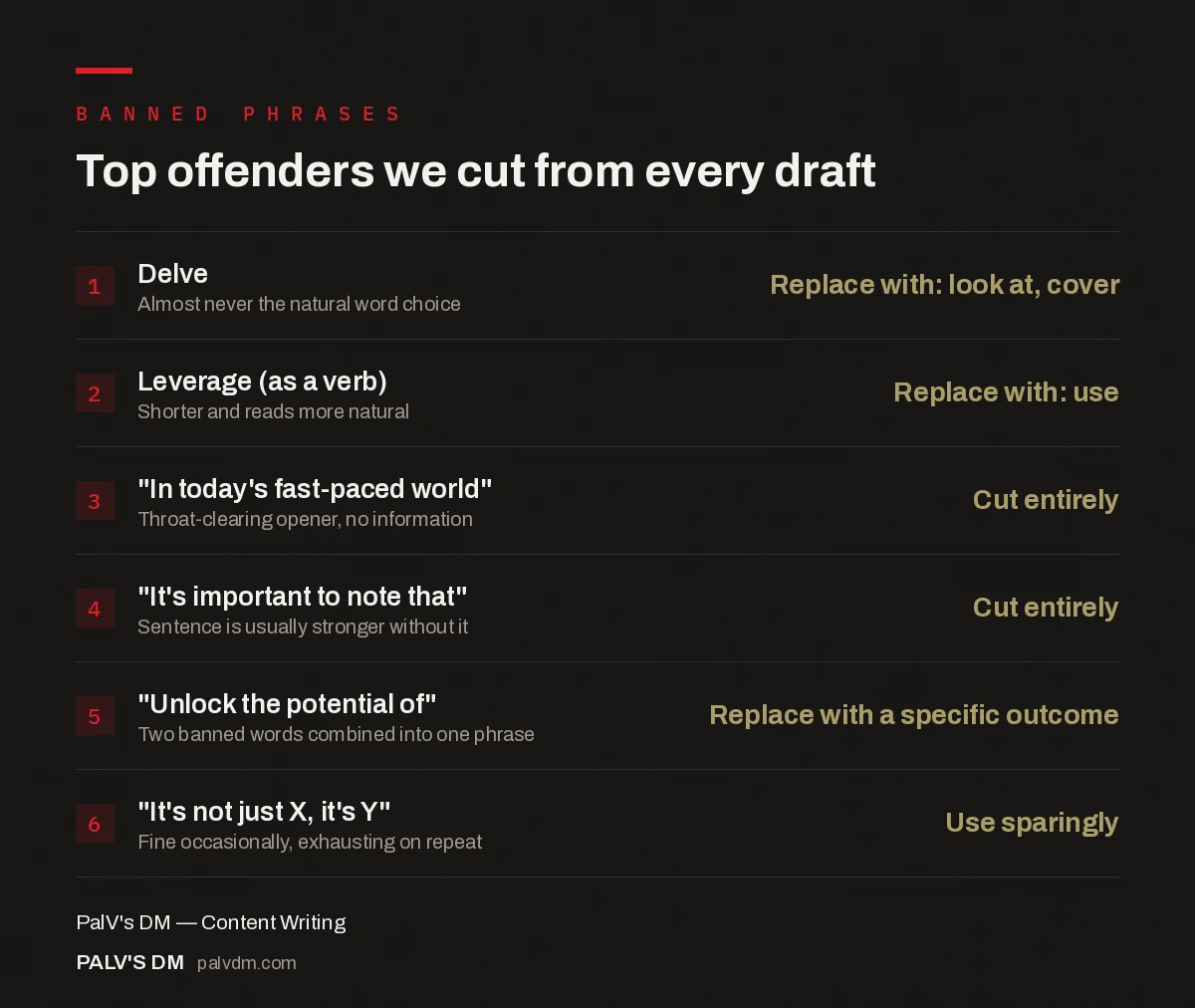
Top offenders we cut from every draft
- Delve — Replace with: look at, cover. Almost never the natural word choice.
- Leverage (as a verb) — Replace with: use. Shorter and reads more natural.
- “In today’s fast-paced world” — Cut entirely. Throat-clearing opener, no information.
- “It’s important to note that” — Cut entirely. Sentence is usually stronger without it.
- “Unlock the potential of” — Replace with a specific outcome. Two banned words combined into one phrase.
- “It’s not just X, it’s Y” — Use sparingly. Fine occasionally, exhausting on repeat.
Related reading on humanising and editing
For the full editing process this list fits into, see how to humanise AI-written copy. If you want more structural tells beyond vocabulary, read phrases that instantly signal AI-written copy. This post is part of our content strategy guide cluster, and pairs with AI writing tools: where they help and where they wreck quality for the bigger workflow picture. If detector scores are part of your QA process, our piece on AI content detectors: what they measure and why it’s not quality explains why a clean banned-phrase pass matters more than a passing detector score.
FAQ
Is using the word “delve” always a sign of AI-written content?
Not by itself — a single instance proves nothing. It’s the frequency and combination with other overused words and phrases in the same piece that signals unedited AI output, not any one word in isolation.
Do banned-phrase lists differ by industry or audience?
The core list is fairly consistent across industries because it reflects patterns in how AI models generate text generally, not industry-specific jargon. Some teams add extra terms specific to their own audience’s pet peeves on top of the core list.
Should I ban these words even in human-written drafts?
Yes, if they show up. These words became AI-associated because they were already overused in corporate and marketing writing before generative AI existed; a human writer falling into the same habits benefits from the same edit.
How often should a banned-phrase list be updated?
Periodically, since the specific words AI models overuse can shift as models and training data change. Revisit the list every few months and add anything you’re noticing repeatedly in fresh drafts.
Is it overkill to ban common words like “comprehensive” or “crucial”?
Not overkill, but it should be about frequency and reflex use rather than a total ban. The goal is catching lazy, automatic word choices, not eliminating perfectly good words from the language entirely.