Phrases That Instantly Signal AI-Written Copy
The structural patterns that give away AI-written copy faster than vocabulary does: parallel negation, tricolons, uniform sentence length, and more.
The fastest way to spot AI-written copy isn’t any single word — it’s a cluster of structural habits: parallel “not just X, but Y” constructions, groups of three, uniform sentence length, heavy em-dash use, and section-ending recaps that restate what was just said. Any one of these shows up occasionally in good human writing. Several of them together, repeated across a whole page, is the real tell. Below are the patterns worth training your eye to catch.
Published August 2026 — SEO team at PalV’s DM.
Why do structural patterns give away AI writing more than vocabulary does?
Because vocabulary is easy to fix with a find-and-replace pass, but structural habits are baked into how the text was generated in the first place and survive light editing. A model trained to produce fluent, well-formed sentences tends to default to a narrow set of rhetorical structures it saw repeated often in training data. A human writer under deadline pressure might overuse one or two habits; an unedited AI draft tends to stack several of them at once, in a way that reads smoothly sentence-by-sentence but starts to feel mechanical across a full page.
The structural tells
- The parallel negation construction — “It’s not just about X, it’s about Y.” Effective once. Repeated four times in one post, it starts to feel like a formula rather than a genuine rhetorical choice.
- The tricolon habit — grouping things in threes (“faster, cheaper, and more reliable”) far more often than natural speech does. Threes aren’t wrong, but a page where nearly every list and description comes in exact groups of three reads as patterned.
- Uniform sentence length — when nearly every sentence in a paragraph runs 15-25 words, with none shorter or longer, the rhythm feels flat in a way that’s hard to describe but easy to notice once you’re looking for it.
- Heavy em-dash use — not one or two per page, but four, five, six in quick succession, often doing the job a comma or a full stop would do more naturally.
- The rhetorical-question opener — starting section after section with a question (“But what does this mean for your business?”) instead of just stating the point directly.
- The section-ending recap — closing nearly every section with a sentence that just restates what the section already said, instead of ending on the actual point or moving forward.
- The generic transition stack — “Furthermore,” “moreover,” “additionally,” “in addition” appearing far more often than they would in natural writing, where transitions tend to vary more and sometimes disappear entirely.
- The hedge-everything stance — balancing every claim with an immediate counterpoint, never quite landing on a real opinion, which produces technically accurate but ultimately noncommittal prose.
How common are these patterns really, and does one instance matter?
One instance of any single pattern rarely matters and shows up in plenty of genuinely human writing — people naturally reach for tricolons and rhetorical questions sometimes. What’s diagnostic is density and combination. A page with one em-dash, one tricolon, and one rhetorical question spread across 1,500 words is unremarkable. A page with all eight patterns above, repeated multiple times each, is very likely unedited AI output, or AI output edited only for vocabulary and not for structure.
| Pattern frequency | Likely read |
|---|---|
| 1-2 patterns, used once or twice each | Normal human writing variation |
| 3-4 patterns, used a few times each | Possibly AI-assisted with a light edit |
| 5+ patterns, repeated throughout | Very likely unedited or under-edited AI draft |
How do you actually train yourself to catch these while editing?
- Read the draft aloud, or use a text-to-speech tool. Patterns that look fine on the page often sound repetitive out loud.
- Highlight every em-dash in a document; if there are more than one or two per 500 words, some need to go.
- Count sentences per paragraph that fall in the same 15-25 word range; if it’s most of them, cut a few short and let one or two run long.
- Search for “not just,” “not only,” and “it’s about” to catch parallel negation clusters.
- Check the last sentence of every section; if it just restates the section’s opening point, cut it or replace it with something that actually moves the argument forward.
Do these tells apply to short-form content too, or just long articles?
They show up in shorter content too, just with less room to accumulate. A 200-word product description with two tricolons and a rhetorical-question opener is already showing the pattern, even without the length to make it as obvious as a full blog post would. The shorter the piece, the less margin there is for even one or two of these habits before the whole thing reads as generic.
What’s the actual fix once you’ve spotted the patterns?
Rewrite for variety, not just correctness. Break up a run of same-length sentences by cutting one down to five words. Replace a parallel-negation construction with a direct statement. Delete a section-ending recap entirely and see if the section is actually weaker without it — usually it isn’t. This is mechanical work once you know what to look for, and it’s exactly the kind of editing pass that turns a serviceable AI-assisted first draft into something that reads like one specific person wrote it with an actual point of view.
Why does fixing structure matter more than fixing vocabulary alone?
Because a vocabulary-only edit is the easiest gap for a reader, or an editor, to spot once they know to look for it. Swapping “delve” for “explore” while leaving five stacked em-dashes and three tricolons in the same paragraph doesn’t change how the passage actually reads — it just removes the most obvious single-word flag while leaving the underlying pattern fully intact. A page can pass a casual word-search for banned terms and still read as obviously unedited the moment someone reads two consecutive paragraphs aloud.
Structure is also harder for a writer to notice in their own work, because each individual sentence looks fine in isolation. The problem only shows up at the paragraph or section level, which is exactly why a second pair of eyes, or a deliberate checklist pass separate from the first read-through, catches issues a single quick edit misses. Teams that build structural review into their process, not just a vocabulary find-and-replace, consistently produce content that reads as more credible and more specific, independent of whether any AI tool was involved in the first draft.
Our content writing service trains editors specifically to catch these structural patterns, not just banned vocabulary, because the structure is what survives a sloppy vocabulary-only edit.
None of this means treating every tricolon or every em-dash as an error to be hunted down. Good writing, human or AI-assisted, still uses these constructions when they genuinely fit. The goal is catching the difference between a deliberate choice made once and a reflex repeated eight times on the same page, and that judgment call is exactly what makes editing a skill rather than a mechanical checklist exercise.
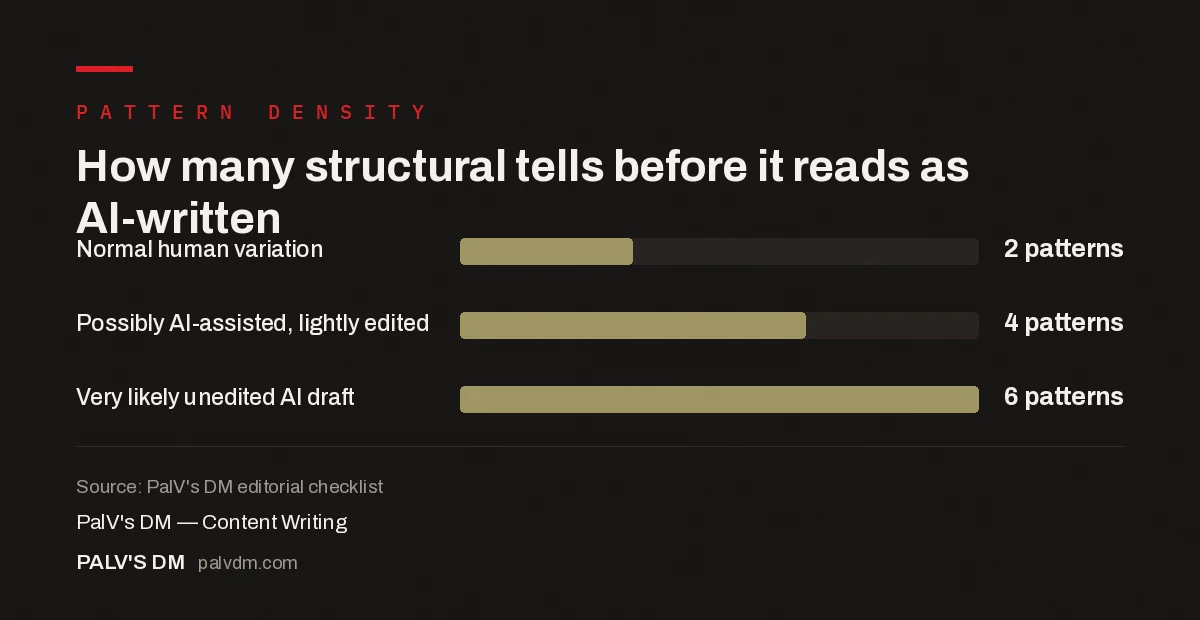
How many structural tells before it reads as AI-written
| Metric | Value |
|---|---|
| Normal human variation | 2 patterns |
| Possibly AI-assisted, lightly edited | 4 patterns |
| Very likely unedited AI draft | 6 patterns |
Source: PalV’s DM editorial checklist
Related reading on spotting and fixing AI writing tells
For the vocabulary side of this same problem, see the banned phrase list we edit out of every draft. For the full editing process, read how to humanise AI-written copy. This post is part of our content strategy guide cluster on AI writing, and pairs with AI content detectors: what they measure and why it’s not quality if you’re deciding how much to trust automated tools versus your own editorial eye. If you’re weighing AI tool use at all, start with AI writing tools: where they help and where they wreck quality.
FAQ
Is a single em-dash in a post a sign of AI writing?
No. One or two em-dashes in a full-length post is completely normal in human writing. It’s five or six in quick succession, repeated across a page, that signals an unedited AI habit rather than a deliberate stylistic choice.
Can these structural tells show up in content that’s fully human-written?
Yes, especially from writers who learned formal or academic writing conventions, or who are simply following patterns they picked up from reading a lot of similarly structured content. The tells indicate pattern overuse, not proof of AI authorship on their own.
Do editing tools automatically fix these structural patterns?
Some grammar and style tools flag repetitive sentence structure or overused transitions, but most won’t catch parallel negation clusters or section-ending recap habits specifically. A trained human editor reading with this list in mind catches more than most automated tools currently do.
Which pattern is the easiest one to fix first?
Uniform sentence length is usually the fastest win. Picking three or four sentences in a paragraph and deliberately shortening or lengthening them takes minutes and immediately changes how the passage reads.
Should I worry about these patterns in internal documents, not just published content?
Less urgently, since internal docs aren’t being evaluated for reader engagement or search performance. But if a document is meant to persuade or inform decision-makers, the same patterns that make published content feel generic will make an internal memo feel less credible too.