AI Content Detectors: What They Measure and Why It’s Not Quality
AI content detectors measure statistical writing patterns, not accuracy or quality. Here's what they actually catch, how reliable they are, and what to check instead.
AI content detectors measure statistical patterns in word choice and sentence structure that correlate with machine-generated text, not whether content is accurate, useful, or well-researched. A detector can flag a carefully fact-checked, genuinely useful piece as “likely AI” if it happens to use predictable phrasing, and it can miss a low-quality, inaccurate AI draft that’s been lightly reworded. Treating a detector score as a quality score is the mistake worth correcting before it shapes an entire editorial process around the wrong target.
Published August 2026 — SEO team at PalV’s DM.
What do AI content detectors actually measure?
Statistical predictability. Most detectors analyse “perplexity” (how surprising or predictable each word choice is given what came before) and “burstiness” (how much sentence length and structure varies across a passage). Human writing tends to be less predictable word-to-word and more variable in rhythm; AI-generated text, by design, tends toward the statistically likely next word, which produces smoother, more uniform patterns. Detectors compare a piece of text against these patterns and output a probability score.
None of that measures whether the content is correct, whether it’s useful to the reader, or whether it says anything worth reading. A detector has no mechanism for checking facts, evaluating originality of ideas, or assessing whether a claim is properly sourced. It’s a stylometric pattern-matcher, not a fact-checker or a quality evaluator.
How accurate are these tools, really?
It varies substantially by tool and by testing methodology, which is itself part of the problem — there’s no single agreed-upon accuracy figure across the industry. Independent comparisons have found wide swings in both overall accuracy and false-positive rates between popular detectors, with some tools showing false-positive rates under 1% in certain tests and others showing false-positive rates in the high single digits or worse in others. Performance also tends to drop meaningfully on mixed human-and-AI content, which is exactly the kind of writing most real content teams produce — an AI-assisted first draft with substantial human editing.
| What detectors can do | What detectors can’t do |
|---|---|
| Flag statistically predictable phrasing patterns | Verify facts or statistics in the content |
| Estimate a probability score for AI origin | Reliably score mixed human/AI content |
| Catch obviously unedited, generic AI output | Judge originality of ideas or arguments |
| Provide a rough, imperfect signal for editorial review | Guarantee zero false positives on human writing |
Why do false positives happen to real human writers?
Because clear, structured, grammatically correct writing can look statistically similar to AI output, especially from non-native English writers, technical writers, or anyone trained to write in a formal, consistent style. A detector doesn’t know who wrote something; it only measures pattern predictability. Writers who learned English formally, or who write in a naturally consistent, methodical style, are disproportionately likely to get flagged, which is a documented and widely discussed limitation of these tools, not an edge case.
Should content teams use detectors at all?
As a rough, early-warning signal, cautiously yes. As a pass/fail quality gate, no. A detector flagging a piece is a reasonable prompt to have a human editor look more closely at whether the content is generic and undersourced — but the actual decision about whether to publish should be based on the human review, not the detector score itself. Using a detector score as the sole publishing gate creates two failure modes: genuinely good, human-reviewed content gets rejected or endlessly rewritten to dodge a false positive, while genuinely thin, inaccurate AI content that’s been superficially reworded slips through because it no longer trips the pattern-matcher.
What should you check instead of, or alongside, a detector score?
- Does every statistic have a real, checkable source? This is the single most important quality check, and no detector performs it.
- Is there at least one specific, non-generic detail per section? A named example, a real number, a genuine opinion — the things a generic AI draft is least likely to contain unedited.
- Would a subject-matter expert find anything wrong or oversimplified? Detectors can’t evaluate domain accuracy; only a knowledgeable human reviewer can.
- Does the piece read naturally when read aloud? A simple, low-tech test that catches a lot of what detectors miss and flags some of what they falsely catch.
What’s the practical takeaway for a content team choosing tools?
- Don’t build an editorial process around passing a detector score — build it around fact-checking and substantive human review.
- If you use a detector, treat a flag as “look closer,” not “reject automatically.”
- Weight false-positive risk heavily if any of your writers write in a formal or non-native style; the tool is more likely to be wrong about them specifically.
- Measure what actually matters instead — accuracy, specificity, and whether a human could defend every claim in the piece.
Chasing a lower detector score without fixing the underlying substance produces content that’s better at evading pattern-matching and no more useful to a reader, which defeats the purpose. Our content writing service focuses editorial review on accuracy and originality rather than optimising for any specific detector’s score, because that’s what actually correlates with content performing well.
What happens when teams optimise purely for a lower detector score?
The content usually gets worse, not better. The fastest ways to lower a detector score — swapping in synonyms, adding random sentence-length variation, inserting filler clauses — don’t add any real information. They just make the pattern-matching harder without touching the actual problem, which is usually a lack of specific, sourced substance. A team chasing a detector score can end up spending editing time on synonym-swapping instead of on the fact-checking and expert input that would have made the piece genuinely better and, as a side effect, probably would have lowered the detector score anyway through natural, varied writing.
This is the same trap as keyword-stuffing was in early SEO: optimising directly for what a tool measures, instead of for the underlying quality the tool was only ever a rough proxy for. The teams that get the best long-term results treat detector scores, if they use them at all, as a diagnostic nudge to double-check a piece, not a target to hit through cosmetic rewording.
A useful test for whether a team is chasing the wrong metric: ask what changed in the actual content the last time a detector score improved. If the answer is “we fact-checked a claim and added a real example,” the score improvement is a side effect of genuine work. If the answer is “we swapped some words around,” the team is optimising for the proxy instead of the target, and it’s worth resetting the review process before that habit spreads across the whole content calendar.
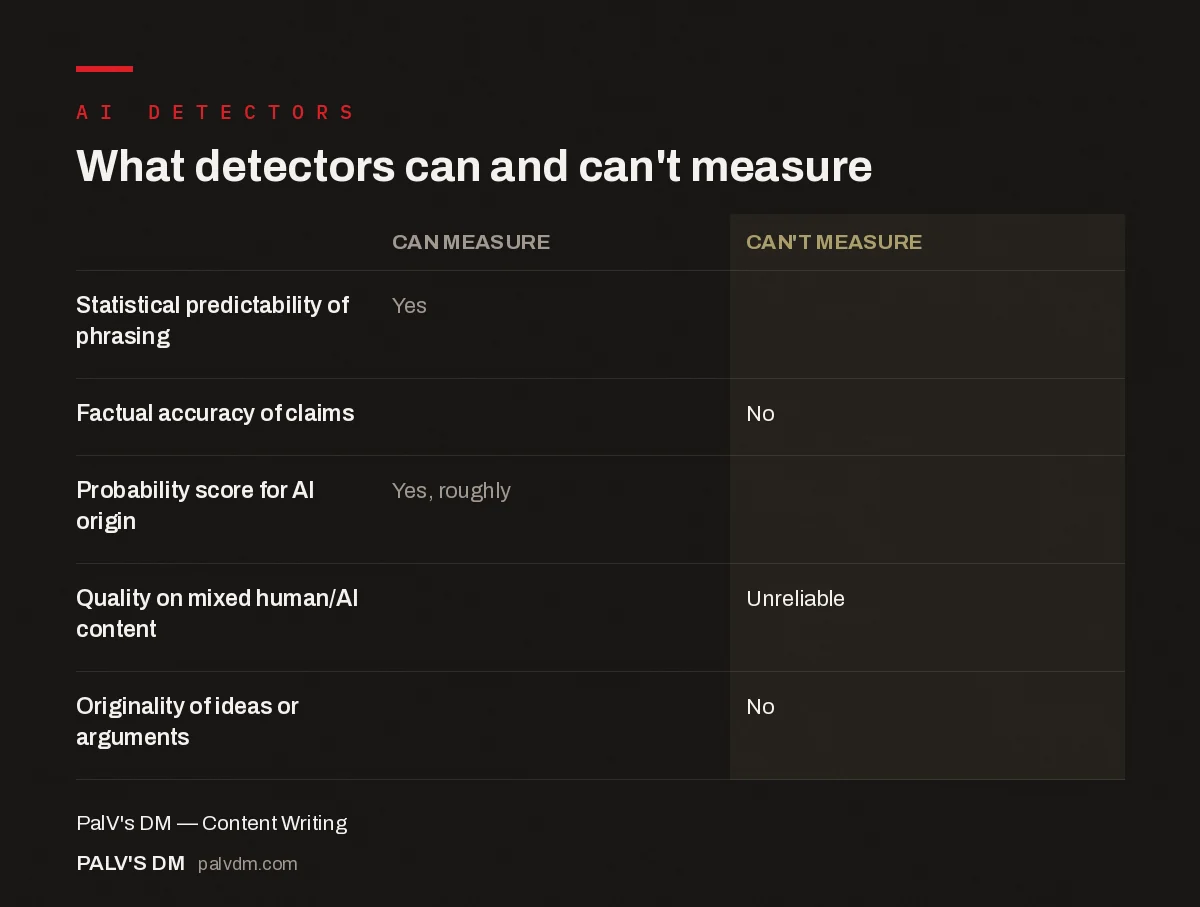
What detectors can and can’t measure
| Can measure | Can’t measure | |
|---|---|---|
| Statistical predictability of phrasing | Yes | |
| Factual accuracy of claims | No | |
| Probability score for AI origin | Yes, roughly | |
| Quality on mixed human/AI content | Unreliable | |
| Originality of ideas or arguments | No |
What does a real false-positive case look like?
A useful, well-documented example: in 2023, Stanford researchers testing GPT detectors on TOEFL essays written by non-native English speakers found that several widely used detectors misclassified a large share of those genuinely human-written essays as AI-generated, while the same tools performed much better on essays from native English speakers. The essays weren’t unusual in content; they simply used the more formulaic, less “bursty” sentence structures common in formal second-language writing, which happens to overlap statistically with the predictable patterns detectors are trained to flag.
The practical lesson for a content team isn’t “detectors are useless,” it’s “detectors carry a specific, known bias that maps onto writer background, not writing quality.” A team that disciplines a writer, or discards a piece, purely on a detector flag risks penalising exactly the writers least able to defend themselves against a false accusation — freelancers writing in a second language, technical writers trained toward formal consistency, or anyone who simply writes in short, declarative sentences. That’s a fairness problem as much as an accuracy one, and it’s a strong argument for using a detector score as one input into a human review, never as the review itself.
Do different detector tools actually agree with each other?
Not reliably, which is itself useful evidence that no single tool has cracked the underlying problem. It’s common for the same piece of text to score very differently across two or three popular detectors — one flagging it as highly likely AI-generated, another scoring it as mostly human, a third landing somewhere in between. This isn’t a sign that one tool is right and the others are broken; it reflects that each tool trains on different reference data and weights perplexity and burstiness signals differently, so their outputs are estimates built on different assumptions, not a single objective measurement.
A practical implication: if a team decides to use detectors at all, running a single tool and treating its number as final is riskier than it looks, precisely because the tools don’t converge on the same answer for the same text. Checking a borderline piece against more than one tool, and weighting disagreement as a signal to rely on human judgment instead, is a more defensible process than picking one detector and trusting its output as ground truth.
Related reading on AI content quality
For the editing process that actually improves quality rather than just detector scores, see how to humanise AI-written copy and the banned phrase list we edit out of every draft. If you’re deciding how much AI assistance to use at all, read AI writing tools: where they help and where they wreck quality. This post is part of our content strategy guide, and for the policy question behind all of this, see is AI-generated content against Google’s guidelines.
FAQ
Can AI content detectors reliably tell if I used ChatGPT specifically?
No, detectors generally can’t reliably identify which specific tool produced a piece of text. They estimate a general probability of AI origin based on statistical patterns, not a tool-specific fingerprint.
Do detectors get less accurate as AI models improve?
This is a reasonable concern raised across the industry: as models produce more varied, less statistically predictable output, the perplexity-based signals detectors rely on become harder to distinguish from human writing, which puts ongoing pressure on detector accuracy over time.
Is it fair for universities or publishers to reject work based on a detector score alone?
Given the documented false-positive rates, using a detector score as the sole basis for rejecting someone’s work is widely criticised as unreliable. Most guidance recommends treating a flag as a prompt for further human review, not a final verdict.
Can editing an AI draft heavily still trigger a detector?
It depends on how heavily and how the editing changes sentence structure and word predictability. Substantial human rewriting, especially with varied sentence length and specific added detail, generally reduces detector flags, though no method guarantees a specific score.
What’s a better metric than a detector score for content quality?
A combination of factual accuracy (every claim sourced and verified), specificity (real examples and numbers, not generalities), and whether a subject-matter expert would sign off on it. None of these are things a pattern-matching detector measures.