Is AI-Generated Content Against Google’s Guidelines?
No, AI-generated content isn't against Google's guidelines by default. Here's what Google's spam policy actually says, and what really puts a page at risk.
No, AI-generated content is not against Google’s guidelines simply because it was produced with AI. Google’s official spam policy documentation states that using automation, including AI, to generate content is a policy violation only when the goal is manipulating search rankings rather than helping users. The policy Google previously titled “automatically generated content” was renamed “scaled content abuse” to make this explicit — the concern is volume and intent, not the tool used to write the words.
Published August 2026 — SEO team at PalV’s DM.
What does Google actually say about AI-generated content?
Google’s Search Central documentation on spam policies addresses this directly: content is evaluated for whether it’s helpful and created for people first, regardless of how it was produced. The guidance acknowledges AI can be useful for researching topics and adding structure to original content. What crosses the line, per the same documentation, is using generative AI or similar tools to generate many pages without adding value for users — scaled content abuse applies equally whether that scaling was done by AI, by a team of low-paid human writers, or by any other automated method.
Myth: “Google can detect AI writing and automatically penalises it”
This isn’t accurate, and it’s one of the most persistent misunderstandings in the industry. Google has not confirmed any classifier that identifies “this was written by AI” and applies a penalty on that basis alone. What Google’s ranking systems evaluate is quality, helpfulness, and originality signals — the same signals that apply to human-written content. A poorly written, generic human-written post can rank badly for the same reasons a poorly written, generic AI-written post can. The production method isn’t the input to that evaluation; the output quality is.
Myth: “Any use of AI in the writing process is risky”
Also not accurate, and this misunderstanding causes some teams to avoid legitimate uses of AI tools that Google’s own documentation explicitly permits — research assistance, structural help, summarising source material. The risk isn’t touching an AI tool at any point in the workflow. It’s publishing large volumes of unedited, low-substance content whose only purpose is occupying keyword space, which was always against Google’s spam policies, long before generative AI existed in its current form.
What does “scaled content abuse” actually cover?
| Behaviour | Violates policy? |
|---|---|
| Using AI to draft a post, then editing it with real data and human judgment | No |
| Publishing hundreds of AI-generated pages with no human review, targeting keyword variations | Yes |
| Using AI to summarise research you conducted yourself | No |
| Scraping and stitching together content from other sites, AI-assisted or not | Yes |
| Writing every post entirely by hand with no AI involvement, but at high volume with no real value added | Yes — this is method-agnostic |
| Using AI for a first draft, then adding original data, a named expert quote, and human editing | No |
Why does this myth persist despite Google’s clear public statements?
Partly because “AI content bad” is a simpler, more shareable claim than “content quality depends on substance regardless of production method.” Partly because plenty of visibly low-quality AI content did get published at scale during the early period of generative AI tools becoming widely accessible, and some of it did get caught by ranking updates — but it was caught for being thin and unhelpful, not for the AI label. The correlation between “AI-produced” and “got demoted” was real in a lot of observed cases, but the causal driver was quality and scale abuse, which the sites in question would likely have triggered with low-quality human content too.
How do you tell if your AI-assisted content is at risk, regardless of the myth?
- Check whether a human reviewed and substantively edited each piece, not just skimmed it for typos.
- Check whether each piece adds something beyond what’s already ranking — a real number, a genuine detail, an actual point of view.
- Check your publishing volume against your review capacity. If you’re publishing faster than a human can genuinely fact-check and edit, that’s the actual risk zone, independent of AI use.
- Check for accuracy issues. Unverified AI-generated statistics are a real, common problem — not because of a “detected AI” penalty, but because false claims damage trust and can trigger quality-signal issues on their own.
What should you actually do with this information?
Stop treating “did we use AI” as the compliance question and start treating “did a human make this genuinely useful and accurate” as the compliance question, because that’s the question Google’s documented policy actually asks. Teams that get this backwards either avoid useful AI-assisted workflows out of unnecessary caution, or lean into AI drafting without adding the human substance that was always the actual requirement. Neither serves the content or the reader.
How does this play out for a real content team publishing weekly?
Say a team publishes eight posts a month, all drafted with AI assistance and edited by one person before going live. Under the actual policy, the compliance question isn’t whether AI touched the draft — it’s whether that one editor genuinely reviewed each piece, verified the claims, and added something the AI couldn’t supply on its own. Eight properly edited posts a month is very different from eighty unreviewed posts a month, even if both sets used the same AI tool at the drafting stage. The volume-versus-review-capacity ratio is a better predictor of risk than any measure of “how much AI was involved.”
This also explains why two sites can use the same AI tools and get very different outcomes. One treats the AI output as a finished product and publishes at high volume with minimal review. The other treats it as raw material, adds real data and expert input, and publishes at a pace its editorial team can actually keep up with. Google’s policy, as written, treats these two operations very differently — not because of the tool, but because of what happened after the tool was used.
If you want a second opinion on whether your current content process carries real risk under Google’s actual stated policy rather than the popular myth version of it, our content writing service reviews this as part of every new client engagement.
It’s worth revisiting this assessment periodically rather than deciding once and forgetting about it, since both Google’s documented guidance and the tools available for AI-assisted writing keep changing. A process that was safely within policy a year ago might need adjusting if your publishing volume has grown faster than your review capacity, even if nothing else about the workflow changed.
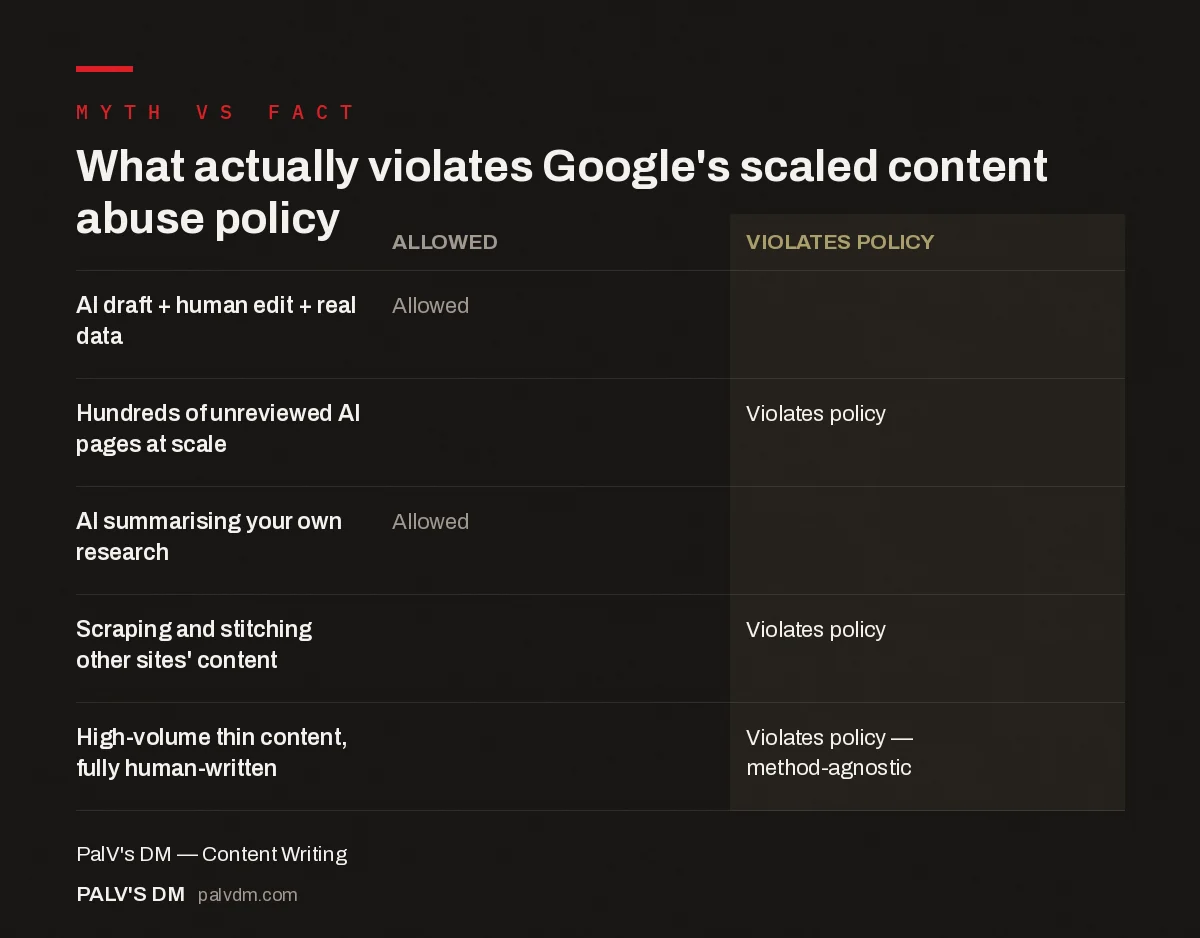
What actually violates Google’s scaled content abuse policy
| Allowed | Violates policy | |
|---|---|---|
| AI draft + human edit + real data | Allowed | |
| Hundreds of unreviewed AI pages at scale | Violates policy | |
| AI summarising your own research | Allowed | |
| Scraping and stitching other sites’ content | Violates policy | |
| High-volume thin content, fully human-written | Violates policy — method-agnostic |
How does this connect to Google’s helpful content system?
Google folded its dedicated helpful content system into its core ranking system in March 2024, which is a relevant detail here because of how that system evaluates quality: site-wide, not just page by page. A site with a pattern of thin, unedited AI output can see its stronger, genuinely useful pages lose visibility too, because the classifier is assessing the site’s overall pattern of helpfulness rather than scoring each URL in total isolation. This is a separate mechanism from any AI-specific detection — it’s the same site-wide quality signal that would catch a site full of thin human-written content, applied without regard to how the content was produced.
The practical read for a content team: a handful of unreviewed AI drafts mixed into an otherwise well-edited site is a smaller risk than a consistent pattern of low-substance publishing across many pages, because the site-wide signal responds to the pattern, not the individual outlier. This is also why teams sometimes see ranking drops that feel disconnected from any one specific post — the classifier is reading the whole site’s editorial standard, not flagging a single page as “this one was AI.”
What does a realistic before-and-after look like for AI-assisted content?
Consider a post about small-business GST filing deadlines, drafted with AI assistance from a prompt with no source material attached. The raw AI draft states general filing windows without citing the current year’s actual notified dates, uses a generic example business, and includes no specific late-filing penalty figures — it reads plausibly but isn’t verifiably accurate, and it adds nothing a reader couldn’t get from a dozen similar pages already ranking.
The edited, published version looks different in three concrete ways: the filing deadlines are checked against the current GST portal notification and cited, the example business reflects a realistic scenario a target reader would recognise, and the penalty section states the actual late fee structure rather than a vague “penalties may apply.” None of that editing required rewriting the AI draft from scratch — it required a human with domain knowledge treating the draft as a starting structure, not a finished article. That gap between raw output and reviewed output is exactly what Google’s policy is evaluating, and it’s invisible to any tool that only measures how “AI-sounding” the prose is.
Related reading on AI content policy and quality
For the practical side of what a compliant AI-assisted workflow looks like, see AI writing tools: where they help and where they wreck quality and how to humanise AI-written copy. If you’re relying on a detection tool to check for AI content, read AI content detectors: what they measure and why it’s not quality first — it explains why detector scores aren’t a reliable proxy for Google’s actual policy. This post is part of our broader content strategy guide, and pairs well with our piece on Google’s scaled content abuse policy for the full policy detail.
FAQ
Does Google require disclosure when AI was used to write content?
No, Google’s spam policies don’t require a disclosure label for AI-assisted content. The evaluation is based on quality and helpfulness signals, not a disclosure requirement.
Can a page get manually penalised just for being AI-written?
Not based on production method alone, according to Google’s published policy. A manual action would relate to a specific policy violation such as scaled content abuse, which requires the volume-plus-low-value-plus-manipulation-intent combination, not simply “was AI involved.”
Is there a safe percentage of AI-generated text per post?
Google’s documentation doesn’t specify a percentage threshold, because the evaluation isn’t based on production ratio. A heavily AI-assisted post with strong human-added substance can outperform a fully human-written post with no real substance, and vice versa.
What’s the actual difference between “helpful AI use” and “scaled content abuse”?
Helpful use treats AI as a drafting and research aid, with a human adding real value and reviewing for accuracy. Scaled content abuse is publishing large volumes of thin, unreviewed content mainly to manipulate rankings, which Google’s policy treats the same regardless of who or what generated the words.
Should I stop using AI tools to be safe, even if my content is reviewed?
Not based on Google’s stated policy. If a human is genuinely reviewing, fact-checking, and adding real substance to each piece, using AI as part of the drafting process is not itself a compliance risk according to Google’s own documentation.