SEO After a Funding Round: Spending It Without Waste
A practical guide to SEO after raising funding: fix technical debt first, build content capacity, add ownership, then scale into new markets in order.

The honest answer to what to do with SEO after raising funding is: spend it in order, not all at once. Most funded companies get this backwards — they double content output, hire three writers, and buy a bigger tool stack in the same month, before fixing the technical and structural problems that were capping their organic growth in the first place. The money doesn’t fail because it’s spent on the wrong things. It fails because it’s spent in the wrong sequence.
Key takeaway
- Fix technical debt and build a reliable content pipeline before adding headcount or tools — spending on volume before fixing the foundation just scales the waste.
- A funding round should upgrade the depth of SEO work (competitor tracking, technical audits, content strategy), not just the amount of content published.
- The sequencing that works: technical debt, then content capacity, then a dedicated owner, then tracking, then expansion into new markets or languages.
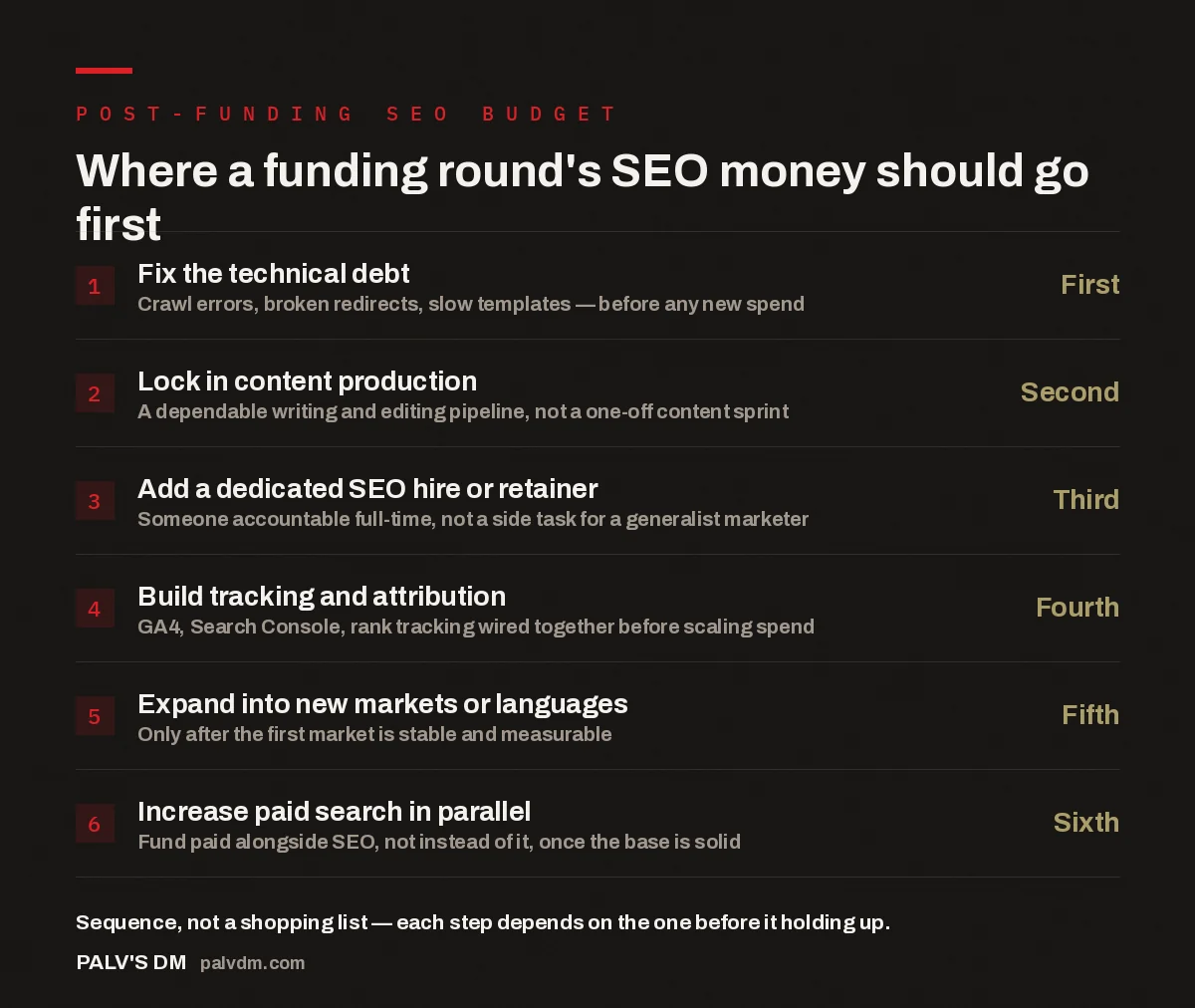
Where a funding round’s SEO money should go first
- Fix the technical debt — First. Crawl errors, broken redirects, slow templates — before any new spend.
- Lock in content production — Second. A dependable writing and editing pipeline, not a one-off content sprint.
- Add a dedicated SEO hire or retainer — Third. Someone accountable full-time, not a side task for a generalist marketer.
- Build tracking and attribution — Fourth. GA4, Search Console, rank tracking wired together before scaling spend.
- Expand into new markets or languages — Fifth. Only after the first market is stable and measurable.
- Increase paid search in parallel — Sixth. Fund paid alongside SEO, not instead of it, once the base is solid.
How much of a funding round should go toward SEO?
There’s no fixed percentage that applies to every company, and anyone who gives you a precise number without knowing your site, your category, and your current organic baseline is guessing. What actually determines the right SEO budget after raising funding is the gap between where your site is today and where it needs to be to support the growth targets tied to the round. A site with clean technical foundations and a working content engine needs proportionally less new spend than a site that’s been neglected for two years and is now expected to carry a chunk of the growth story investors were sold.
The more useful question than “what percentage” is “what’s currently the constraint.” If your constraint is that nobody owns SEO full-time, hiring solves more than a bigger content budget. If your constraint is that your site takes six seconds to load on mobile, no amount of new content will fix what a slow site caps. Diagnose the constraint first, then size the spend to remove it — not the other way around.
What should you fund first with SEO after raising a funding round?
The pattern that shows up consistently in accounts we take on post-funding is the same: companies fund the visible, fast-feeling work first (more articles, a redesign, a bigger ads budget) and leave the invisible, slower-feeling work for later (crawl health, internal linking, page speed, structured data). That ordering is backwards, because the invisible work is what determines whether the visible work compounds or leaks away.
- Technical debt first. Broken redirect chains, orphaned pages, duplicate content from old campaigns, and slow templates all cap how much value new content can generate. Fixing this doesn’t produce a dashboard people get excited about, but it’s the multiplier on everything that comes after.
- A dependable content pipeline second. Not a sprint where you publish forty pages in a month and then go quiet for two quarters. A cadence you can actually sustain with the team and budget you have, built around a keyword and topic plan rather than whatever the current campaign needs.
- A dedicated owner third. Whether that’s an in-house hire or an agency retainer, SEO stops compounding the moment it’s a part-time responsibility bolted onto someone whose real job is paid ads or content marketing generally.
- Measurement fourth. If you can’t attribute organic growth to specific pages, keywords, and changes, you can’t tell your board what the SEO spend actually returned — and you’ll be forced to justify the next round of spend on faith instead of evidence.
Only after those four are in place does it make sense to fund market or language expansion, or to meaningfully scale up paid search alongside organic. Startups often want to skip straight to expansion because it maps neatly to the growth narrative in the pitch deck — but expanding on a shaky foundation just multiplies the same problems across more markets.
The founders who waste funding on SEO aren’t the ones who spend too little. They’re the ones who spend the right amount on the wrong order of operations.
Palash, Founder, PalV’s DM
What mistakes do funded companies make with SEO budget?
The most common mistake is treating SEO spend as a volume lever instead of a quality and sequencing lever. Investors and boards like to see activity, and “we tripled our content output” is an easy sentence to say in an update. But tripling output without first fixing indexing issues, internal linking, or page experience just produces three times the content competing for the same capped visibility — and often cannibalising each other in search results.
A second mistake is hiring too broad, too fast. A newly funded company often hires a “growth marketer” or a small in-house team expected to run SEO, paid, email, and social simultaneously. SEO gets the leftover hours. It’s not that generalist hires can’t do good work — it’s that SEO specifically rewards sustained, specialised attention, and a role split five ways rarely gives it that.
A third mistake is switching agencies or tools right after the round closes, purely because there’s suddenly budget to do so, without a clear reason the existing setup was underperforming. Continuity matters in SEO — a rebuild from scratch resets momentum on rankings, content history, and internal knowledge of what’s already been tried. If the existing approach is genuinely not working, changing it is right. If it’s working but slow, funding more of the same approach usually beats replacing it.
How does SEO spend after funding differ from bootstrapped SEO spend?
Bootstrapped companies are usually constrained by budget and forced into sequencing by necessity — they can only afford one thing at a time, so the order tends to sort itself out. Funded companies have the opposite problem: enough budget to do several things simultaneously, which removes the natural discipline that scarcity used to provide. The skill after a funding round isn’t finding money for SEO, it’s resisting the urge to spend all of it in the same quarter.
| Area | Bootstrapped approach | Post-funding approach |
|---|---|---|
| Content | Slow, steady, one writer, tightly prioritised | Can support a real editorial cadence and a content strategist |
| Technical work | Fixed reactively, when something breaks | Can be audited and fixed proactively, on a schedule |
| Ownership | Often the founder, part-time | Can justify a dedicated hire or a full retainer |
| Tooling | Free or low-cost tools, manual tracking | Paid tools for keyword tracking, technical audits, competitor analysis |
| Risk | Under-investing and moving too slowly | Over-spending on volume before fixing the foundation |
Neither approach is inherently better — they’re responses to different constraints. The point of this comparison isn’t that funded companies should try to spend like bootstrapped ones. It’s that the discipline bootstrapped companies get for free (forced sequencing) has to be deliberately rebuilt once budget stops being the limiting factor.
When should you upgrade your SEO plan after a funding round?
The right trigger for upgrading an SEO plan is evidence, not calendar timing. If you’re consistently exhausting the current plan’s scope — running out of keyword targets before the month ends, sitting on a backlog of technical fixes the current retainer hours can’t cover, or seeing organic traffic plateau despite full delivery — that’s a real signal to scale up. Upgrading purely because the funding round closed, without that evidence, tends to buy capacity that sits unused for a quarter or two while the team catches up operationally.
A practical middle path: use the first month or two after a round to audit where the current plan is actually constrained, then scale the specific part that’s constrained — more content hours, more technical audit time, a second market — rather than upgrading the whole plan uniformly. This keeps the new spend tied to a diagnosed gap instead of a general sense that “we have money now, so let’s do more of everything.”
Next step
If you’ve just raised a round and want a straight read on where your SEO spend should actually go — before you commit budget to the wrong sequence — that’s the exact conversation to have with us early.
FAQ: SEO after raising funding
Should we increase our SEO budget immediately after closing a funding round?
Not automatically. Increase it once you’ve identified what’s actually constraining your organic growth today — a technical issue, a content gap, or lack of dedicated ownership. Spending more before diagnosing the constraint usually means paying for volume that a weak foundation can’t fully convert into rankings or traffic.
Is it better to hire in-house or use an agency after raising funding?
It depends on whether you need strategic ownership or execution capacity. A dedicated in-house hire works well if SEO needs to sit close to product and engineering decisions daily. A retainer works well if you need a full team — technical, content, and strategy — without the overhead of building one internally. Many funded companies use both: an in-house owner plus an agency for execution depth.
How long before SEO spend after funding shows results?
SEO doesn’t move faster just because the budget behind it got bigger. Technical fixes can show movement within weeks. New content targeting competitive terms typically takes several months to rank and longer to compound. Funding can widen what you’re able to do, but it doesn’t compress the underlying timeline for search engines to trust and rank new or improved pages.
Should we cut SEO spend if the next funding round doesn’t come through?
Cut the parts that were scaled beyond what the foundation could support — extra content volume, a second market that isn’t yet self-sustaining — before cutting the foundational work like technical maintenance and a dedicated owner. Organic traffic built well tends to be one of the more durable channels during a slowdown, since it doesn’t disappear the moment ad spend is paused.
Does SEO after raising funding need a different strategy than before?
The strategy shouldn’t change just because the budget did — the fundamentals of what earns rankings stay the same. What changes is the depth you can now afford: more thorough technical audits, competitor-led keyword research instead of guesswork, and a content plan built around a real editorial calendar rather than whatever fits around one person’s spare hours.
Related reading
If you’re mapping out SEO after raising funding, these cover the pieces that come next: SEO for Startups: The Realistic First-Year Path lays out what a sustainable first year actually looks like, How We Decide What Goes Into a Client’s First 90 Days explains how we sequence early work with a new client, When to Upgrade Your SEO Plan (And When Not To) goes deeper on the evidence-based trigger for scaling spend, and Do You Need SEO If You Already Run Google Ads? is worth reading before you decide how to split budget between paid and organic.
Short version: a funding round doesn’t change what makes SEO work — it changes how much of it you can afford to do properly. Fix technical debt first, build a content pipeline you can actually sustain, put a dedicated owner behind it, and get measurement in place before you scale into new markets or bigger paid spend. Spend in that order and the round buys you compounding growth. Spend out of order and it just buys you a bigger version of the same problems.