Writing a Listicle Where Every Item Stands Alone
A good listicle lets readers jump to any item and get full value immediately. Here is how to write list content where every entry stands on its own.
Published: August 2026
A listicle where every item stands alone means a reader can jump to item 6, get a complete, useful answer, and never read items 1 through 5 — and that’s a feature, not a failure. Most listicles are written as a single argument split into numbered chunks, which forces sequential reading the format was never meant to demand. Writing each item as a self-contained unit, with its own context and payoff, is what makes a listicle genuinely scannable instead of just numbered.
Listicles rank well and get shared often because they promise a specific, bounded amount of value: “12 ways to do X” tells the reader exactly what they’re getting before they click. But that promise breaks the moment item 4 only makes sense if you’ve read items 1 through 3. This guide covers how to write list content that keeps its scannability promise all the way through.
Why do so many listicles fail their own format?
The most common failure is writing a linear argument and chopping it into numbered sections after the fact. Item 3 references “the technique we covered above,” item 7 assumes you remember a term defined in item 2, and by item 9 the numbering is really just a table of contents for an essay, not a genuinely modular list.
This happens because listicles are often drafted the way any other article is drafted — start at the top, build an argument, add headers later. A list that’s meant to be jumped into at any point has to be planned that way from the outline stage, not retrofitted.
What does a self-contained list item actually include?
Each item needs enough context to make sense in isolation, which usually means:
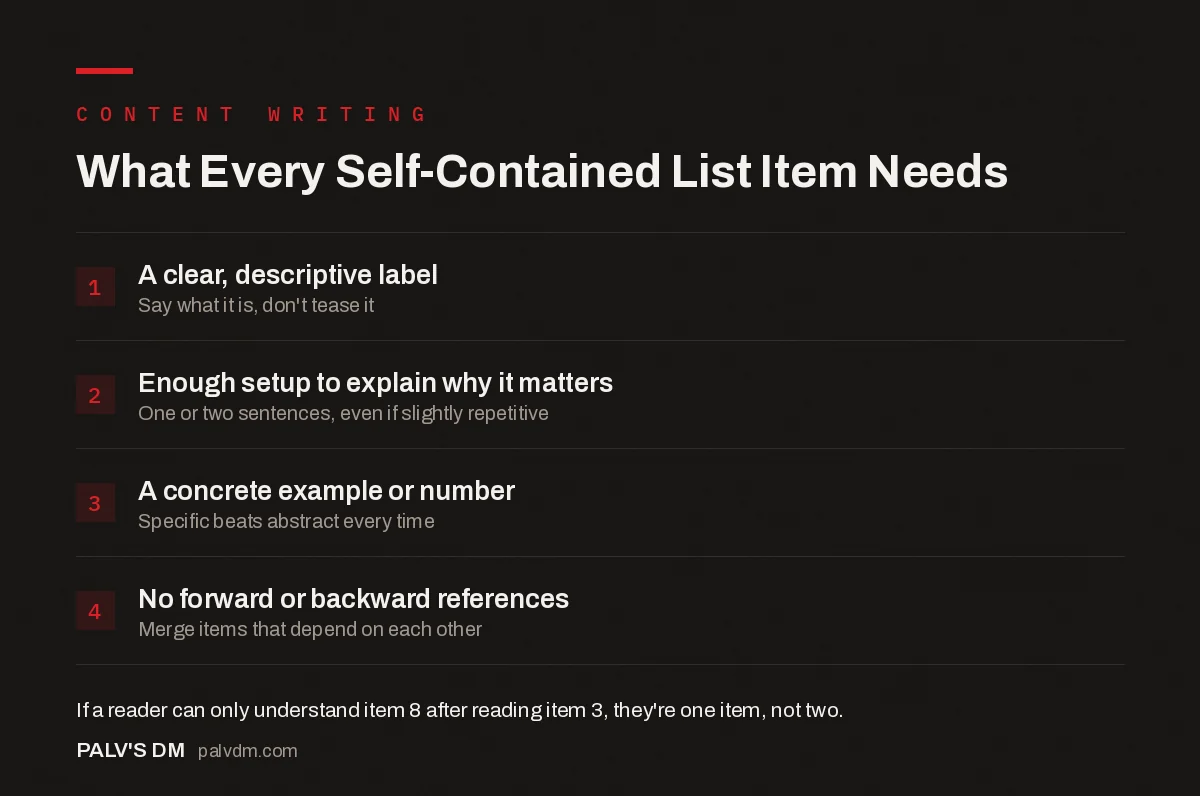
The infographic below breaks down the four elements every self-contained item needs.
What Every Self-Contained List Item Needs
- A clear, descriptive label. Say what it is, don’t tease it.
- Enough setup to explain why it matters. One or two sentences, even if slightly repetitive.
- A concrete example or number. Specific beats abstract every time.
- No forward or backward references. Merge items that depend on each other.
How do you order items if each one stands alone?
If every item is genuinely independent, order stops being about narrative flow and starts being about reader value and skimmability. Two ordering approaches work well:
| Ordering approach | When to use it |
|---|---|
| Highest-impact first | When readers are likely to only act on the top few items — puts the best advice where it’s guaranteed to be read |
| Difficulty or effort ascending | When the list doubles as a roadmap and readers are expected to work through several items in sequence anyway |
| Alphabetical or categorical | Reference-style lists (tools, terms, resources) where there’s no natural hierarchy of importance |
What doesn’t work well: ordering items to build toward a “best for last” reveal, since that structure assumes sequential reading, which is exactly what a good listicle shouldn’t require.
How long should each item be?
Item length should be consistent enough that readers can predict how much time each one costs them, and long enough to be genuinely useful rather than a one-line tease. A list where item 2 is 20 words and item 9 is 400 words feels unbalanced and makes the shorter items look like filler added to hit a round number like “15 ways.”
A workable range for most practical listicles is 75 to 200 words per item — enough for a claim, a reason, and a concrete example, without ballooning into a mini-essay that breaks the scannable promise of the format.
Does the list number itself matter?
The number in the headline sets a promise readers hold you to, so it should reflect genuine, distinct value rather than being padded or artificially trimmed to sound rounder. A “10 ways” post with three items that are really the same idea restated is a worse experience than an honest “7 ways” post where every item earns its place. Readers and AI summarisation tools both tend to notice when list items overlap heavily — it reads as padding either way.
How do you outline a listicle so items don’t end up dependent on each other?
Plan items before you plan flow. Write each candidate item on its own line, with a one-sentence summary of what it delivers, before deciding on order or transitions. This forces you to check each item in isolation: does this line make sense and provide value without anything above it? If the summary needs to reference another item to make sense, that’s a signal the two items aren’t actually independent and should be merged or restructured.
A second useful check during outlining: read the list of headers alone, with no body text. If a reader could get real value from just the headers plus a sentence of context per item, the structure is sound. If the headers are vague (“Tip 3,” “Another approach,” “Don’t forget this”) and only make sense once you’ve read the surrounding prose, the outline needs another pass before drafting starts.
What are the most common mistakes when converting an article into a listicle?
Five mistakes account for most of the broken listicles PalV’s DM sees during content audits. The first is the retrofit problem already covered above: writing linear prose, then inserting numbers and headers after the draft is done. The second is inconsistent granularity, where item 1 covers a broad strategy and item 2 covers a single settings toggle — readers can’t calibrate how much value each entry holds when the scope keeps jumping.
The third mistake is burying the actual answer inside a lead-in sentence. An item titled “Use structured data” that opens with “Before we get into structured data, it’s worth understanding how search engines parse HTML” delays the payoff by a full sentence or two, which defeats the scannability the format promises. The fourth is reusing the same example across multiple items — if items 3, 6, and 9 all cite the same case to illustrate different points, it signals the writer ran out of distinct material and started stretching one idea across several slots.
The fifth, and the one that does the most damage to AI-summarisation performance, is vague headers that require the body text to disambiguate. “3. The content angle” tells a reader or a language model nothing about what the item actually recommends; “3. Lead with the objection, not the feature” does. Search engines and AI answer engines pull list items into featured snippets and summaries far more often when the header alone carries the claim.
How do you handle a listicle where a few items genuinely need more context than others?
Not every item in a real listicle is equally weighty, and forcing artificial uniformity can hurt more than it helps. The fix isn’t identical word counts everywhere — it’s identical structure. Every item should open with the same shape: label, then payoff, then support. A 60-word item and a 180-word item can sit next to each other comfortably as long as both follow label-payoff-support and neither depends on the item before it.
When one item genuinely needs a sub-list or a short example block to stand on its own, that’s a sign the item is doing more work than its neighbours, not a sign something is wrong. The test is still independence: can this item be lifted out, pasted into a different document, and still make complete sense to someone who has never seen the rest of the list? If yes, extra length inside that one item is fine. If the extra length is there because the item leans on context from elsewhere in the post, that’s the retrofit problem again, just disguised as thoroughness.
FAQs
Should listicle items have their own subheadings?
Yes, always. A subheading per item is what makes the format scannable in the first place — without it, a reader can’t jump to the item they want without reading past ones they don’t. Number plus a descriptive label, not just “1,” “2,” “3.”
Is it fine to group related items under one number?
Generally no, because it breaks the self-contained promise. If two items are closely related enough that neither makes sense without the other, they’re really one item and should be merged and relabeled rather than force-numbered separately.
How do you avoid listicles feeling shallow?
Depth per item, not more items. A tightly written 8-item list with concrete examples in each item reads as more substantial than a padded 20-item list where half the entries are restatements. Favour fewer, better items over hitting a round number.
Do listicles need an introduction and conclusion if every item stands alone?
Yes, a short one. The introduction sets the scope and promise of the list (what it covers, who it’s for); a brief closing section can point to a next step or related resource. Neither needs to be load-bearing for understanding any individual item.
Can a listicle rank well without being the longest post on the topic?
Yes. Search engines and AI answer engines increasingly reward listicles where every item is genuinely useful over ones that are simply the longest. A tightly written, non-padded list can outperform a bloated competitor because it satisfies the query faster.
Where listicle writing fits in a content programme
Listicles work well paired with how-to content when a topic has both a sequential process and a set of independent tips worth covering separately, and with a strong opening since a listicle’s introduction has to set scope fast before readers start skimming for the item they want. As with any content format, list content performs best when it’s planned as part of a broader content strategy rather than written reactively whenever a “top N” idea comes up.
Writing list items that each genuinely stand alone takes more editorial discipline than it looks like from the outside. PalV’s DM’s content writing team plans listicles item-first, not outline-first, so nothing in the final piece depends on reading it top to bottom.