What a Realistic SEO Budget Looks Like for an Early-Stage Startup
How much should an early-stage startup spend on SEO? Real published prices, what each budget level buys, and a method for deciding your own number.

An early-stage startup’s SEO budget should be sized by what it needs to buy, not by a percentage of revenue: roughly ₹5,000 to ₹15,000 a month buys ongoing consultancy and prioritised fixes, while content production and any development work sit on top of that. PalV’s DM publishes its own numbers — SEO Foundation at ₹5,000 a month, Growth at ₹10,000, Ultimate at ₹15,000, standalone services from ₹500, and web development from ₹20,000 — precisely so this conversation can start from a real figure rather than a “request a quote” form.
The harder truth is that the budget question is usually asked in the wrong order. “What should we spend on SEO?” has no answer until you know how long you can spend it for. A ₹15,000 monthly budget sustained for twelve months will beat a ₹60,000 budget abandoned after three, because organic search compounds and does not respond to intensity.
What does an SEO budget actually pay for?
SEO spending falls into four buckets, and confusing them is why quotes vary so wildly. A ₹5,000 retainer and a ₹50,000 retainer are frequently not the same product at different volumes; they are different products.
| Bucket | What it covers | How it is usually priced |
|---|---|---|
| Strategy and diagnosis | Audits, keyword research, prioritisation, roadmap | One-off, or included in a retainer |
| Implementation | On-page changes, technical fixes, internal linking, schema | Retainer hours or developer time |
| Content production | Briefs, writing, editing, images | Per article or per month |
| Authority and promotion | Digital PR, outreach, original research | Per campaign, and the most variable line |
Two quotes for “SEO” can differ by a factor of ten without either being dishonest, because one includes content production and developer implementation while the other is advisory only. Before comparing prices, ask each supplier which of the four buckets their figure covers and who is expected to do the work in the buckets it does not. A quote that will not answer that question is not a quote.
Most startup budgets fail because they fund the first bucket and none of the others. An audit nobody implements produces nothing — an audit you cannot act on is the most common wasted line item in early-stage marketing spend.
What can a small monthly budget realistically achieve?
Small budgets are not useless; they are narrow. The mistake is spreading a small budget across every activity rather than funding one properly.
- Around ₹5,000 a month. Diagnosis, prioritisation and a steady queue of fixes you or your developer implement. This level buys direction, not delivery capacity. It works when someone on your side can execute.
- Around ₹10,000 a month. Direction plus implementation of on-page and technical work, with a modest content cadence. Enough to move existing pages and build a first topic cluster.
- Around ₹15,000 a month. Ongoing strategy, implementation, a sustained content programme and AI-visibility work as a tracked surface rather than an afterthought.
- Standalone services from ₹500. Useful when the constraint is a specific blockage — a technical fix, a keyword map, a single optimised page — rather than an ongoing programme. Choosing between one-time work and a retainer is a genuine fork for pre-revenue startups.
Content and development are separate. A retainer that includes both at a low monthly figure is either producing very little of each or producing both badly. What content actually costs to produce is worth pricing separately so you can see the trade-off.
How long does the budget need to run?
Duration matters more than monthly amount, and it is the variable founders underweight. Technical fixes register in days. Pages already at positions 8 to 20 move with on-page work. But new pages competing for commercial terms take three to six months to produce meaningful traffic, and competitive terms take closer to a year. The month-by-month SEO timeline sets out what to expect at each stage.
The practical implication: budget for at least two quarters before judging the channel, and preferably three. Why six months is the honest minimum is not a sales argument — it is a description of how crawling, evaluation and link acquisition lags stack up. A startup that cannot commit six months of any figure is better served by one-time work that produces permanent fixes than by a retainer it will cancel in month three.
How should a startup decide the actual number?
Work from the value of a customer backwards. This takes twenty minutes and produces a defensible figure rather than a guess.
- Establish what a customer is worth. Average order value multiplied by expected repeat purchases, or contract value multiplied by expected retention. Calculating customer lifetime value does not need to be precise, only honest.
- Decide an acceptable acquisition cost. A common starting point is a third of lifetime value, adjusted for your margin and cash position. Working out customer acquisition cost gives you the comparison denominator.
- Estimate how many customers organic search could plausibly deliver. Use search volume on your commercial keywords, a conservative click share, and your existing site conversion rate. Conservative is the operative word.
- Multiply and divide. Target customers multiplied by acceptable acquisition cost gives an annual budget ceiling. Divide by twelve.
- Sanity check against the alternative. If the same money bought paid clicks at your category’s cost per click, how many customers would it produce? Knowing your break-even cost per click makes that comparison concrete.
If the arithmetic produces a number below ₹5,000 a month, organic search is probably not your first channel this year. That is a legitimate finding, and recognising when you do not need an agency yet saves more money than negotiating a discount.
What should a startup cut first when money is tight?
Cut in this order, because the items at the top are the ones with the weakest link to outcomes at small scale.
- Paid link acquisition. Not merely expensive but risky. Link schemes violate Google’s spam policies, and a young domain has no buffer.
- Tool subscriptions beyond one. Search Console is free and irreplaceable. A single paid keyword tool is enough at this stage.
- Volume content. Halve the output and double the evidence in what remains. Google’s guidance asks whether content adds substantial value compared with existing results, which volume alone does not.
- Rank tracking breadth. Track twenty keywords that matter, not four hundred.
Do not cut technical implementation or measurement. A site with indexation problems converts every other rupee into waste, and a startup without properly configured analytics cannot tell whether any of this worked.
When is doing it yourself cheaper?
Founder-led SEO is genuinely viable in two situations: when the site is small enough that the work is measured in hours rather than weeks, and when the founder has subject expertise that would be expensive to buy. A founder who can write authoritatively about their own field has an advantage no agency writer can replicate, and Google’s guidance is explicit that first-hand experience is what distinguishes useful content.
It stops being cheaper the moment the founder’s time has a higher-value use, or when the work needs specialist diagnosis. The DIY versus hiring decision usually resolves into a hybrid: buy diagnosis and prioritisation, do the execution yourself. That is exactly what a low-tier retainer plus standalone services for the specialist pieces is for.
How do you know the budget is too small?
Four signals, all checkable within a quarter. Nothing on the roadmap ships, because there is no implementation capacity funded. Every month’s report describes the same recommendations. The keyword targets agreed at kickoff are ones no site at your authority level currently ranks for. Or the retainer covers strategy while content and development sit unfunded, so the strategy has nothing to act on.
There is a fifth signal worth watching for, and it is subtler: the reporting improves while the business does not. Impressions climb, keyword counts rise, a dashboard turns green, and enquiries stay flat. That usually means the budget is funding activity against informational queries that were never going to convert, and the fix is to redirect the same money toward commercial pages rather than to increase it.
None of those are agency problems. They are budget-design problems, and the fix is either a larger budget, a narrower target list, or a longer timeline. How SEO pricing actually works in India and what genuinely cheap SEO tends to cost you later are worth reading before assuming the answer is a cheaper supplier.
The summary for a founder deciding this week: pick a figure you can sustain for six months, spend it on diagnosis plus implementation rather than diagnosis alone, keep content and development as visible separate lines, and judge the channel on enquiries rather than rankings. If the arithmetic will not support six months at ₹5,000, spend the money on one-time fixes that stay fixed and revisit the retainer question after your next funding or revenue milestone.
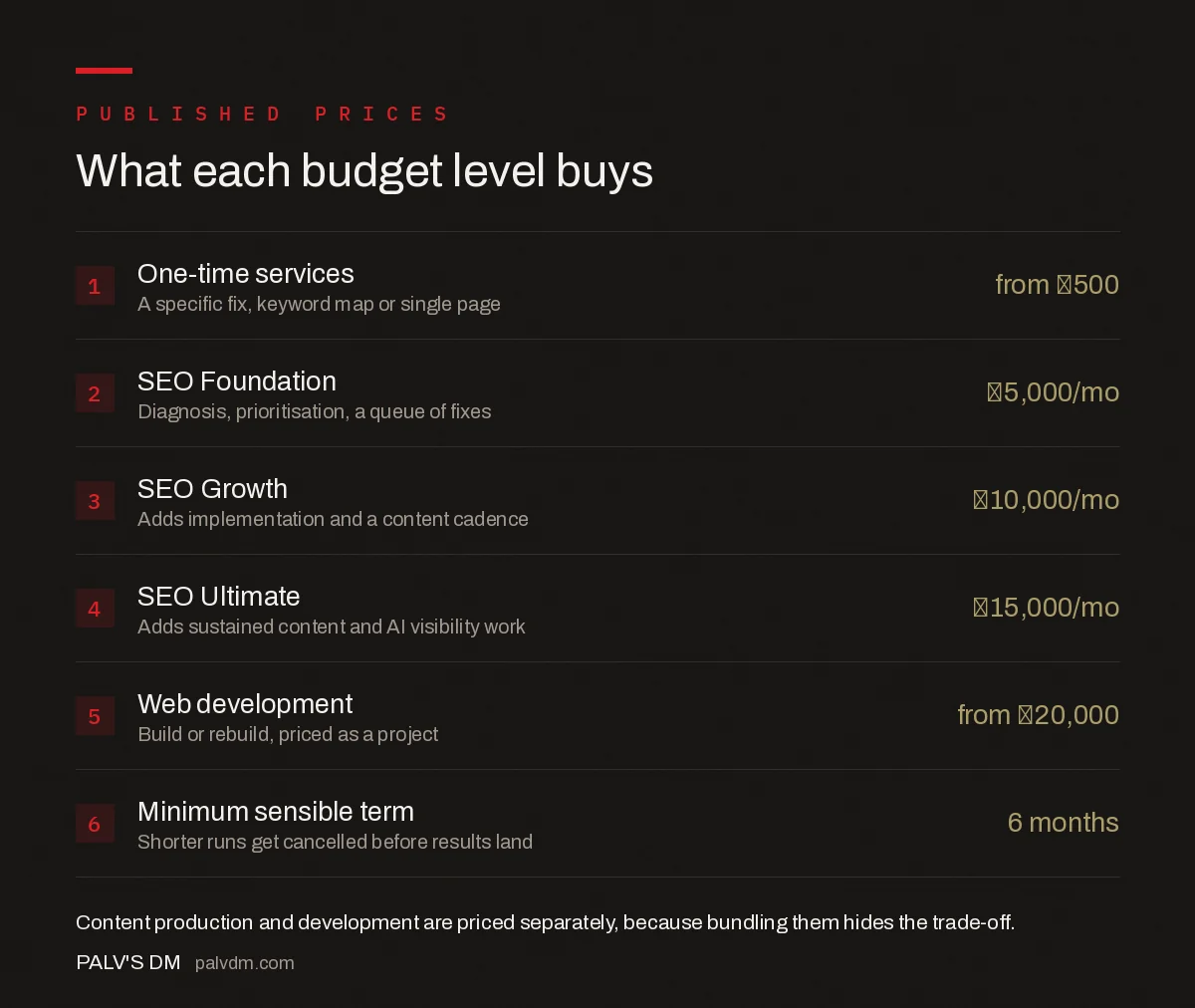
What each budget level buys
- Standalone services — from ₹500. A specific fix, keyword map or single page.
- SEO Foundation — ₹5,000/mo. Diagnosis, prioritisation, a queue of fixes.
- SEO Growth — ₹10,000/mo. Adds implementation and a content cadence.
- SEO Ultimate — ₹15,000/mo. Adds sustained content and AI visibility work.
- Web development — from ₹20,000. Build or rebuild, priced as a project.
- Minimum sensible term — 6 months. Shorter runs get cancelled before results land.
Frequently asked questions
How much should a startup spend on SEO per month?
Size the budget by what it must buy rather than by a revenue percentage. Roughly ₹5,000 a month buys diagnosis, prioritisation and a queue of fixes someone on your side implements. Around ₹10,000 adds implementation capacity and a modest content cadence. Around ₹15,000 supports a sustained content programme and AI-visibility work. Content and development are separate lines.
Is a small SEO budget worth spending at all?
Yes, if it is narrow rather than thin. A small budget funding one activity properly beats the same money spread across strategy, content, links and tools. Duration matters more than monthly amount: ₹15,000 a month sustained for twelve months outperforms ₹60,000 abandoned after three, because organic search compounds and does not respond to intensity.
How do I calculate an SEO budget for my startup?
Work backwards from customer value. Establish what a customer is worth over their lifetime, decide an acceptable acquisition cost, estimate conservatively how many customers organic search could deliver using search volume and your existing conversion rate, multiply to get an annual ceiling, then divide by twelve. Sanity check it against what the same money would buy in paid clicks.
How long should a startup commit to an SEO budget?
At least two quarters, preferably three. Technical fixes register in days and pages already near the first page can move quickly, but new pages targeting commercial terms take three to six months to produce meaningful traffic. A startup unable to commit six months is better served by one-time work producing permanent fixes than by a retainer it will cancel.
What should I cut from an SEO budget first?
Paid link acquisition first, because it violates Google’s spam policies and a young domain has no buffer. Then tool subscriptions beyond one, since Search Console is free and irreplaceable. Then content volume — halve the output and double the evidence in what remains. Never cut technical implementation or analytics configuration.
Is DIY SEO cheaper than hiring someone?
It is cheaper when the site is small enough that the work takes hours rather than weeks, and when the founder has subject expertise that would be costly to buy in. It stops being cheaper when founder time has a higher-value use or the work needs specialist diagnosis. The common resolution is buying diagnosis and prioritisation while executing yourself.
Sources
- Do you need an SEO? — Google Search Central
- Creating helpful, reliable, people-first content — Google Search Central
- SEO Starter Guide — Google Search Central
Want this done on your site?
Every PalV’s DM engagement starts with a free audit of your actual website — a 12-point
crawl covering what is blocking indexation, on-page gaps against your primary keywords, speed
findings, and the three to five fixes worth making first. Delivered in two working days. No
payment details, and the findings are yours whether you hire us or not.