Service Support — Content Writing
What SEO Content Should Cost Per Article in India
Content writing rates in India range from ₹1 to ₹25+ per word — see what drives content writing rates and what a fair per-article quote includes.

Fair rates for SEO content in India generally fall into three bands: roughly ₹1–3 per word for volume-first freelance or gig-platform writing, ₹4–10 per word for briefed, edited, SEO-structured articles from experienced freelancers or small agencies, and ₹10–25+ per word for agency work that includes research, technical SEO packaging, and strategic oversight. The number on its own tells you almost nothing — what determines whether a quote is fair is what’s actually bundled into it. This guide breaks down what drives content writing rates in India, what should come with each price band, and how to read a quote so you’re not paying agency money for gig-platform output.
Key takeaway
- Content writing rates in India range from roughly ₹1/word for unbriefed gig work to ₹25+/word for full-service SEO content — the gap is almost entirely about research, structure, and editing, not the writer’s typing speed.
- A quote isn’t comparable across vendors unless you know what’s included: research time, on-page SEO formatting, revisions, and a human edit pass all change the real cost per usable article.
- The cheapest quote per article is rarely the cheapest cost per ranking page, because unusable drafts still cost you the time to rewrite, brief again, or discard them.
What A Fair Per-Article Quote Should Include
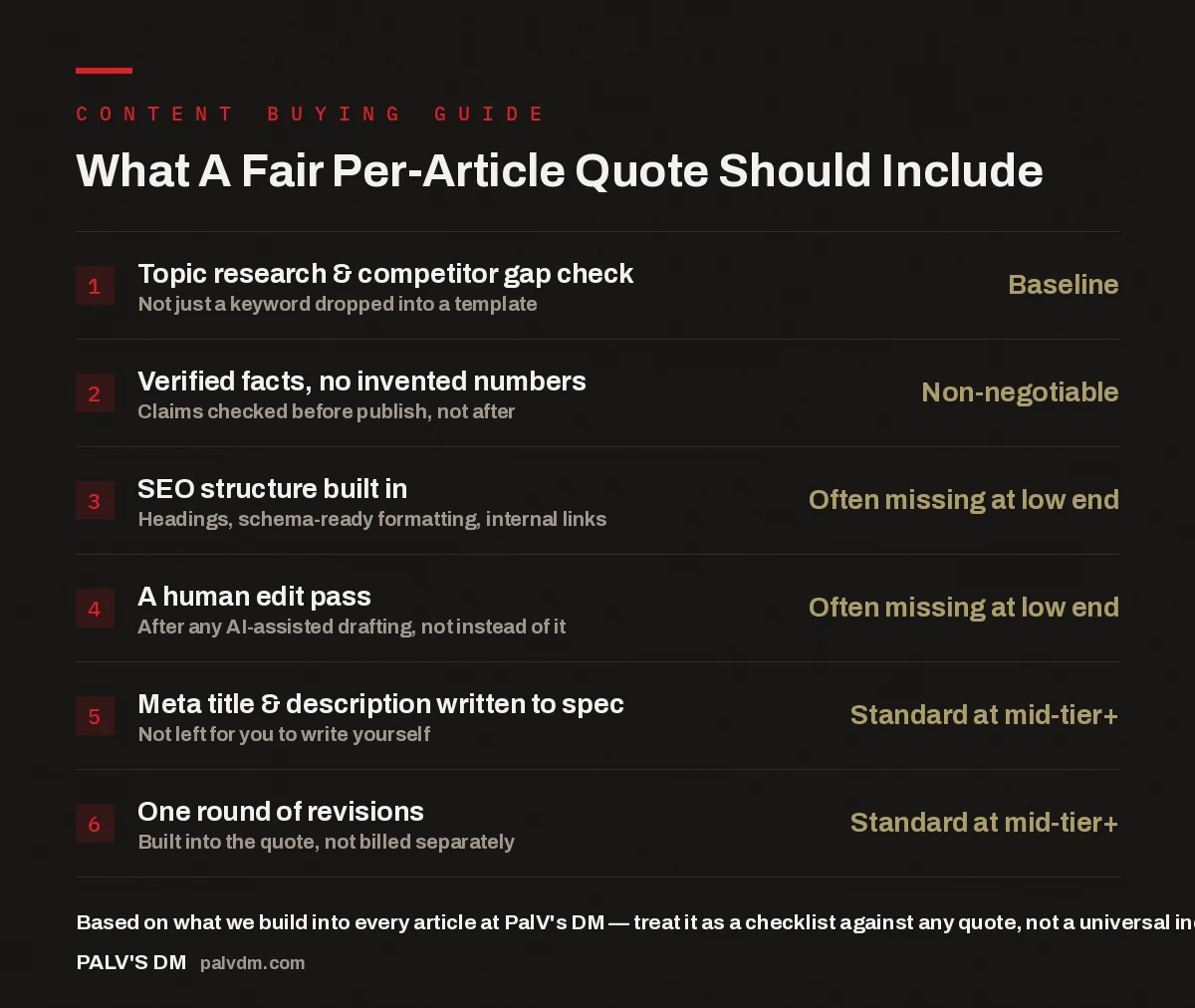
- Topic research & competitor gap check — Baseline. Not just a keyword dropped into a template.
- Verified facts, no invented numbers — Non-negotiable. Claims checked before publish, not after.
- SEO structure built in — Often missing at low end. Headings, schema-ready formatting, internal links.
- A human edit pass — Often missing at low end. After any AI-assisted drafting, not instead of it.
- Meta title & description written to spec — Standard at mid-tier+. Not left for you to write yourself.
- One round of revisions — Standard at mid-tier+. Built into the quote, not billed separately.
What actually determines content writing rates in India?
Four things move the price of an article far more than the word count does. First, research depth — an article built on a quick skim of the top three Google results costs less to produce than one built on reading primary sources, checking claims, and mapping what competitors got wrong. Second, SEO structuring — deciding heading hierarchy, working in internal links, writing schema-friendly formatting, and matching search intent takes a different skill than fluent writing alone. Third, editing — a genuine human pass that checks facts, tightens the argument, and removes filler is slower and more expensive than a spellcheck. Fourth, subject complexity — a listicle on “productivity tips” is cheaper to write credibly than a technical explainer on GST compliance or a medical topic that needs a subject-matter check.
Two vendors quoting ₹3/word and ₹15/word for what looks like “the same 1,200-word article” are usually not quoting the same product at all. One is quoting typing. The other is quoting a researched, structured, edited piece of content designed to rank and hold up to scrutiny. The rupee figure is the wrong first question — the right first question is what work sits behind it.
How much should you pay per article in India?
These bands describe what’s typically on offer at each price point in the Indian market, not a fixed rate card — treat them as a starting frame for evaluating a quote, not a number to demand from every vendor.
| Price band | What you typically get | Best fit for |
|---|---|---|
| ~₹1–3/word | Fast turnaround, minimal briefing, little to no independent research, formatting left to you | Low-stakes filler content, internal use, non-SEO copy |
| ~₹4–10/word | Briefed writer, on-page SEO structure, one edit pass, basic fact-checking | Most small and mid-size businesses running a real content programme |
| ~₹10–25+/word | Strategist-level briefing, deeper research, technical SEO packaging, senior editing, revisions included | Competitive keywords, BOFU/commercial pages, regulated or technical topics |
Per-word pricing is common but not universal — many agencies quote per article instead, which folds research and formatting time into a flat fee regardless of exact length. If you’re comparing a per-word quote to a per-article quote, do the arithmetic on a realistic word count before assuming one is cheaper than the other.
Why does the cheapest option often cost more later?
The claim “cheap content is a false economy” gets repeated so often it sounds like a sales line, so it’s worth being specific about the mechanism. An article bought at the low end usually needs one of three things afterward: a rewrite because it doesn’t actually answer the search intent, a structural pass because there’s no internal linking or heading logic for search engines to parse, or a fact-check because claims were never verified against a real source. Each of those is billable work that gets added back on top of the original “cheap” price — except now it’s happening after a delay, and often after the page has already published without ranking.
The pattern that shows up repeatedly in accounts that switch to us from a low-cost content mill: the true cost per published, ranking article was higher with the cheap vendor, once you count the time spent briefing again, editing internally, or replacing pieces that never moved the needle. That’s not a hard number we can quote you — it depends entirely on how much rewriting a given piece needs — but it’s the reason “cost per article” is the wrong unit to optimise for. Cost per usable, ranking article is the number that matters.
For a closer look at how this plays out over a longer period, see our breakdown of cheap content vs. researched content over 12 months.
People ask us for our per-word rate before they’ve told us what the article needs to do. That’s backwards. Tell me the keyword, the competition, and what the page needs to prove, and I’ll tell you what it should cost — the rate is an output of the brief, not an input to it.
Palash, Founder, PalV’s DM
Freelancer, agency, or in-house writer — which rate structure fits you?
A single freelance writer is usually the cheapest per-word option if you already have someone in-house who can brief them properly, check their SEO structure, and edit the draft. Without that internal capacity, you’re effectively paying a lower rate for a service you then have to deliver yourself. An agency’s higher per-word rate typically buys back that internal time — briefing, SEO structuring, and editing are built into the workflow rather than left to you.
In-house hires make sense at volume — once you’re consistently publishing more than a handful of articles a month, a salaried writer or content lead can work out cheaper per piece than either freelance or agency rates, provided you also have someone with the SEO judgment to direct them. That’s the part teams underestimate: a good writer without SEO direction produces good prose that doesn’t rank. If you’re not sure which gap you actually have, this comparison of hiring a writer versus a content strategist walks through how to tell the difference before you commit to either.
What should you actually receive for the price?
Regardless of which price band you’re buying in, a fair quote should specify what’s included before you pay, not after. At minimum, ask what’s covered on: research and source-checking, on-page SEO formatting (headings, internal links, meta fields), revisions, and turnaround time. Vendors who can’t answer these clearly, or who treat every addition as a separate line item after the fact, are usually the ones whose low headline rate hides the real cost.
If you want a concrete sense of what a fully specified article order looks like end to end, this walkthrough of what you get when you order an article from us covers it deliverable by deliverable, and this piece on the technical package that comes with every article covers the schema, meta, and image work that often gets left out of cheaper quotes entirely.
How do you evaluate a content writing quote before you commit?
- Ask what the rate includes, line by line — research time, formatting, meta fields, revisions — rather than accepting a single all-in figure.
- Ask who edits the piece before delivery, and whether that’s a genuine second pass or the same person checking their own work.
- Ask for a sample on a topic close to yours, not a generic portfolio piece, so you can judge research depth rather than just prose quality.
- Compare cost per word only after confirming both quotes are for a comparable scope of work — briefed and structured versus unbriefed and unstructured are not the same product.
- Factor in your own time. A cheaper quote that needs heavy internal editing or a rewrite isn’t actually cheaper once that time is counted.
Get a quote scoped to your actual pages
- We price content writing per article based on keyword difficulty, research depth, and what the page needs to prove — not a flat rate card.
- Every article includes research, SEO structuring, a human edit pass, and technical packaging as standard.
Frequently asked questions
Is per-word or per-article pricing better for content writing in India?
Neither is inherently better — per-word pricing is easier to compare across vendors on paper, while per-article pricing folds in research and formatting time regardless of exact length. What matters more is confirming what’s included in either structure before comparing the headline number.
Why do content writing rates in India vary so widely?
Rates vary because “an article” isn’t a standard product — the same word count can mean an unbriefed draft with no research, or a structured, fact-checked, SEO-formatted piece with a full edit pass. The price difference reflects the work behind the words, not just market variation for the same output.
Should I pay more for content on a competitive keyword?
Generally yes. Competitive keywords need deeper competitor gap analysis, stronger structuring, and often a subject-matter check to hold up against pages that are already ranking. Paying the same low rate across every keyword regardless of difficulty usually shows up as underperformance on your hardest-to-rank pages.
Does AI-assisted writing mean content should cost less?
Not necessarily. AI can speed up a first draft, but research, fact verification, SEO structuring, and a genuine human edit pass still take the same time they always did — and skipping them to pass on savings is usually what produces the generic, unverified content that underperforms. The drafting speed isn’t the expensive part of a good article; the judgment around it is.
How many articles do I need before I see results?
This depends heavily on your site’s existing authority, competition, and publishing consistency, so there’s no fixed number that applies to every site. For a fuller breakdown of how volume and traffic tend to relate, see our guide on how many articles you typically need before traffic moves.
Short version: content writing rates in India run from roughly ₹1/word for unbriefed, unedited work to ₹25+/word for fully researched, SEO-structured, edited articles — and the gap between them is entirely about research, structuring, and editing, not typing speed. Judge a quote by what it includes, not by the rupee figure alone, and weigh cost per article against cost per usable, ranking article before deciding what’s actually cheap.