Service Support — Content Writing
How Many Articles You Need Before Traffic Moves
How many blog posts to rank? There's no fixed number—domain trust, niche competition, and content depth decide how many articles you actually need.

There’s no fixed number. For a brand-new site in a competitive niche, meaningful movement usually needs somewhere between 30 and 60 published, well-targeted articles before search traffic becomes visible in analytics — not because of a magic threshold, but because that’s roughly how long it takes to build topical coverage, earn internal linking density, and give Google enough signal to trust the domain. For an established site adding to an existing content base, the number can be a fraction of that. The honest answer to “how many blog posts to rank” is: it depends on what you’re competing against, not on a round number someone can sell you.
Key takeaway
- There is no universal article count — domain trust, competition, and content depth all change the number more than raw volume does.
- New domains in competitive niches need broader topical coverage before traffic moves; established sites often need far less.
- Consistent publishing into a linked cluster compounds faster than the same number of articles published in isolation.
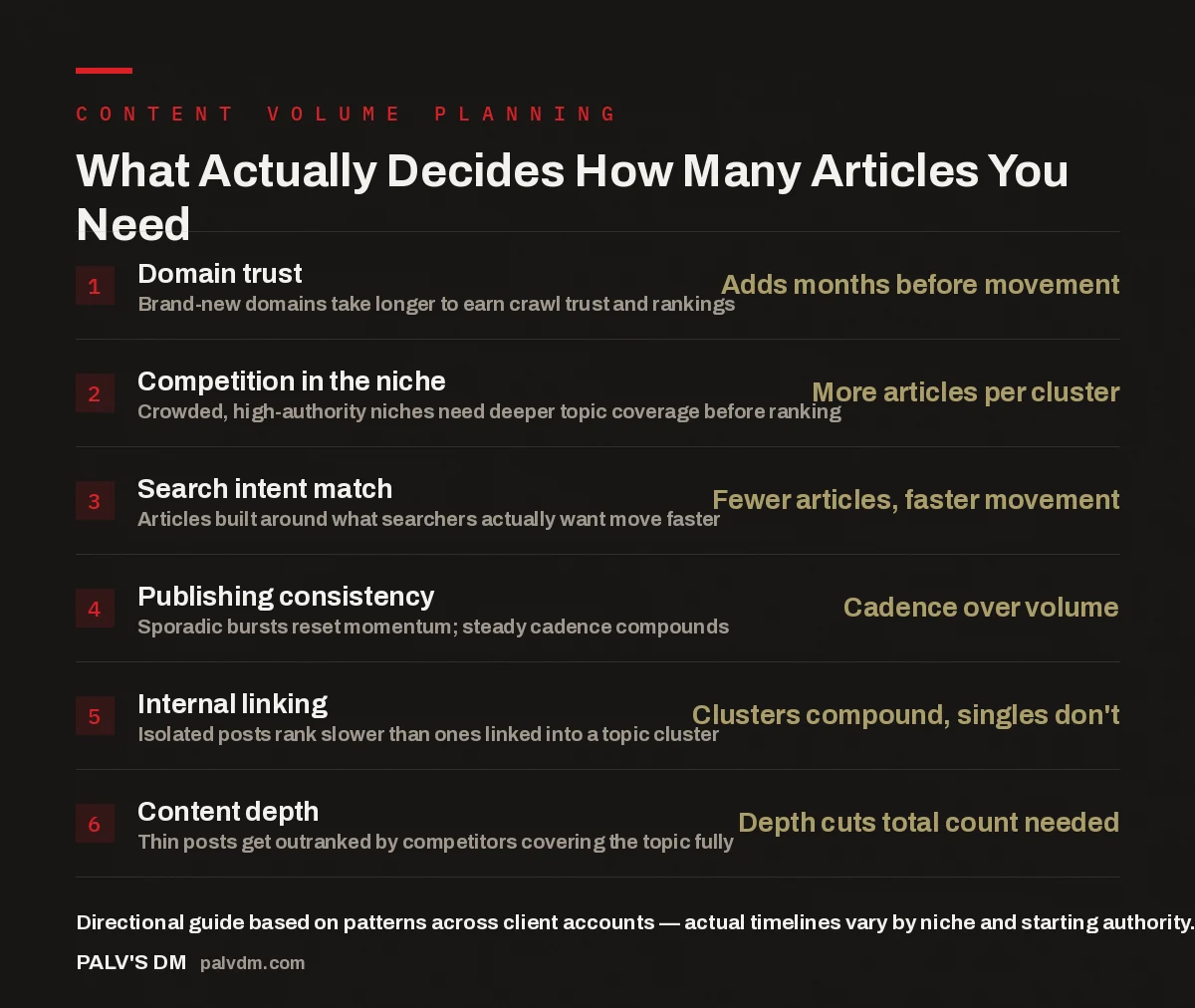
What Actually Decides How Many Articles You Need
- Domain trust — Adds months before movement. Brand-new domains take longer to earn crawl trust and rankings.
- Competition in the niche — More articles per cluster. Crowded, high-authority niches need deeper topic coverage before ranking.
- Search intent match — Fewer articles, faster movement. Articles built around what searchers actually want move faster.
- Publishing consistency — Cadence over volume. Sporadic bursts reset momentum; steady cadence compounds.
- Internal linking — Clusters compound, singles don’t. Isolated posts rank slower than ones linked into a topic cluster.
- Content depth — Depth cuts total count needed. Thin posts get outranked by competitors covering the topic fully.
Why isn’t there a fixed number of articles to rank?
Because ranking isn’t a volume game, it’s a coverage and trust game, and both of those vary by site. A ten-year-old domain with existing backlinks and a history of indexed pages can sometimes add ten well-targeted articles and see movement within weeks. A brand-new domain with no history has to first convince Google it’s worth crawling regularly, then worth trusting on a topic, and only then does adding more pages start compounding. In the accounts we work on, the pattern that shows up repeatedly is that the first 10-15 articles on a new site do very little visible traffic work — they’re building the topical footprint the eleventh article can then rank faster on top of. Anyone promising a specific article count without knowing your domain’s age, backlink profile, and niche competition is guessing.
The other reason a fixed number doesn’t work is that “articles” isn’t a unit of quality. Thirty thin, generic posts will move traffic slower than twelve articles that each answer a specific question no one else on page one has answered properly. Article count is a proxy for comprehensive coverage of a topic area, and you can hit that coverage with very different numbers of posts depending on how deep each one goes.
How does domain age change the article count you need?
Domain age itself isn’t the mechanism — what changes is the trust signal Google has accumulated for that domain. A site live for years, crawled daily, with some indexed and ranking pages already, needs less new content to move a given keyword than a site launched three months ago with no crawl history. The same content strategy produces different timelines on different sites because the content isn’t the variable — the starting trust is.
Practically, this means a new site should spend its first batch of articles on foundational, lower-competition topics before attempting the harder, more competitive keywords the business actually cares about. Trying to rank a brand-new domain directly on its highest-value, most competitive term with a handful of articles is the single most common reason “we published content and nothing happened” complaints show up. The content wasn’t wrong; the sequencing was.
Does competition in the niche change how many articles you need?
Yes, and it’s usually the biggest lever after domain trust. If the top-ranking pages for your target keywords are from established publishers with dozens of articles covering every angle, matching that with three or four won’t compete — not because the writing is worse, but because the topic isn’t covered as completely as what’s already ranking. In a low-competition niche, the same three or four well-targeted articles might be enough to outrank thinner, older competing pages.
Before committing to any article count, look at what currently ranks for your priority keywords: how many pages the top competitors have on the topic, how deep those pages go, and how recently they were updated. That gives a realistic target — not a round number pulled from a content calendar template.
Clients ask us for a number because a number is easy to plan around. But the honest answer is always “enough to out-cover what’s currently ranking” — and that’s a different number for every keyword.
Palash, Founder, PalV’s DM
Does publishing consistency matter more than total volume?
In the accounts we track, steady publishing tends to outperform the same total volume delivered in bursts. Publishing fifteen articles in one month and then going quiet for four months resets momentum — crawl frequency tends to drop off during the gap, and each new burst has to re-earn attention. Spreading the same fifteen articles across a consistent weekly or bi-weekly cadence keeps the site being crawled and indexed regularly, which tends to compound results faster even though the total article count is identical.
This is also why “how many articles” is often the wrong question on its own — “how many articles, on what cadence, over what period” is the more useful framing. A realistic plan states both the article count and the publishing rhythm.
Does internal linking reduce how many articles you need?
It changes what each article contributes. An article published in isolation, with no links to or from related content, has to build its own authority from scratch. An article published as part of a linked cluster — where related articles link to each other and back to a central pillar or money page — benefits from the authority those other articles have already earned. This is why a site with twenty well-linked articles on a tight cluster often outperforms a site with forty articles scattered across unrelated topics with no links between them.
The practical implication: plan clusters, not just a list of individual article ideas. Group related keywords together, write the articles that cover that group, and link them to each other and to the relevant service or product page. The linking structure is doing real work, not just serving user navigation.
What should you actually plan for if you’re starting from zero?
If you’re starting a blog from nothing, a workable default is to plan in batches of 10-15 articles focused on one topic cluster at a time, published on a consistent cadence, before judging whether the strategy is working. Judging results after two or three articles rarely reflects what the strategy can do — there isn’t enough coverage yet for search engines to have a clear picture of what the site is authoritative on. Once the first cluster is published and linked, that’s the point to check analytics and decide whether to expand it, move to a new cluster, or adjust targeting based on what’s gaining traction.
- Start with one topic cluster, not scattered single articles across unrelated subjects.
- Plan 10-15 articles per cluster as a realistic first checkpoint, not a finish line.
- Publish on a consistent cadence rather than in one large burst.
- Link every new article to related articles in the same cluster and to the relevant service page.
- Review what’s ranking and what isn’t only after the full cluster is live — not after the first two or three posts.
How do you know if the problem is volume or something else?
Before assuming you simply need more articles, check whether the ones you already have are actually indexed, target keywords with realistic search demand, and answer the query as directly as what’s currently ranking. A site can publish 50 articles and see nothing move if those articles are thin, poorly targeted, or buried with no internal links pointing to them. In that scenario, publishing more of the same won’t fix it — the fix is strengthening what’s already there, sometimes before writing anything new.
If existing articles are reasonably targeted, deep, and internally linked, and traffic still hasn’t moved after a full cluster’s worth of consistent publishing, that’s usually a genuine volume or competition gap — and the next move is more coverage of the same cluster, or a harder look at how strong the competing pages actually are.
Key takeaway
- Plan article volume around topic clusters and competitive coverage, not a round number.
- New domains need a foundational batch of articles before the harder keywords are realistic targets.
- If you’d rather have this mapped out for your specific site than estimate it yourself, that’s exactly what a content plan does.
A few sibling questions come up constantly once the “how many articles” question is answered — what content should actually cost, whether cheap content is a false economy, and what a properly researched article includes. Our guide on what SEO content should cost per article in India covers realistic pricing so volume plans don’t get built around unrealistic budgets, and cheap content vs researched content looks at what actually happens over a 12-month period when the cheaper option is chosen for volume’s sake. If you’re briefing content without an in-house SEO, buying content without an SEO to brief it covers what tends to go wrong when article count is decided without any keyword or cluster strategy behind it.
FAQ
How many blog posts do I need before I see any traffic at all?
There’s no universal number, but for a new site in a competitive niche, expect the first 10-15 articles in a topic cluster to do most of the foundational work with limited visible traffic, and movement to become more noticeable as that cluster is completed and linked. Established sites with existing authority can often see movement with far fewer new articles.
Is it better to publish many articles quickly or a few articles consistently?
A steady, consistent cadence tends to outperform the same total volume delivered in one large burst followed by silence. Consistent publishing keeps the site being crawled regularly and avoids the momentum reset that happens when publishing goes quiet for extended periods.
Can a new website ever compete with an established competitor on article count alone?
Matching a competitor’s article count without matching their domain trust rarely works on its own. A newer site usually needs to start with lower-competition, more specific topics within the cluster before attempting the same high-competition keywords an established competitor already ranks for.
What if I’ve already published 50 articles and traffic still hasn’t moved?
Check whether those articles are indexed, targeting keywords with real search demand, and linked to each other before publishing more. Volume rarely fixes thin content, poor targeting, or missing internal links — those need to be addressed directly, sometimes before any new articles are added.
Does article length affect how many articles I need to publish?
Yes — length isn’t the goal, but depth of coverage is. An article that thoroughly answers a query and covers the angles a searcher cares about reduces the total number of articles needed to cover a topic cluster, compared to several shorter, thinner posts that each cover only part of the same ground.
Short version: there’s no fixed number of articles that guarantees traffic. What determines the real count is domain trust, how competitive your niche already is, whether each article is deep enough to out-cover what’s ranking, and whether the articles are published on a consistent cadence and linked into a cluster rather than scattered. Plan in cluster-sized batches of 10-15 articles, judge results after a full cluster is live, and treat the number as a moving target shaped by what’s already ranking — not a fixed goalpost.