Service Support — Content Writing
Buying Content Without an SEO to Brief It
Learn how to order SEO content without an in-house SEO: the six-point brief that lets any content team do the keyword and structure work for you.

You can order SEO content without having an SEO on staff, and you don’t need to learn keyword research to do it well. What you need is a short, specific brief: the page’s job, one target keyword phrase, one example to beat, the funnel stage, what already exists on your site, and a couple of non-negotiables on facts and sourcing. Hand a competent content team those six things and they will do the actual SEO thinking themselves — that’s what you’re paying them for.
Key takeaway
- You don’t need SEO expertise to order SEO content — you need six specific inputs a writer can’t guess: the page’s job, one keyword, one example, the funnel stage, existing overlap, and your fact-checking rules.
- A vague brief (“write about content marketing”) produces a generic article; a six-point brief produces one that competes for a real search.
- Anything past those six points — keyword research, structure, internal linking, schema — is the writer’s job, not yours, and a good agency will tell you if you’re over-specifying.
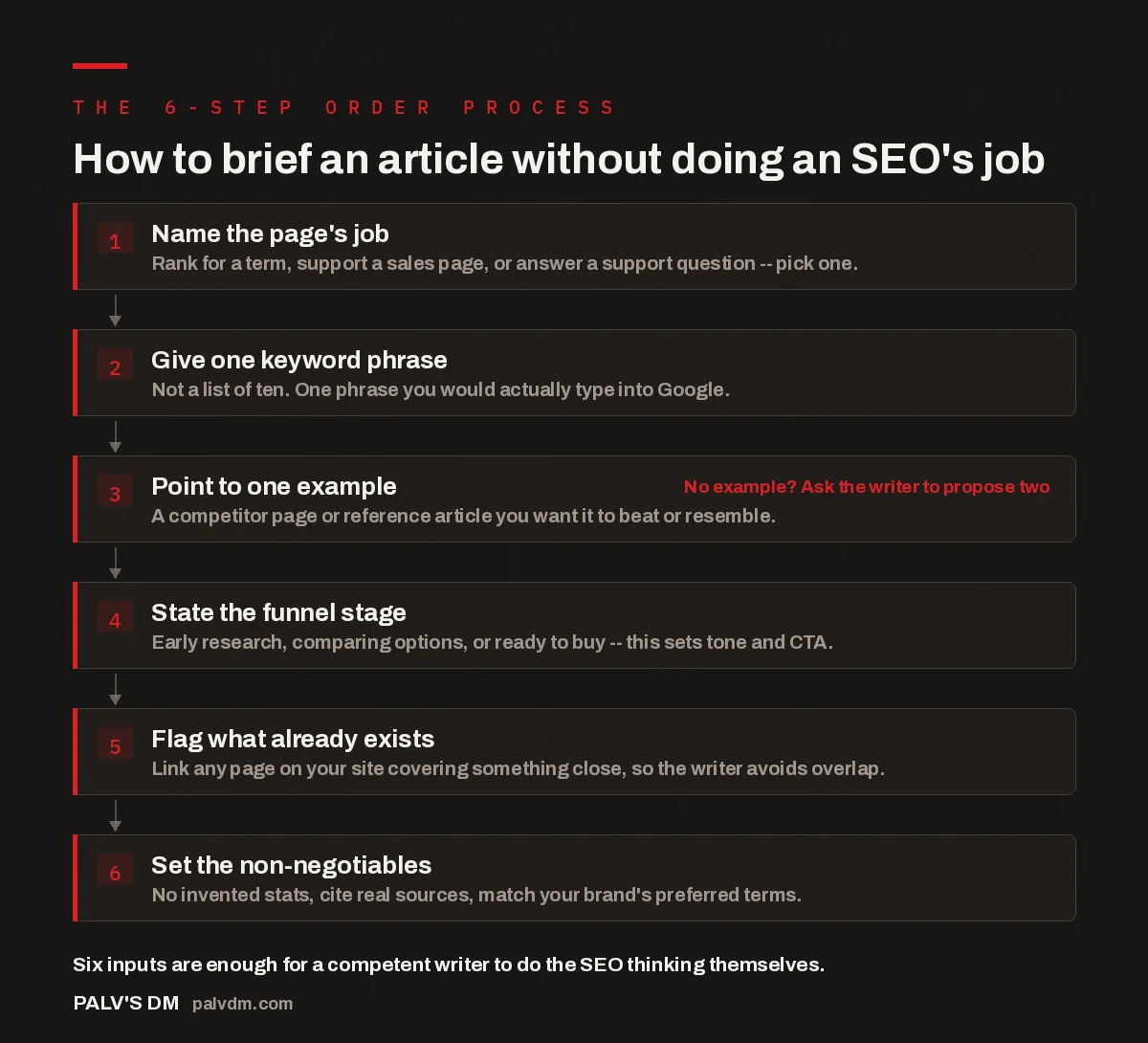
How to brief an article without doing an SEO’s job
- Name the page’s job. Rank for a term, support a sales page, or answer a support question — pick one.
- Give one keyword phrase. Not a list of ten. One phrase you would actually type into Google.
- Point to one example. A competitor page or reference article you want it to beat or resemble. No example? Ask the writer to propose two
- State the funnel stage. Early research, comparing options, or ready to buy — this sets tone and CTA.
- Flag what already exists. Link any page on your site covering something close, so the writer avoids overlap.
- Set the non-negotiables. No invented stats, cite real sources, match your brand’s preferred terms.
Why does briefing content feel impossible without an SEO on staff?
Because most guidance on “how to order SEO content” was written for people who already know SEO — it tells you to specify search intent, keyword clusters, SERP features, and content gaps, as if you were writing the brief yourself and the writer was just typing it up. If you don’t have that vocabulary, the advice is useless, and the honest fallback most business owners land on is either writing three vague lines (“an article about our services”) or giving up and doing it themselves badly.
Neither is necessary. Keyword research, competitor analysis, and structural decisions are the content team’s job, the same way you don’t tell an accountant which ledger entries to use. You’re responsible for the business context a writer can’t invent: what the page needs to accomplish, who it’s for, and what “good” looks like to you. Get that across clearly and the rest is execution.
What do you need to tell a content writer before you order?
Below is the same six-step order shown in the graphic above, with the reasoning behind each one.
- Name the page’s job. Is this article meant to rank and pull in new visitors, to support an existing sales page by answering the objections that stall a purchase, or to reduce support tickets by answering a question your team gets asked repeatedly? These need different structures and different endings. A ranking-focused piece needs to satisfy the search intent completely; a sales-support piece needs to end near a decision, not a definition.
- Give one keyword phrase, not a wish list. If you hand over ten keywords, the writer has to guess which one actually matters, and the article ends up trying to serve all ten and satisfying none well. Pick the single phrase you’d type into Google if you were the customer. If you genuinely have several related terms, that’s a sign you need several articles, not one crowded one.
- Point to one example. A competitor’s article you want to outrank, or a piece from any industry that has the tone and depth you’re after. This single reference does more work than a paragraph of abstract instructions — it tells the writer your bar for depth, your tolerance for jargon, and roughly how long the piece should run. If you don’t have one, say so and ask the writer to propose two options before drafting.
- State the funnel stage. Is the reader still figuring out whether they have the problem, comparing two or three ways to solve it, or already sold and looking for a reason to pick you specifically? This one line changes the tone, the depth of explanation, and whether the article ends with a soft next-step link or a direct call to action.
- Flag what already exists on your site. Even a rough list of your most relevant existing pages saves a writer from either duplicating a topic you’ve already covered or leaving out an obvious internal link. You don’t need a content audit — a five-minute list of “these are our closest related pages” is enough.
- Set the non-negotiables. No invented statistics, cite sources for any claim that needs one, and stick to your brand’s preferred terms for your own product or service. These are the guardrails that matter most and the ones a generic writer is most likely to get wrong without being told explicitly.
What should you not have to specify yourself?
The line between “your input” and “the agency’s job” is where most first-time buyers over-think the brief. If you’re spending time deciding on H2 headings, working out secondary keywords, or mapping out internal links across your whole site, you’re doing work that should sit with the content team.
| You provide | The content team figures out |
|---|---|
| The page’s job and funnel stage | Keyword research, related terms, and search intent |
| One reference example | Article structure, heading order, and word count |
| A rough list of your existing related pages | Which internal links actually belong in the piece |
| Facts, figures, and terminology specific to your business | Sourcing, formatting, and how claims get verified |
| Approval on the final draft | Schema markup, meta description, and image needs |
If a content team asks you to fill in the right-hand column yourself, that’s a sign they expect you to do their SEO thinking for them.
Do you need a strategist instead of a writer?
Sometimes. If you can answer all six brief points above for a single article, a writer is enough — they’ll turn your inputs into a well-structured, well-researched piece. But if you’re trying to plan twenty articles across a quarter and you don’t know which topics matter most or how they should link to each other, that’s a strategist’s job, not a writer’s, and asking a writer to make those calls one article at a time usually produces a set of disconnected pieces rather than a body of content that reinforces itself. We’ve written more on how to tell whether you need a writer or a content strategist if you’re ordering at that scale.
The clients who get the best content out of us aren’t the ones who hand over a keyword spreadsheet. They’re the ones who can tell us in three sentences what the page needs to do and who it’s for — the SEO part is our job to translate.
Palash, Founder, PalV’s DM
What should show up when the article is delivered?
A finished article shouldn’t just be a Google Doc of text. If you’ve ordered SEO content properly, the delivery should include a meta title and description, appropriate schema markup, internal links already placed rather than left for you to add, and images with alt text — not just the words in between the headings. We’ve broken down exactly what you get when you order an article from us and the fuller list of what comes with every article: schema, meta, images, links if you want to check a quote against a checklist before you commit.
Knowing what should be included also protects you from a common gap: an agency that delivers clean prose but leaves schema, meta, alt text, and internal linking as “your team’s responsibility.” That’s extra work you didn’t budget for — worth asking about explicitly before the order goes in, not after the invoice arrives.
Does skipping in-house SEO expertise cost you later?
Not if the brief is right and the vendor is doing their job — but it can, if you use “I don’t have an SEO” as a reason to accept a lower-effort brief and a lower-effort article to match. The pattern that shows up repeatedly in accounts we take over from cheaper providers isn’t that the writing was bad grammatically; it’s that the article never had a clear job, so it reads pleasantly and ranks for nothing in particular. That’s a briefing failure, not a writing failure, and it’s exactly what the six-point brief above is meant to prevent. We’ve written about this gap directly in cheap content vs researched content: the cost over 12 months, and if budget is the real question behind “how do I order this,” what SEO content should cost per article in India is a useful reference point before you compare quotes.
The other risk worth naming: without any SEO literacy, it’s harder to judge a brief-fulfilling article from a mediocre one at review time. That’s less a reason to learn SEO yourself and more a reason to pick a vendor whose review process you trust — ask how they check a draft against the original brief before it reaches you.
Short version
- Give the page’s job, one keyword, one example, the funnel stage, existing overlap, and your fact-checking rules — that’s a complete brief.
- Leave keyword research, structure, and technical package (schema, meta, links) to the content team.
- If a vendor pushes SEO decisions back onto you, that’s a sign to look elsewhere.
Frequently asked questions
Can I really order SEO content with zero SEO knowledge?
Yes, as long as you can answer the six brief points: the page’s job, one target keyword, one reference example, the funnel stage, what already exists on your site, and your rules on facts and sourcing. Everything past that — keyword research, structure, technical setup — is the content team’s responsibility, not yours.
What if I only have a topic, not a specific keyword phrase?
Say so in the brief instead of guessing at a phrase. A competent writer or strategist can turn a broad topic into a specific target keyword faster and more accurately than you can, since that step genuinely requires search-behaviour research. Forcing yourself to pick a keyword you’re unsure about can send the article in the wrong direction.
Should I write a full brief document, or is a short brief enough?
Short is enough, and shorter is often better. A tight brief that hits the six points above gives a writer clear direction without boxing them into decisions that are properly theirs to make, like heading structure or paragraph order. Long briefs that try to pre-write the article usually produce stiffer copy, not better copy.
How do I check the delivered article actually matches what I ordered?
Reread your original six-point brief against the draft: does it address the stated page job, does it target the agreed keyword naturally, does it match the tone of your reference example, and does the ending fit the funnel stage you specified? If those four line up, the article is doing its job even if you can’t personally judge the finer SEO mechanics.
Is it cheaper to hire an in-house SEO instead of briefing an agency this way?
Not for most businesses ordering a handful of articles a month — a six-point brief plus a content team that does the SEO thinking is usually far cheaper than a full-time hire, and it scales down when you don’t need content that quarter. In-house SEO expertise starts to pay for itself once content volume and the surrounding technical work grow large enough to need daily attention.