Service Support — Content Writing
What You Get When You Order an Article From Us
Every article order includes a brief, human draft, fact-check, on-page SEO, links, and review: the full seo content writing service package explained.
When you order an article from us, you’re not paying for 1,200 words of text. You’re paying for a researched brief, a human-written draft, a fact-check pass, on-page SEO setup (title, meta, headings, schema), internal linking placed with intent, and an editor’s review — all before the article reaches you. That’s the full package on every order, regardless of topic or word count. If any one of those pieces is missing, the article isn’t finished, even if the word count says otherwise.
Key takeaway
- An article order includes a research-backed brief, a human draft, fact-checking, on-page SEO, internal links, and editor review — not just writing.
- The brief is built from actual search results and search intent for your keyword, not a generic content outline template.
- Nothing ships until a second person has reviewed it — the writer is never the last check on their own work.
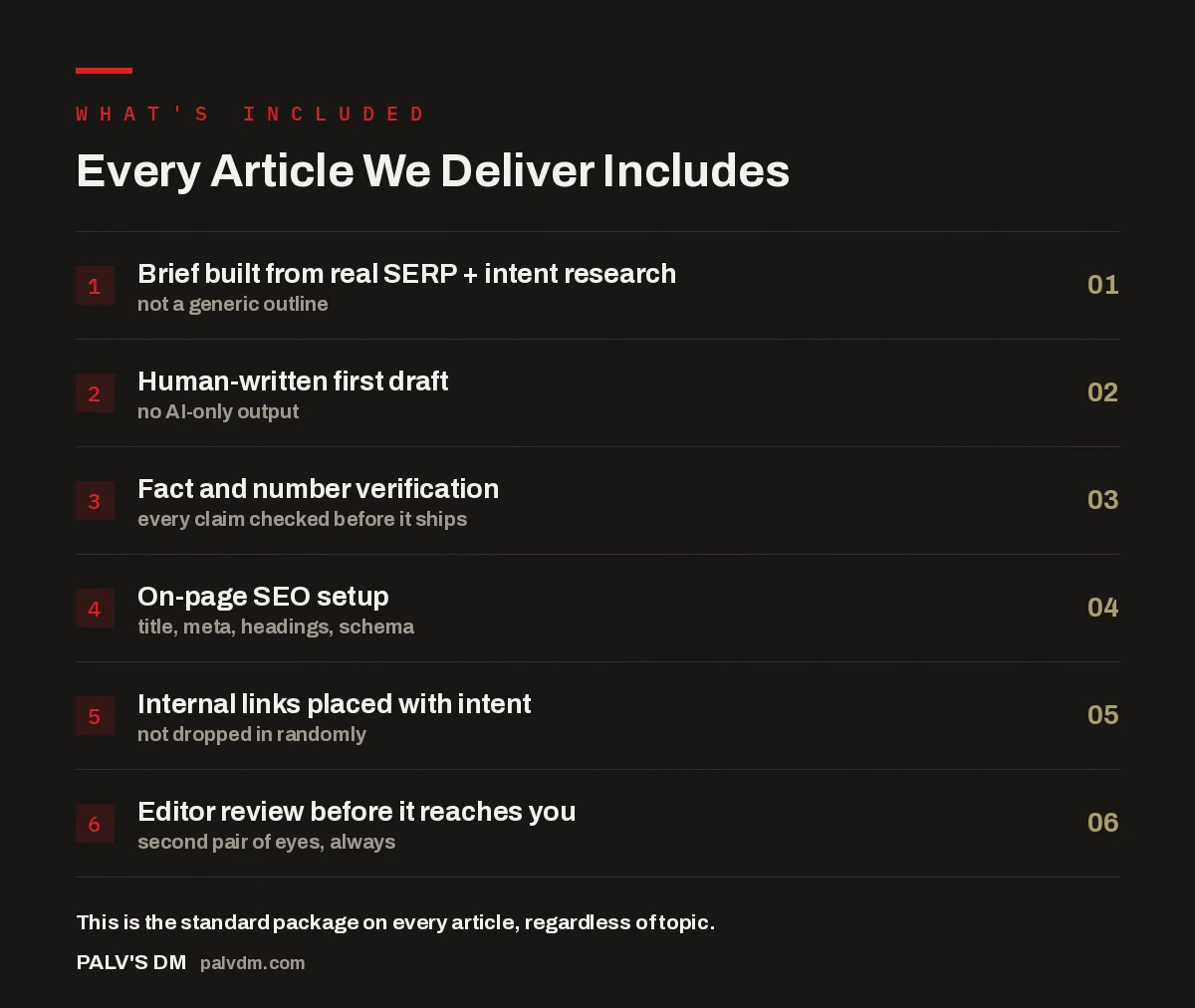
Every Article We Deliver Includes
- Brief built from real SERP + intent research — 01. not a generic outline.
- Human-written first draft — 02. no AI-only output.
- Fact and number verification — 03. every claim checked before it ships.
- On-page SEO setup — 04. title, meta, headings, schema.
- Internal links placed with intent — 05. not dropped in randomly.
- Editor review before it reaches you — 06. second pair of eyes, always.
What’s Actually in the Package When You Order an Article?
Most people who search for an seo content writing service assume they’re buying a writer’s time. What you’re actually buying is a process with six checkpoints, and the writing is only one of them. The brief comes first, built from what’s genuinely ranking for the target keyword and what the searcher is trying to accomplish. The draft comes second, written by a person who has read that brief, not generated from a one-line prompt. Then the article goes through fact-checking, on-page SEO setup, internal linking, and editor review — in that order, every time.
The reason we describe it this way instead of just saying “we write your content” is that most of the quality problems we see in bought content trace back to a missing checkpoint, not bad writing. A draft with no brief drifts off-topic. A draft with no fact-check ships a wrong number. A draft with no editor pass reads like a first attempt because it is one. Removing any single step doesn’t make the article 15% worse — it tends to make one specific thing go wrong, and that thing is usually the thing a reader or a search engine notices first.
How Does the Brief Get Built Before Anyone Writes a Word?
The brief starts with the keyword and the actual search results for it, not a template pulled from a swipe file. We look at what’s currently ranking, what those pages cover that others don’t, what questions show up in related searches, and where the gaps are. From that, the brief specifies the angle, the subheadings the article needs to answer, the search intent it has to satisfy (informational, commercial, or transactional), and which existing pages on your site it should link to or from.
This matters more for buyers than it sounds like it should. An article written against a thin brief tends to read fine on its own but does nothing for the site around it — it doesn’t connect to your other pages, it doesn’t target the intent your buyer is actually in, and it doesn’t cover what a competing page already covers better. A properly built brief is what keeps an individual article from becoming an orphan piece of content that never earns rankings or links from the rest of your site.
Who Actually Writes the Draft?
A person writes the first draft, working from the brief. We use AI tools inside the process — for research assistance, for checking structure against the brief, occasionally for a first-pass outline — but the sentences a reader ends up reading are written and rewritten by a human writer who understands the topic and the brand voice they’re writing in. This isn’t a purity stance; it’s a quality one. Fully AI-generated drafts tend to hedge everything, repeat themselves across paragraphs, and default to generic phrasing that could apply to any company in any industry. A human writer catches that in a way a generation pass doesn’t catch itself.
Where you have an in-house tone of voice, style guide, or list of terms you don’t use, the writer works from that document, not from a generic “professional” default. Where you don’t have one yet, we default to direct, specific, jargon-light writing and flag anything that reads too promotional for the format.
An article isn’t done when the writing is done. It’s done when someone other than the writer has checked it, and that’s the step most cheap content skips entirely.
Palash, Founder, PalV’s DM
What Happens During Fact-Checking?
Every number, date, tool name, and claim of fact in an article gets checked against a source before the article is considered finished. If a number can’t be verified against something credible, it doesn’t go in — we’d rather write the sentence qualitatively (“in the accounts we work on, this shows up repeatedly”) than publish a precise-sounding figure we can’t stand behind. This is also where we catch outdated claims: a tool that’s changed its pricing, a platform feature that’s since been deprecated, a “best practice” that search engines have since moved away from.
This step exists because inaccurate content is a liability for you, not just an embarrassment. A wrong statistic on your blog gets copied into a sales deck, quoted by a prospect, or cited by an AI answer engine as if it were verified fact. Once that happens, it’s your name attached to it, not the writer’s.
What’s Included for On-Page SEO?
Every article ships with a title tag and meta description written for the target keyword, a heading structure that actually maps to how people search (question-style H2s where that matches real queries), schema markup where it applies to the content type, and image alt text that describes the image rather than stuffing keywords into it. None of this is billed as an add-on — it’s part of what “an article” means in our process, because an article without on-page setup isn’t ready to be published, it’s a Word document with headings.
Internal linking is handled the same way. The writer places 2 to 4 links to genuinely related pages on your site, with descriptive anchor text rather than “click here,” and one clear link to the relevant service or product page if the article’s funnel stage calls for it. Links aren’t dropped in to hit a quota — they’re chosen because a reader who’s interested in this article is plausibly interested in that page too.
How Many Rounds of Review Does an Article Go Through?
Two, at minimum. The first is a structural and factual review — does this match the brief, does every claim check out, does it actually answer the question in the title. The second is a language and voice pass, sometimes called the humanising pass internally, where an editor reads it the way a real visitor would: does this sound like a person wrote it, does any paragraph drag, does the opening actually answer the question in the first few sentences instead of building up to it. An article doesn’t move to “ready to publish” until both passes are done. The writer is never the only person who reads their own work before you do.
If you want a deeper look at how these stages connect end to end — from the moment a topic is briefed to the moment it’s live on your site — our content pipeline from brief to published walks through the full sequence. And if you want the specifics on exactly what technical elements ship with every article, what comes with every article: schema, meta, images, links covers that in more detail than we’ve gone into here.
The two-review structure is also explained on its own in the two approval gates in our writing process, if you’re specifically weighing whether a cheaper single-review workflow is good enough for what you need.
Ready to order an article?
You get the full package described above on every order — no version where the brief, fact-check, or SEO setup is optional. If you’re still comparing this against cheaper options, what SEO content should cost per article in India breaks down where the price difference actually comes from.
Frequently Asked Questions
Do I need to provide the topic and keyword, or do you choose them?
Either works. If you already have a keyword or topic list, we brief directly against it. If you don’t, we can suggest topics based on your site and what’s realistically achievable for your current authority, but you’ll always see the proposed brief before writing starts.
How many revision rounds are included with an article order?
One round of client revisions is included after the article has already been through our two internal review passes. Most revision requests at that stage are small — tone adjustments, added detail on a specific point — since the structural and factual issues have usually already been caught before it reaches you.
Will the article include statistics or data points?
Only where we can verify them against a real source. We won’t invent a percentage or a study to make a paragraph sound more authoritative. Where hard data genuinely exists and is relevant, we’ll cite it and link the source; where it doesn’t, the article makes the point qualitatively instead.
Do you write for industries you’re not already familiar with?
Yes. Unfamiliarity with a topic gets handled at the brief stage, through research and, where needed, a short set of questions back to you, rather than being left for the writer to guess at mid-draft. If a topic is genuinely outside what we can responsibly cover — certain regulated or highly technical medical or legal areas — we’ll tell you upfront rather than take the order.
Who owns the article once it’s delivered?
You do, fully. Once payment is complete, the content, the images, and any research notes we’ve compiled belong to you to publish, edit, or take elsewhere, with no ongoing license or attribution requirement back to us.
Short version: ordering an article from us gets you a research-backed brief, a human-written draft, verified facts, on-page SEO (title, meta, headings, schema), intentional internal linking, and a two-stage editor review — as one package, on every order, not as separate line items you have to ask for.