Service Support — Content Writing
The Two Approval Gates in Our Writing Process
Our content approval process runs on just two client checkpoints: brief approval, then final draft review. Here is exactly what each gate covers and why.
Our content approval process has exactly two client checkpoints: Gate One, where you approve the brief and outline before any drafting starts, and Gate Two, where you review the finished article before it publishes. That’s it — no round of “just a few line edits” after line edits, no five-stage sign-off chain that stalls a content calendar for weeks. Everything that happens between those two gates — research, drafting, fact-checking, the humanising pass — is our job, not yours. The two gates sit at the only two points where your input actually changes the outcome: before we’ve written anything, and after we’ve written everything.
Key takeaway
- Our content approval process has two client gates, not four or five: brief/outline approval, then final draft review.
- Gate One catches the expensive mistakes — wrong angle, wrong keyword, missing structure — before a single sentence gets written.
- Gate Two is a review of a finished, fact-checked, formatted article — not a first draft you’re expected to rewrite.
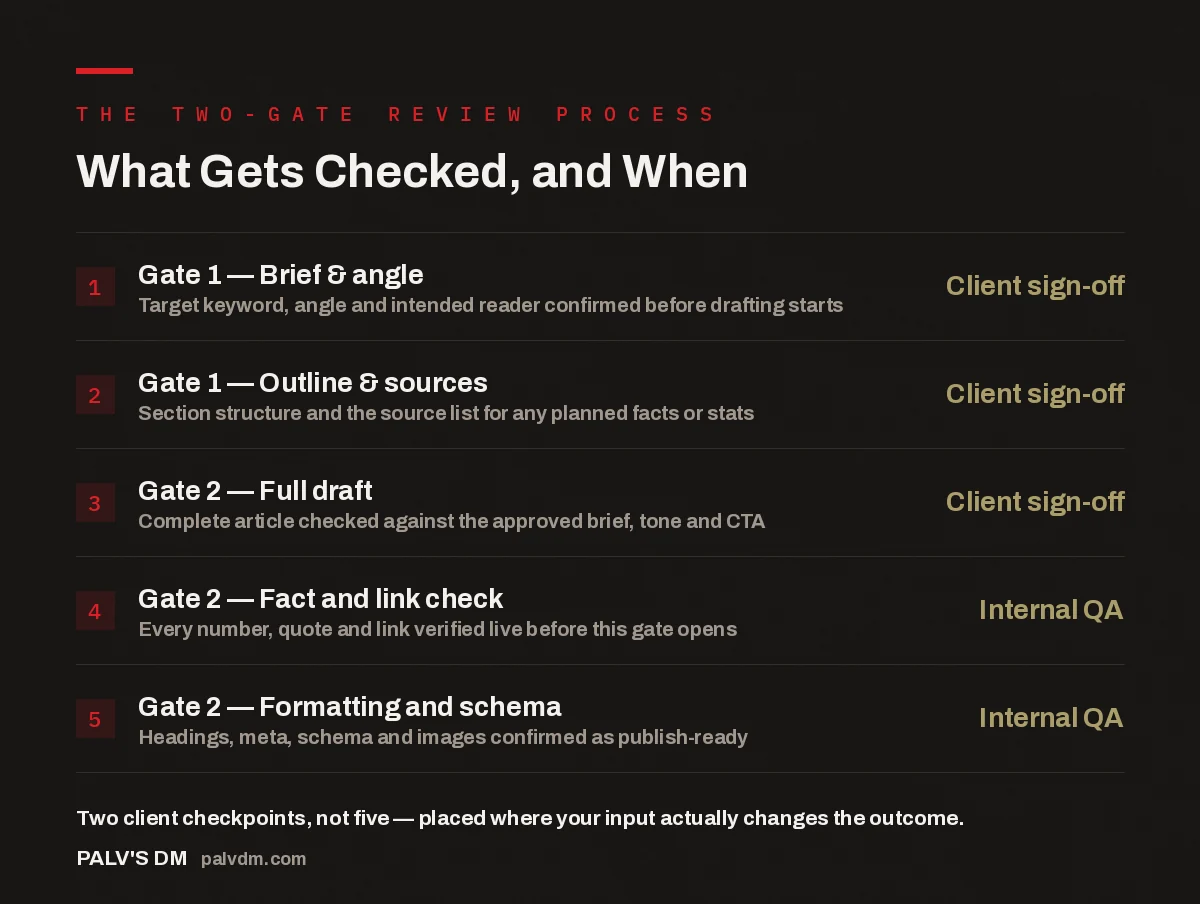
What Gets Checked, and When
- Gate 1 — Brief & angle — Client sign-off. Target keyword, angle and intended reader confirmed before drafting starts.
- Gate 1 — Outline & sources — Client sign-off. Section structure and the source list for any planned facts or stats.
- Gate 2 — Full draft — Client sign-off. Complete article checked against the approved brief, tone and CTA.
- Gate 2 — Fact and link check — Internal QA. Every number, quote and link verified live before this gate opens.
- Gate 2 — Formatting and schema — Internal QA. Headings, meta, schema and images confirmed as publish-ready.
What Is a Content Approval Process, and Why Only Two Gates?
A content approval process is simply the set of points where a client reviews and signs off on work before it moves forward. Most agencies default to more checkpoints, not fewer — a brief review, a draft-one review, a draft-two review, a “final” review that somehow isn’t final. Each one feels safe to add and none of them feels safe to remove. The result, in the accounts we’ve inherited from other agencies, is a content calendar that takes six weeks to publish four articles, most of that time spent waiting on an inbox reply rather than on actual writing.
We run a two-gate content approval process because two is the number of moments where a client decision genuinely changes what gets produced. Before drafting, your call on angle and structure determines the whole shape of the piece. After drafting, your call on the finished article determines whether it publishes as written or gets sent back with notes. Every checkpoint in between — a mid-draft review, a “just checking in” pass — asks you to judge work that isn’t finished yet, which mostly produces feedback on things we were already going to fix ourselves.
What Happens at Gate One — Brief and Outline Approval?
Gate One happens before a single sentence of the article exists. You’re reviewing three things: the target keyword and search intent we’re writing for, the angle — the specific argument or answer the piece will make, not just its topic — and a section-by-section outline showing what each H2 will cover and in what order. If the piece will lean on any statistics, named tools, or claims that need a source, we attach the source list at this stage too, so you can flag anything questionable before it’s woven into prose.
This gate is deliberately light to review. You’re not proofreading sentences or judging tone — there isn’t any prose yet. You’re checking whether the plan matches what you actually wanted: is this the angle you’d take with this keyword, does the outline cover the objections your buyers actually raise, is anything missing that a competitor’s page already covers. Because the review object is short — an outline and a few bullet points — most clients turn Gate One around the same day they receive it.
Skipping this gate is the single most common way content projects go wrong. A writer drafts a full article on a plausible-sounding angle, the client reads the finished piece, and only then says “actually, we wanted this framed around implementation, not strategy.” At that point the fix isn’t a quick edit — it’s close to a rewrite. Gate One exists specifically to make that conversation happen when it costs an outline, not a finished draft.
What Happens at Gate Two — Final Draft Review?
Gate Two is the only other point where you’re asked to look at the piece. By the time it reaches you, the article has already been through our internal pipeline: drafted against the approved outline, checked for factual accuracy against the source list you saw at Gate One, run through a humanising pass to strip out anything that reads like generic AI output, and formatted with headings, internal links, schema and images in place. You’re reviewing a finished article, not a rough draft.
What you’re checking at this stage is different from what you checked at Gate One. The structural decisions were already made and approved — you’re now judging whether the execution matches your brand’s voice, whether the examples and framing feel right for your specific business, and whether the call to action fits your funnel. If something needs to change, it’s usually a tone adjustment, a swapped example, or a tightened section — not a request to rethink the whole piece, because the whole piece was already agreed at Gate One.
Revisions at Gate Two are scoped to what was approved at Gate One. If a Gate Two review asks for a different angle entirely, that’s effectively reopening Gate One with a finished draft already sitting in front of you — which is exactly the expensive, late-stage rework the two-gate structure is built to prevent.
Why Doesn’t Every Draft Go Through Three or Four Rounds of Review?
More review rounds sound like more quality control, but in practice they mostly redistribute the same decisions across more meetings. The pattern that shows up repeatedly in accounts we take over from other agencies: a mid-draft “check-in” catches the same structural issues Gate One would have caught, just later, after more writing has already happened. A “polish” review after that mostly catches typos and phrasing — exactly what our internal QA and humanising pass already handle before the piece reaches you.
Extra gates also cost more than time: every additional checkpoint is another point where a piece can sit in an inbox for a week. A two-gate content approval process keeps the number of places that can stall to two, and keeps each one fast because it has one clear question attached — is this the right plan, and is this the right execution of that plan.
Every checkpoint we remove from a content approval process has to be replaced by something internal that does the same job — otherwise we’re not simplifying the process, we’re just skipping the check.
Palash, Founder, PalV’s DM
Gate One vs Gate Two: What Changes Between Them?
| What’s being reviewed | Gate One (brief & outline) | Gate Two (final draft) |
|---|---|---|
| Object you review | Angle, keyword, section outline, source list | Complete, formatted, fact-checked article |
| Question you’re answering | Is this the right plan? | Is this the right execution of that plan? |
| Typical turnaround | Same day for most clients | 1–2 business days for most clients |
| What’s still open to change | Structure, framing, sources | Tone, examples, phrasing — not the core angle |
What Should You Actually Check at Each Gate?
Knowing what to look for at each gate makes both reviews faster. At Gate One, resist the urge to line-edit an outline — there’s no prose yet to line-edit. Instead check whether the angle matches what you’d tell a prospect if they asked the question in person, whether the outline addresses the objections your sales team actually hears, and whether any listed source looks off before it gets built into a sentence.
- At Gate One: does the angle match how you’d actually answer this question for a prospect?
- At Gate One: does the outline order match how your buyers think through the decision?
- At Gate Two: does the finished piece sound like your brand, not a generic version of it?
- At Gate Two: is the call to action pointing at the right page for where this reader is in the funnel?
At Gate Two, the useful check is fit, not correctness — accuracy and formatting were already handled internally before the piece reached you. Read it as a prospective customer would, not as an editor hunting for something to change. If the angle you approved at Gate One is well executed, the fastest and most useful Gate Two review is often “approved, no changes.”
This two-gate structure is one piece of a longer pipeline — the same process that covers research, drafting, fact-checking and formatting is laid out in full in our content pipeline from brief to published. If you’re weighing whether a lean two-gate process fits your team versus wanting a dedicated strategist reviewing every stage, that trade-off between a writer and a content strategist is worth reading before you commit to a workflow.
Key takeaway
- Two client gates, both fast to clear, because each one asks a single narrow question instead of “does everything look okay.”
- Everything between the gates — fact-checking, the humanising pass, formatting — is handled internally before you ever see it.
- Want to see this process run on your own content calendar?
FAQ: The Two Approval Gates in Our Content Approval Process
How long does each approval gate usually take?
Gate One is short to review — an outline and a few bullet points, not a finished article — so most clients respond the same day. Gate Two involves reading a complete piece, so we typically ask for a response within one to two business days, though nothing stops you from turning it around faster.
Can we ask for more than two rounds of review on an article?
Yes — if Gate Two review asks for changes, we revise and send it back for another look before publishing. What we avoid is adding a third standing gate to the standard workflow, since most of what an extra checkpoint would catch is already handled by internal fact-checking, formatting QA and the humanising pass before the piece reaches Gate Two.
What happens if we don’t respond at Gate One or Gate Two?
The piece simply waits — we don’t draft past an unapproved brief, and we don’t publish past an unapproved final draft. On active retainers we’ll follow up and, if the calendar allows, move on to the next planned article so a slow response on one piece doesn’t stall the whole month’s output.
Who approves the brief if we don’t have an in-house SEO or content lead?
Whoever knows the business and the customer best — often a founder, a marketing generalist, or whoever normally answers sales objections. Gate One doesn’t require SEO expertise; it requires someone who can say whether the angle and outline match how the business actually talks about the topic.
Does this two-gate process change for bulk content orders?
The structure stays the same per article — every piece still gets its own Gate One and Gate Two — but for larger batches we typically bundle outlines for several articles into one Gate One review and stagger Gate Two reviews as drafts complete, so you’re not reviewing everything in a single sitting.
Short version: our content approval process runs on two gates, not five. Gate One approves the brief, angle and outline before drafting starts. Gate Two reviews the finished, fact-checked, formatted article before it publishes. Everything in between — research, drafting, verification, the humanising pass — happens on our side, so the only times you need to weigh in are the two moments where your input actually changes what gets produced.