Service Support — Content Writing
Our Content Pipeline From Brief to Published
Our content production process runs every article through six checkpoints — brief, draft, evidence check, two approval gates and a humanising pass.
Our content production process runs every article through six fixed stages — brief, draft, evidence check, first approval gate, humanising pass, second approval gate — before anything gets scheduled. No stage gets skipped to hit a deadline, and no article moves to the next stage without a named person signing off on the one before it. That structure exists because most “content mills” fail in predictable, avoidable ways: writers work off a keyword instead of a brief, nobody checks the numbers, and the piece reads like it was assembled rather than written. This is what actually happens between a client saying “we need an article on X” and that article going live.
Key takeaway
- Every article starts from a written brief (keyword, intent, funnel stage, money page) — never a blank prompt.
- Two separate approval gates sit either side of the humanising pass, so structure and accuracy get checked before tone does.
- Nothing ships without a source trail for every factual claim and the full technical package — schema, meta, images, internal links.
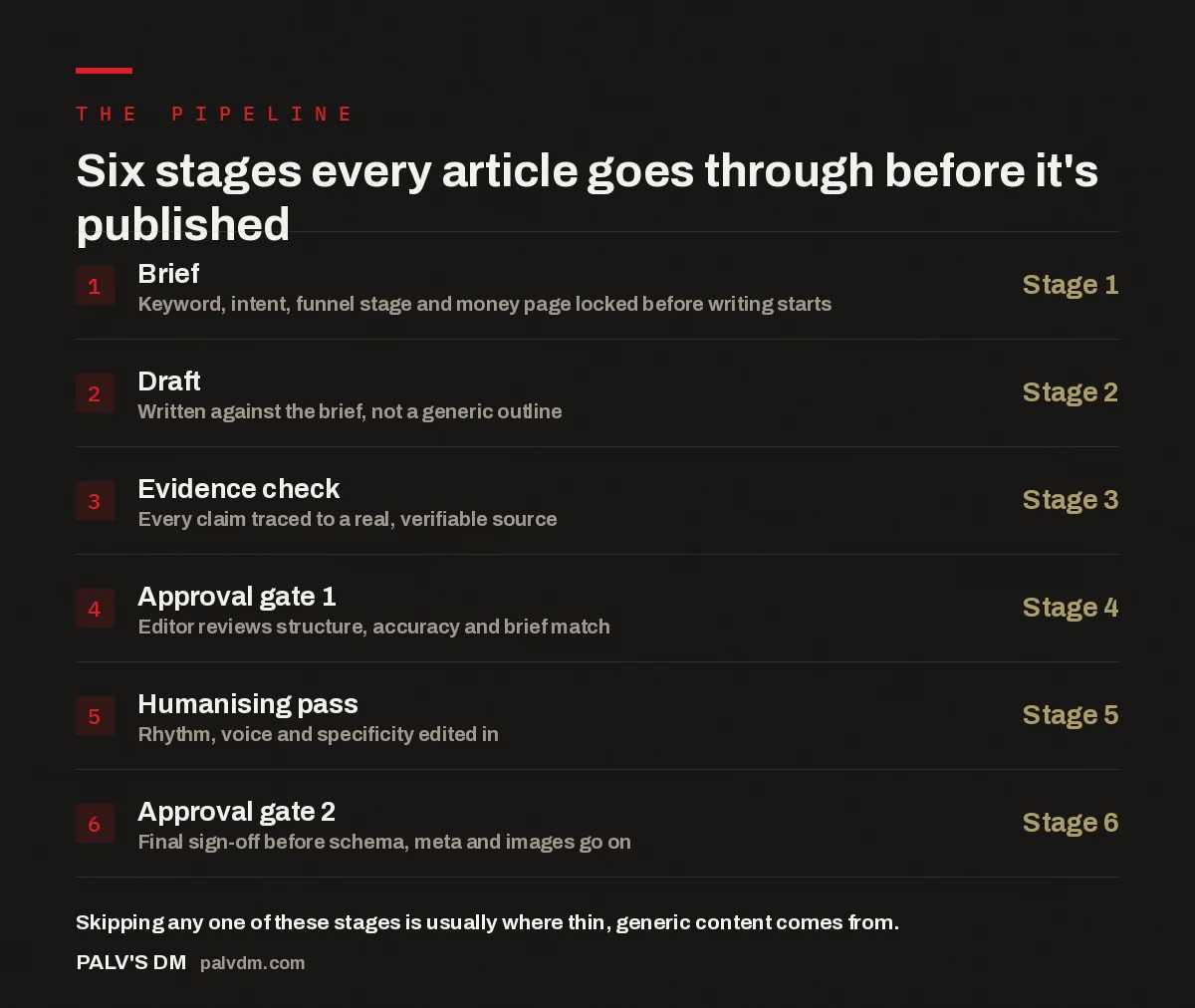
Six stages every article goes through before it’s published
- Brief — Stage 1. Keyword, intent, funnel stage and money page locked before writing starts.
- Draft — Stage 2. Written against the brief, not a generic outline.
- Evidence check — Stage 3. Every claim traced to a real, verifiable source.
- Approval gate 1 — Stage 4. Editor reviews structure, accuracy and brief match.
- Humanising pass — Stage 5. Rhythm, voice and specificity edited in.
- Approval gate 2 — Stage 6. Final sign-off before schema, meta and images go on.
What does a content production process actually look like in practice?
In practice, it looks like a queue with checkpoints rather than a single writer typing until they hit a word count. An article enters at “brief” and can only move forward once the person responsible for the current stage marks it done. If the evidence check turns up a claim nobody can source, the piece goes back to draft rather than forward to approval. If the first approval gate flags a structural problem — the piece answers the wrong question, or drifts off the money page it’s meant to support — it goes back to draft too. The pipeline is linear on paper but it isn’t a straight line in reality; pieces bounce backward more often than clients assume.
The reason for building it this way is ordinary rather than clever: a single person writing, editing, fact-checking and formatting their own work under a deadline will always cut a corner somewhere, usually without noticing which one. Splitting the work into stages with different owners is the only reliable way we’ve found to stop that from happening quietly.
How does a brief turn into a working draft?
A brief sets the keyword, the search intent, the funnel stage, the archetype (guide, comparison, myth-buster, how-to), and the money page the article should eventually point a reader toward. It also names two or three internal pieces already live on the site that the new article can genuinely link to — not a random internal-linking quota, but pieces that share a real topical connection. A writer working from that brief isn’t guessing what the article is for; they know before the first sentence whether the reader arriving on this page is comparing options, trying to learn a concept, or ready to buy.
The draft stage is where that brief gets executed. We ask writers to open with a direct answer to the question implied by the title — no scene-setting, no “in today’s digital landscape” — because that’s both better for the reader and better for how AI answer engines lift content into summaries. Headings are written as questions where a question is the natural way someone would search, and each section is written to stand on its own, so a reader (or a language model quoting a section) doesn’t need the paragraph above it to make sense of a “this” or “that.”
If the topic is genuinely outside a writer’s existing knowledge, that gets flagged at brief stage rather than papered over in the draft — we’ve written separately about how we handle topics we don’t know anything about, and it’s a different workflow to a standard brief.
Why does every claim get checked before the piece moves forward?
The evidence check exists because the fastest way to lose a client’s trust — and increasingly, to lose an AI engine’s trust when it’s deciding whether to cite you — is to publish a number nobody can trace back to a real source. Before a draft goes to the first approval gate, every statistic, every “studies show,” every named tool or platform behaviour gets checked against something real: a public report, an official changelog, a source we can point to if a client or reader asks. If a claim can’t be verified, it either gets cut or gets rewritten as what it actually is — a pattern we see across accounts, described honestly as a pattern rather than dressed up as a hard figure.
This is a deliberate constraint, not a nice-to-have. We’d rather publish a section that says “in the accounts we manage, this shows up repeatedly around the three-month mark” than invent a precise percentage that sounds more authoritative and is wrong. We go into more detail on how that verification actually works in why we refuse to publish without verifying numbers.
The pipeline isn’t there to slow writers down. It’s there so a mistake has to survive three separate people to reach a client’s site, instead of one.
Palash, Founder, PalV’s DM
What happens at the two approval gates?
There are two approval gates, and they check different things on purpose. The first gate happens right after the evidence check and before the humanising pass — an editor reads the draft against the original brief and asks whether it answers the right question, covers the archetype correctly (a comparison piece needs an up-front verdict and a real comparison, not just prose that mentions two options), and whether the sourced claims actually hold up on a second read. Nothing about tone or voice gets touched at this stage; it’s a structural and factual check.
The second gate happens after the humanising pass, and it checks the opposite thing: has anything been lost or introduced during the rewrite that changes the meaning of a claim, softens a specific detail into something vaguer, or drifts the piece away from the brief it started with. Splitting approval this way means a single editor isn’t trying to judge structure, facts and voice all at once in one read-through, which is where things get missed. We’ve written a longer breakdown of how these two checkpoints are run in the two approval gates in our writing process.
What does the humanising pass actually change?
The humanising pass sits between the two gates and is where a technically correct draft turns into something a person would actually want to read. That means varying sentence length instead of settling into a monotone rhythm, replacing vague phrasing with specific detail wherever specificity is honestly available (a named tool instead of “a popular platform,” a concrete timeframe instead of “eventually”), and cutting the kind of filler transitions that pad a word count without adding meaning. It also means checking the piece still sounds like it was written by someone who does this work, not by a template — which matters more now that so much competing content reads exactly the same because it came from the same unedited process.
This stage is also where we protect consistency across writers. A site with multiple contributors can end up sounding like five different people if nobody is actively editing toward one voice; the humanising pass is the checkpoint responsible for that, and we cover how it works across a larger writing team in how we keep one voice across multiple writers.
What ships with the article once it clears the second gate?
An article that clears the second approval gate isn’t just text — it goes out with the full technical package attached: schema markup appropriate to the piece (FAQ schema where there’s a genuine FAQ block, article schema throughout), a written meta title and description that actually describes the piece rather than repeating the keyword, a featured image and any supporting graphics, and the internal links back to the brief’s chosen money page and sibling articles. None of that gets bolted on later as an afterthought; it’s built into the same pipeline so nothing ships half-finished. The full list of what’s included in every order is laid out in what comes with every article: schema, meta, images, links.
Only once all of that is attached does the piece move to scheduling. At that point it’s treated as done — not draft-done, but published-done, with every stage of the pipeline accounted for and a named person responsible for each one.
Key takeaway
- The pipeline exists to catch the corners a single writer under deadline pressure would cut without noticing.
- Structure and facts are checked separately from tone and voice, at two different gates, by design.
- An article isn’t “done” until schema, meta, images and internal links are attached — not just the prose.
How long does the full content production process take per article?
It depends on the topic and how much verification the evidence check requires, but the six stages generally run over several working days rather than being turned around same-day. Familiar, well-documented topics move faster through drafting and verification than unfamiliar or technical ones.
Can a client see a draft before it clears both approval gates?
Yes — clients who want visibility into the process can review a draft after the first approval gate, once it’s structurally and factually sound but before the humanising pass. That’s usually a more useful review point than seeing a rough first draft.
Why split approval into two gates instead of one final review?
One reviewer checking structure, factual accuracy and tone all in a single pass tends to miss something, because those are different kinds of attention. Splitting the check before and after the humanising pass means each gate has one clear job instead of three competing ones.
What happens if a draft fails the evidence check?
It goes back to the draft stage rather than moving forward. Any claim that can’t be traced to a real source is either cut entirely or rewritten as a qualitative, pattern-based statement instead of a precise figure — it never gets waved through on the assumption it’s probably close enough.
Does the pipeline change for a comparison or how-to article?
The six stages stay the same, but what the first approval gate checks for adapts to the brief’s archetype — a comparison piece is checked for a genuine comparison table and an up-front verdict, a how-to is checked for numbered, followable steps, and so on.
Short version: every article follows the same six-stage content production process — brief, draft, evidence check, first approval gate, humanising pass, second approval gate — with a different person responsible for each checkpoint. That structure is what stops the usual failure modes of rushed content: unbriefed writing, unverified numbers, and a final read-through that’s trying to catch structure, facts and tone all at once.