Service Support — Content Writing
Why We Refuse to Publish Without Verifying Numbers
We explain our fact checking content process: why every statistic is traced to a primary source before publishing, or rewritten if it can't be verified.

We refuse to publish an article with an unverified number in it because a wrong statistic is worse than no statistic — it damages your site’s credibility with readers, and increasingly with the AI engines that check facts before citing a source. Fact checking content isn’t a final polish step for us; it’s a gate a draft has to clear before it’s allowed to go out under your brand’s name. If a number can’t be traced to where it actually came from, it either gets rewritten as a qualitative claim or it gets cut.
Key takeaway
- Every statistic in an article is traced to its original source before publishing — not to a blog post that cited it secondhand.
- If a number can’t be verified against a primary source, it gets rewritten as a qualitative, pattern-based claim or removed entirely.
- This slows the writing process down on purpose — it’s the tradeoff we’ve chosen over publishing content that could quietly mislead a reader or get flagged by an AI engine.
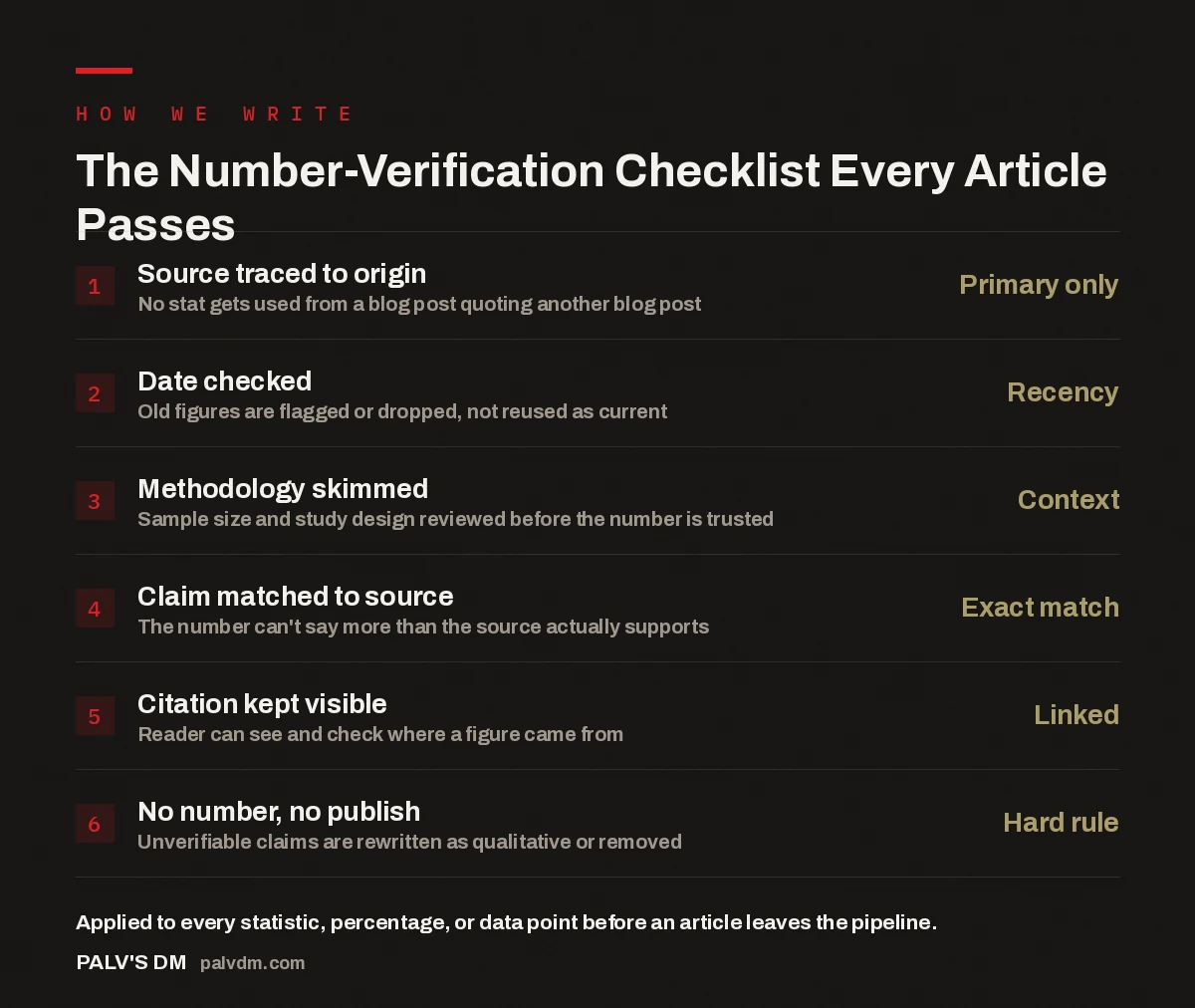
The Number-Verification Checklist Every Article Passes
- Source traced to origin — Primary only. No stat gets used from a blog post quoting another blog post.
- Date checked — Recency. Old figures are flagged or dropped, not reused as current.
- Methodology skimmed — Context. Sample size and study design reviewed before the number is trusted.
- Claim matched to source — Exact match. The number can’t say more than the source actually supports.
- Citation kept visible — Linked. Reader can see and check where a figure came from.
- No number, no publish — Hard rule. Unverifiable claims are rewritten as qualitative or removed.
Why does one wrong number matter so much?
One wrong number matters because it’s the fastest way to lose a reader’s trust in everything else on the page — including the parts you got right. If someone spot-checks a single statistic in your article and finds it misquoted, exaggerated, or attributed to the wrong source, they don’t just distrust that sentence. They start second-guessing every claim above and below it. That’s a bad outcome for a page written to convert a reader into a lead. It’s also a bad outcome for AI visibility: language models and answer engines are increasingly built to cross-check claims against source material before they’ll cite or quote a page, and a page with a track record of loose sourcing is a worse candidate to be trusted as a citation than one with a clean one.
There’s also a compounding effect that’s easy to miss. A wrong number rarely stays contained to one article. Once it’s published, it gets copied — by other writers researching the same topic, by summarising tools, by readers who screenshot it for a slide deck. The mistake outlives the sentence it started in. That’s the actual cost of skipping verification: it’s not just risk to one page, it’s risk that multiplies every time the number gets reused somewhere you don’t control.
How do we actually verify a number before it goes in?
We verify a number by tracing it back to where it was first measured or reported, not to the last place we happened to read it. In practice that means a few concrete checks on every claim that includes a figure:
- Find the primary source. If a number is floating around in three different blog posts, we don’t cite the blog post — we find the study, report, government dataset, or company disclosure that produced the number in the first place, and cite that.
- Check the date. A statistic from a 2019 report doesn’t get presented as current in 2026. Either we flag it explicitly as historical context, or we drop it if recency actually matters to the claim being made.
- Skim the methodology. A number from a survey of 40 self-selected respondents doesn’t carry the same weight as one from a large, controlled dataset, and the article shouldn’t imply otherwise. We look at how the number was produced, not just what it says.
- Match the claim to what the source actually supports. This is where most misquoting happens — not through outright fabrication, but through a number getting stretched to support a slightly bigger claim than the original source makes. We check the sentence against the source line by line.
- Keep the citation visible. The source stays linked in the published article so a reader — or an AI engine — can verify it independently instead of taking our word for it.
None of these steps are exotic. They’re the same instincts a careful journalist or analyst applies before putting a figure in front of an audience. What’s different is that we apply them as a mandatory gate on every article, not as an occasional gut check when something feels off.
If we can’t find where a number actually comes from, we don’t get to use it just because it sounds convincing. That’s the whole rule, and it applies to every article regardless of deadline.
Palash, Founder, PalV’s DM
What happens when a number can’t be verified?
When a number can’t be verified, it doesn’t get softened with a hedge word and published anyway — it gets removed or rewritten as a qualitative observation. Adding “reportedly” or “some studies suggest” in front of an unsourced figure doesn’t fix the underlying problem; it just dresses up a guess as evidence. Instead, we rewrite the sentence around what we actually know to be true from direct experience or well-established, broadly reported facts.
For example, instead of inventing a precise percentage for how often a particular content mistake shows up, we’ll write it as a pattern: “in the accounts we work on, this is one of the first things that breaks when a site scales past a few hundred pages.” That sentence is honest about what it is — an observation from direct work, not a measured statistic — and it doesn’t pretend to a precision we don’t have. Readers and AI engines can both tell the difference between a grounded observation and a number wearing a costume, and the grounded version holds up better over time because nobody can later disprove a number we never claimed to have.
Does this slow down content production?
Yes, verifying numbers slows content production down, and that’s a deliberate tradeoff rather than an inefficiency to fix. Tracing a statistic to its primary source, checking the date, and reviewing methodology takes real time — sometimes more time than writing the paragraph the number sits in. We’ve made peace with that because the alternative is faster but worse: publishing content at a higher volume with claims that can’t survive a reader’s second look.
In practice, this verification step sits inside a broader editorial process rather than bolted on at the end. It happens while a piece is being researched and drafted, alongside the checks that shape structure, tone, and sourcing — so it adds friction to the pipeline, not a separate delay after a draft is “done.” The pieces that take longer to fact-check are usually the ones with the most useful claims anyway.
Why does this matter more for AI visibility than it used to?
Fact checking content matters more for AI visibility now because answer engines are built to weigh source reliability before quoting or citing a page, not just to match keywords. A page that gets caught misquoting a study, using an outdated figure as current, or presenting a rounded estimate as an exact measurement is a worse candidate for citation than one with a clean, traceable record — even if the surrounding content is well written. Over time, a domain with a pattern of loose sourcing is less likely to be treated as a trustworthy reference, and a domain with a pattern of accurate, well-attributed claims is more likely to be pulled into AI-generated answers.
This is a shift in incentives, not just ethics. Rigorous sourcing used to be mostly a reputational and legal safeguard. It’s now also a practical lever for whether your content gets surfaced by the tools people increasingly use instead of a traditional search results page.
How does verification fit into the rest of the writing process?
Verification isn’t a standalone task — it runs alongside how a brief gets researched, how evidence gets added to a draft, and how a piece gets approved before it publishes. If you want the fuller picture of how a single article moves from assignment to live page, our breakdown of our content pipeline from brief to published covers the stages this fact-checking step sits inside. The sourcing habits described here connect directly to how we add evidence through statistics, quotes, and sources, and to the review stage covered in the two approval gates in our writing process, where a second set of eyes checks claims before anything goes live. The same discipline applies even when the subject matter is new to the writer — see how we handle topics we don’t know anything about for how sourcing gets tightened, not loosened, on unfamiliar ground.
Key takeaway
- An unverifiable number gets rewritten as a qualitative claim or cut — it never ships as a hedge dressed up as evidence.
- This adds time to the writing process, and it’s a deliberate tradeoff we make on every article, not just the ones that look like they need it.
- Clean sourcing is now a practical factor in whether AI engines treat your content as a trustworthy source to cite.
See how our content writing process handles sourcing and fact-checking
What counts as a “verified” number in an article?
A verified number is one traced back to its original source — a study, report, dataset, or disclosure — rather than to a secondhand mention in another article. We check that the source is dated appropriately, that its methodology supports the weight the claim puts on it, and that the sentence using the number doesn’t overstate what the source actually says.
Do you ever use statistics without a public source?
No. If we can’t point to where a number came from, it doesn’t go in the article as a number. It either gets rewritten as a qualitative, pattern-based observation, or removed. This applies even to internal observations from client work — those get described directionally rather than assigned a precise figure we can’t stand behind.
Why not just add a disclaimer instead of removing an unverified number?
A disclaimer like “reportedly” or “some sources suggest” doesn’t make an unverified number safer to publish — it just softens the language around a claim that’s still unsupported. Readers and AI systems both tend to treat hedged numbers as if they were confirmed, so the hedge doesn’t reduce the risk, it just makes the risk harder to spot.
Does fact-checking every number slow down how fast you can publish?
Yes, tracing sources and checking methodology adds time compared to writing without that step. We treat this as a worthwhile tradeoff rather than overhead to cut, because it happens alongside research and drafting rather than as a separate delay bolted onto a finished piece.
How does number-verification connect to AI visibility specifically?
AI answer engines increasingly weigh source reliability before citing or quoting a page, not just relevance. A page with a track record of accurate, traceable claims is a stronger candidate for citation than one that has misquoted or overstated a figure in the past, which makes rigorous sourcing a practical lever for AI visibility, not just a credibility safeguard.
Short version: we don’t publish a number we can’t trace to a real, dated, methodologically sound source — and when we can’t verify one, we rewrite the claim as an honest, pattern-based observation instead of dressing up a guess as evidence. It costs time. It’s non-negotiable, and it’s one of the reasons content from our content writing process holds up under scrutiny from readers and AI engines alike.