Service Support — Content Writing
How We Add Evidence: Statistics, Quotes and Sources
How we do research backed content writing: every stat, quote, and source gets flagged, checked against its origin, and cited before an article publishes.
We add evidence to an article the same way a fact-checker would: every claim that isn’t common knowledge gets flagged in the draft, traced to a real source, checked against what that source actually says, and cited in the text before publish. That’s the whole method behind research backed content writing at PalV’s DM — no invented statistics, no “studies show” without a study attached, and no client numbers used unless the client has actually agreed to share them. If a claim can’t be verified, it gets rewritten as an honest, qualitative statement instead of a fabricated one.
Key takeaway
- Every claim that isn’t common knowledge is flagged in the draft, sourced, and checked before it’s allowed to stay in the article.
- Quotes and statistics are only used when they’re linked to a real, checkable source — a study, official documentation, or a named person.
- If we can’t verify a number, we don’t round it, soften it, or estimate it — we drop it and write the point qualitatively instead.
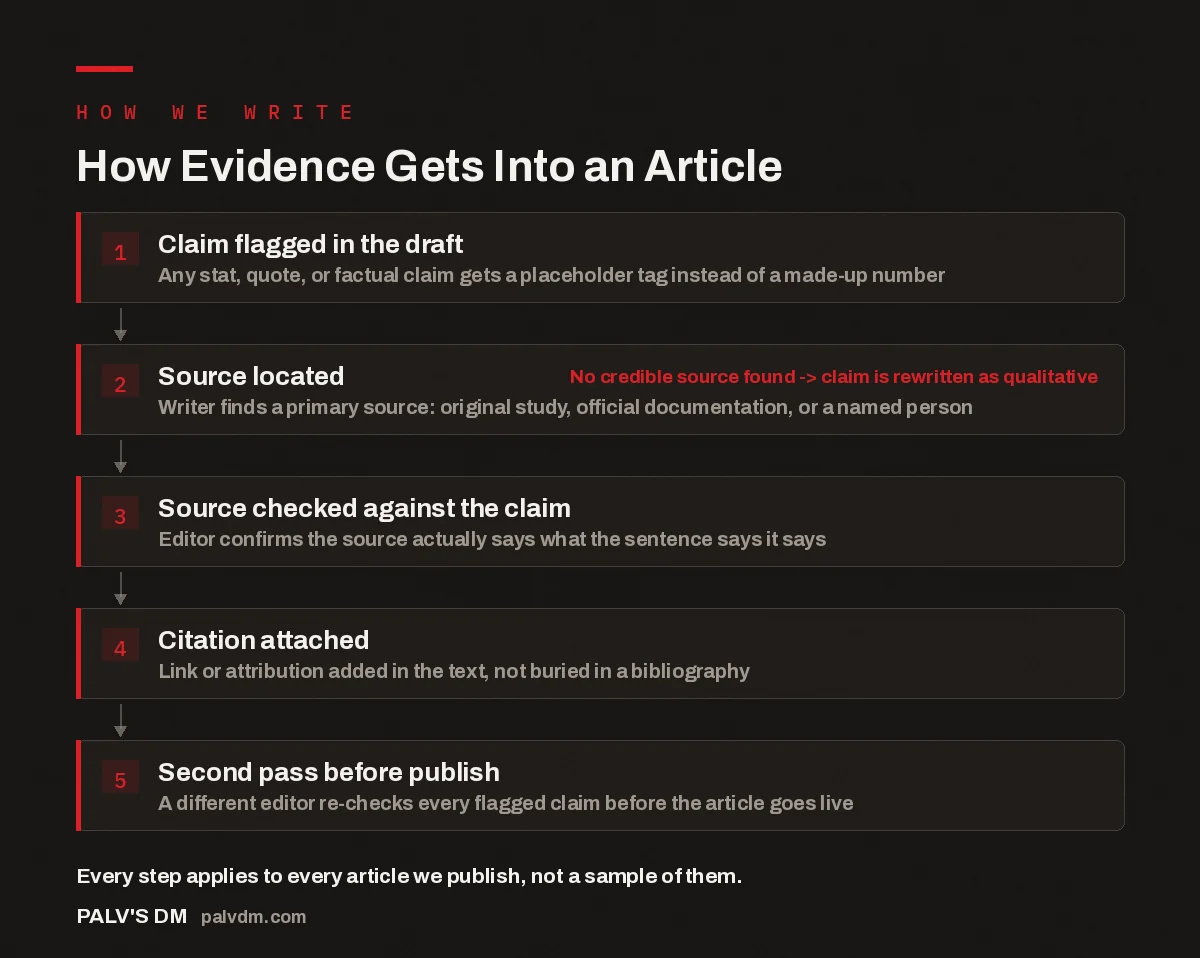
How Evidence Gets Into an Article
- Claim flagged in the draft. Any stat, quote, or factual claim gets a placeholder tag instead of a made-up number.
- Source located. Writer finds a primary source: original study, official documentation, or a named person. No credible source found -> claim is rewritten as qualitative
- Source checked against the claim. Editor confirms the source actually says what the sentence says it says.
- Citation attached. Link or attribution added in the text, not buried in a bibliography.
- Second pass before publish. A different editor re-checks every flagged claim before the article goes live.
What counts as “evidence” in a piece of content?
Evidence is anything in the draft that a reader — or an AI system summarising the page — could reasonably ask “says who?” about. That covers four categories: statistics and figures, direct quotes from a person, references to named studies or reports, and specific factual claims about how a platform, tool, or industry behaves. It does not cover general background knowledge (Google is a search engine) or the writer’s own stated opinion, clearly framed as opinion. The test we apply is simple: if the sentence would collapse without the source behind it, the source has to exist and has to be checkable.
This distinction matters because a lot of SEO content blurs opinion and fact until they’re indistinguishable. “Content with data performs better” reads like a claim. Written as “in the accounts we work on, articles with a concrete example or a named source tend to hold rankings longer than generic ones,” it reads like the pattern-based observation it actually is. Both sentences say something similar. Only one of them pretends to know more than it does.
How do we find a source before we cite it?
When a writer wants to use a statistic or a quote, the first move is not a Google search for a number that fits the sentence — it’s finding out where a number would legitimately come from for this topic. For platform behaviour, that’s official documentation or a company blog post. For industry data, that’s the original report, not a secondary article citing it (secondary sources drift from the original number more often than people expect). For quotes, that’s a named person with a title, not “experts say” or “industry insiders note.”
- Primary source located and the specific page or document saved, not just linked, in case it moves or gets edited later.
- Publication date checked — a number from three years ago gets flagged as dated, not presented as current.
- If the only source is a secondary article repeating a stat with no link to the original, we treat that as no source.
If a writer can’t find a source that meets this bar within a reasonable amount of time, the claim doesn’t go on hold — it gets rewritten. That’s a deliberate choice. Waiting to “find a stat later” is how vague numbers sneak into final drafts under deadline pressure.
How do we verify a claim before it goes into the draft?
Finding a source and verifying it are two different steps, and skipping the second is where most content goes wrong. Verification means an editor — someone other than the writer, wherever the workflow allows it — opens the source and confirms the sentence in the article says what the source actually says, not a rounded, simplified, or more dramatic version of it. This catches three recurring problems: a number lifted from a study’s abstract that doesn’t match the study’s actual methodology, a stat about “businesses” that was really only measured for e-commerce, and a quote pulled slightly out of the context that gave it meaning.
This is also where scope gets checked. A statistic about US enterprise SaaS companies doesn’t automatically apply to an Indian D2C brand, even if the sentence would read more smoothly if it did. Where the source’s scope doesn’t match the article’s audience, we either narrow the claim to match or drop it. Readers and AI answer engines both penalise content that generalises past what its evidence actually supports — one loses trust, the other loses citation confidence.
The fastest way to lose a client’s trust — or an AI engine’s confidence in citing you — isn’t a typo. It’s one wrong number that someone eventually checks.
Palash, Founder, PalV’s DM
How do we attribute quotes and data correctly?
Attribution happens inline, next to the claim, not as a footnote or a bibliography at the bottom of the page. A statistic gets a linked mention of who measured it and roughly when. A quote gets the speaker’s name and title, not an anonymised description. This isn’t just about giving credit — it’s about giving the reader (and any AI system parsing the page) enough information to judge the claim’s reliability without leaving the article. A sentence like “according to a 2024 report” tells a reader nothing useful. “According to Google’s own Search Central documentation, updated in 2024” tells them exactly what they’re looking at and where to verify it.
For client-specific numbers — case study results, internal benchmarks, performance figures — the rule is stricter still. Those only go into an article once the client has explicitly confirmed the figure and approved it for public use. We don’t estimate a client’s results to make a stronger sentence, and we don’t reuse an old approved number in a new context without checking it’s still accurate.
What happens when we can’t find real numbers?
This is the part most content processes skip, and it’s the one that separates research backed content writing from content that just looks well-researched. Not every claim has a clean, citable number behind it — and forcing one in anyway is how fabricated statistics end up published. When there’s no verifiable figure, the sentence gets rewritten to say what we actually know: “directionally,” “in the accounts we work on,” “the pattern that shows up repeatedly” — language that’s honest about being an observation rather than a measurement. It’s a small wording shift with a real consequence: it means every number that does appear in the article is one a reader could go and check themselves.
We treat well-established, broadly reported facts differently from precise statistics. Something like “Google has said it doesn’t use a single, isolated ranking factor to determine E-E-A-T” is a documented behaviour, not an invented number, so it can be stated plainly with a source link. A precise figure — “62% of searches now end without a click” — needs an actual citation, or it doesn’t get used at all, however commonly it circulates online.
How does the second pass catch what the first one missed?
Every article that contains a statistic, quote, or specific factual claim gets a second, separate check before it’s marked ready to publish. This isn’t the same person re-reading their own work — it’s a different editor opening each flagged claim, following its link, and confirming it still holds up. This step exists because sourcing errors are rarely dramatic. They’re usually small: a stat that was accurate when the writer found it but the source page has since been updated, a quote that was paraphrased slightly too loosely, a claim that’s true in general but stated as if it’s universal. A second, independent check catches the kind of drift that’s nearly invisible to the person who wrote the sentence in the first place.
Articles with zero flagged claims skip this step, because there’s nothing to re-check — a purely how-to piece with no external statistics doesn’t need a fact-check pass, and adding one would just slow down delivery without adding accuracy.
Want content that’s actually sourced?
If your current content process involves a writer inventing a plausible-sounding stat under deadline pressure, this is the fix. See how our content writing service handles sourcing, verification, and citation on every article we deliver.
Frequently asked questions
Do you ever use statistics you can’t link to a source?
No. If a specific number can’t be traced to a real, checkable source, it doesn’t go in the article as a number. It gets rewritten as a qualitative statement instead — describing the pattern or direction without inventing a precise figure to attach to it.
Who checks the sources — the writer or an editor?
Both, at different points. The writer locates and links the source while drafting. A separate editor then opens each flagged claim during review and confirms the source actually supports the sentence, catching anything the writer missed or misread.
Can you use our internal company data or case study numbers?
Yes, but only once you’ve explicitly confirmed the figure and approved it for public use. We don’t estimate or round client numbers to make a sentence stronger, and previously approved figures get re-checked before reuse in a new article.
Does this slow down delivery timelines?
It adds time to articles that actually contain claims worth checking, and adds none to ones that don’t. A how-to piece with no external statistics skips the fact-check pass entirely, since there’s nothing flagged to verify.
Why does this matter for AI search, not just Google rankings?
AI answer engines tend to favour content that cites checkable sources over content that states figures with no attribution, because a traceable source is easier for the system to trust and repeat. Unsourced claims are the kind of content those systems are least likely to cite.
The short version
Research backed content writing isn’t a claim we make in a pitch deck — it’s a process step that runs on every article: flag the claim, find a real source, verify the source says what the sentence says, attribute it inline, and re-check it a second time before publish. Anything that doesn’t survive that process gets rewritten honestly instead of published inaccurately. It’s slower than typing a plausible-sounding number and moving on. It’s also the only version of “data-driven content” that holds up when someone actually checks.
Related reading: why we refuse to publish without verifying numbers, our full content pipeline from brief to published, how we handle topics we don’t know anything about, and writing content that both ranks and gets cited.