Service Support — Content Writing
Writing Content That Both Ranks and Gets Cited
A practical guide to writing SEO and GEO content that ranks in search and gets cited by AI engines, using structure, evidence and schema that do both jobs.
Writing seo and geo content means designing a single page that a search index can rank and an AI engine can lift into an answer without misquoting it. In practice that means: answer the question in the first two sentences, back every claim with a source someone could actually check, write each section so it stands alone as a quotable unit, and mark the page up with schema so machines don’t have to guess what they’re reading. SEO and GEO are not two competing goals that force a trade-off — most of the work rewards both at once. Where they diverge is in how tightly you attribute a claim and how self-contained each paragraph needs to be.
Key takeaway
- Ranking and getting cited by AI engines reward mostly the same habits: a direct answer up front, real topical depth, and clean structure.
- The place they diverge is attribution and self-containment — AI engines quote sentences, not whole pages, so each paragraph has to survive being lifted alone.
- Schema markup, verified numbers and named sources do double duty: they help search engines trust the page and give AI engines something safe to repeat.
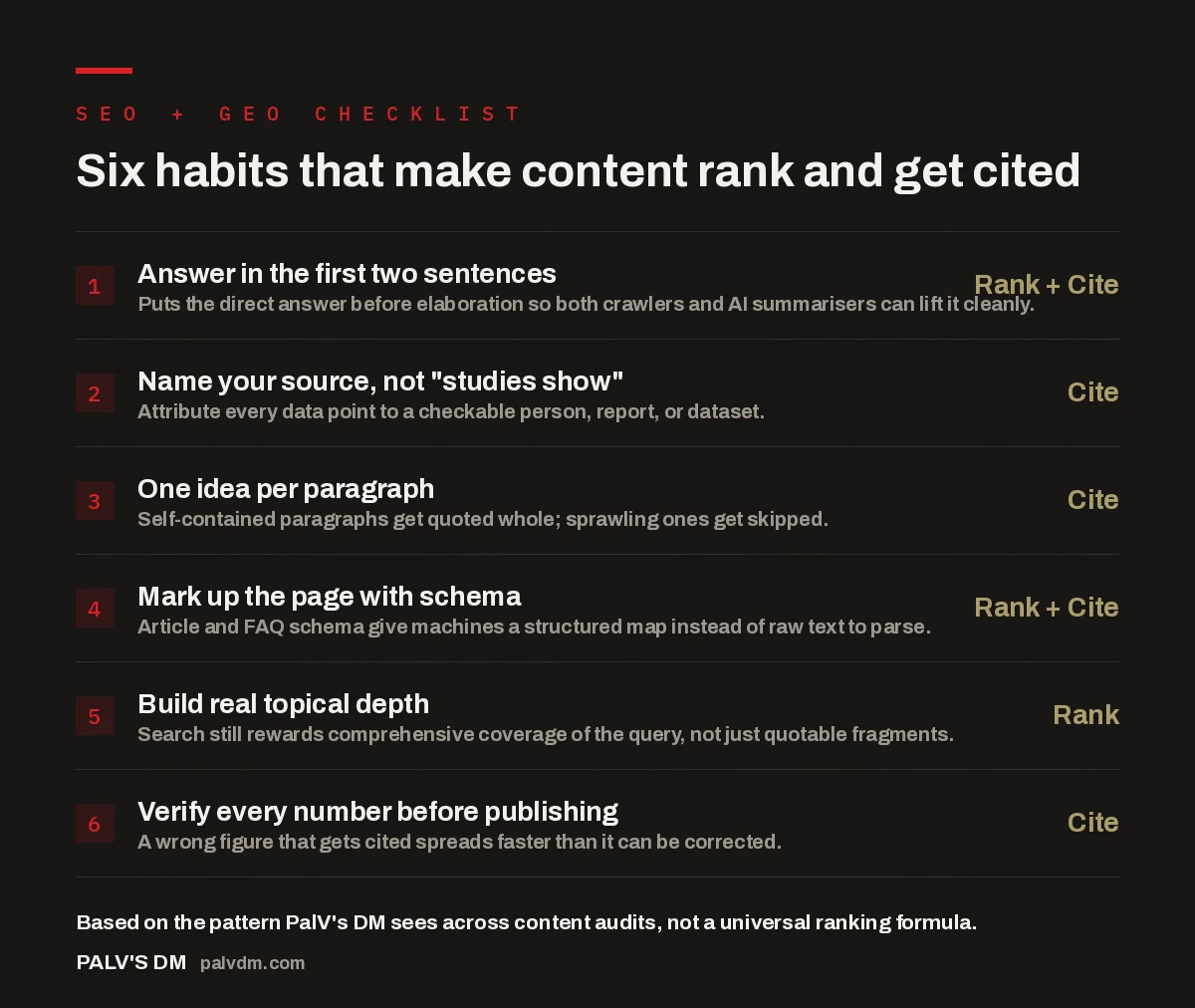
Six habits that make content rank and get cited
- Answer in the first two sentences — Rank + Cite. Puts the direct answer before elaboration so both crawlers and AI summarisers can lift it cleanly.
- Name your source, not “studies show” — Cite. Attribute every data point to a checkable person, report, or dataset.
- One idea per paragraph — Cite. Self-contained paragraphs get quoted whole; sprawling ones get skipped.
- Mark up the page with schema — Rank + Cite. Article and FAQ schema give machines a structured map instead of raw text to parse.
- Build real topical depth — Rank. Search still rewards comprehensive coverage of the query, not just quotable fragments.
- Verify every number before publishing — Cite. A wrong figure that gets cited spreads faster than it can be corrected.
What’s the actual difference between content that ranks and content that gets cited?
Ranking and getting cited are not the same job, even though the two are increasingly treated as one. A page ranks in Google because it demonstrates relevance to a query, depth on the topic, and enough trust signals — internal links, site authority, user behaviour — that Google is willing to put it above competing pages. None of that requires any individual sentence to be quotable on its own; a page can rank well while reading as one long, discursive piece of prose that only makes sense as a whole.
Getting cited by an AI engine — ChatGPT with browsing, Perplexity, Google’s AI Overviews — asks something different. These systems don’t send a reader to your page and let the page make its case in full; they extract a sentence or two, attribute it where they attribute at all, and move on. A paragraph that only makes sense in the context of the three paragraphs before it is close to useless to a summariser. It either gets skipped or gets paraphrased badly, which is worse for you than not being cited at all.
The overlap is bigger than the gap. Both systems reward clarity, real coverage of the topic, and content that answers the question a reader actually typed. Neither rewards padding, and neither is fooled by a page that repeats the keyword without saying anything new. The gap only shows up in the smaller mechanics: how self-contained each unit of text is, and how explicitly you attribute what you claim.
How do you structure a page so both a search index and an AI model can parse it?
Structure carries more weight for GEO than most writers expect, because an AI engine doesn’t read a page the way a person does — it segments the page into candidate chunks and decides which chunk, if any, answers the query well enough to quote. A page that’s structured for that segmentation also happens to be the page Google prefers to rank.
The habits that do both jobs at once:
- Open each section with the answer, not the build-up. If the H2 asks a question, the first sentence under it should answer that question directly.
- Keep one idea per paragraph. A paragraph that starts about pricing and ends about turnaround time can’t be lifted cleanly by anything.
- Use question-style subheadings that match how people actually phrase the query, not internal jargon.
- Put anything comparative or sequential into a table or list instead of prose — a five-step process described as one paragraph is far less likely to get quoted than the same five steps as a numbered list.
- Avoid pronoun-heavy transitions like “this approach” or “these factors” at the start of a new section — restate the noun so the section still makes sense if it’s the only part being read.
None of this requires more words. It usually requires fewer, organised more deliberately.
What kind of evidence makes an AI engine want to quote you?
Evidence is the other lever, and it works the same way for search trust as it does for AI citation: vague claims don’t survive scrutiny, specific ones do. A sentence that says “many businesses see faster results with structured content” gives an AI engine nothing safe to repeat — there’s no source behind it, no way to check it, and no reason to prefer it over a hundred other pages saying the same vague thing.
The alternative isn’t inventing a precise statistic to sound authoritative — that’s a different failure mode, and one that eventually gets a page flagged as unreliable once someone checks the number and it doesn’t hold up. The safer version is honest and specific about what it actually is: a named source when you have one, a described methodology when you don’t (“in the accounts we audit, the pattern that shows up repeatedly is…”), and a direct quote attributed to a real person rather than an anonymous “expert.”
This is also where verification stops being optional. A number that’s wrong and gets cited by an AI engine doesn’t just embarrass the page it came from — it propagates into other answers, other summaries, other pages that cite the citation. We cover how this shows up in practice in how we add evidence, statistics, quotes and sources and why we refuse to publish without verifying numbers.
If a sentence can’t survive being copied out of context and dropped into a chat window, it wasn’t written for how people actually read anymore — it was written for a version of the internet that doesn’t exist.
Palash, Founder, PalV’s DM
What technical elements make a page machine-readable?
Structure and evidence do most of the work, but the technical layer decides whether machines can even find what you’ve built. Article schema tells search engines and AI crawlers what type of content the page is, who wrote it, and when it was published or updated — metadata that’s invisible to a reader but load-bearing for how the page gets indexed and surfaced. FAQPage schema does something similar for question-and-answer content, handing AI engines a pre-structured set of question-and-answer pairs instead of asking them to extract that structure from prose themselves.
Clean semantic HTML matters more than people assume: real H2 and H3 tags instead of bold paragraph text styled to look like a heading, real table markup for comparisons instead of a screenshot of a spreadsheet, real bulleted or numbered lists instead of a paragraph with dashes typed into it. Alt text on images should describe what the image proves, not just what it depicts. None of this is exotic — it’s the same technical package that should sit under every article regardless of topic, which is why it’s worth treating as a fixed checklist rather than a judgement call each time. We lay out the full set in what comes with every article: schema, meta, images, links.
Does optimising for citations ever come at the cost of ranking?
Sometimes, if it’s done carelessly. Chasing quotability by fragmenting every paragraph into a bullet list strips out the connective explanation that shows genuine topical depth — and depth is still a real ranking factor, not a legacy one. A page that reads like forty standalone soundbites with nothing tying them together can look optimised for AI extraction while actually reading as thin to a search engine evaluating whether the page covers the topic properly.
The fix isn’t to abandon self-contained writing — it’s to keep both layers at once. Write the connective tissue that shows real understanding of the topic, argue the position, explain the reasoning, and structure it so the sentences carrying the load-bearing facts and conclusions are still quotable on their own within that fuller argument. A well-built page has both: enough narrative to demonstrate depth, and specific, attributed statements sitting inside that narrative that could be lifted whole and still make sense out of context.
The other real risk sits with speed, not structure: rushing a claim into “citable” shape without checking it first. A citable claim that turns out to be wrong is worse than no claim at all, because it gets copied faster than a vague one ever would have been.
Want this handled for you?
Every article we publish goes through this same discipline — answer-first structure, verified evidence, and the technical package built in before it ships.
Do I need separate content for SEO and for AI engines like ChatGPT?
No — in almost every case the same page can do both jobs if it’s structured well. Write one answer-first, evidence-backed page rather than a “traditional” SEO version and a separate “GEO” version; splitting them usually just produces two mediocre pages instead of one page that both a search index and an AI engine can use.
What is GEO content compared with normal SEO content?
GEO (generative engine optimisation) content is written and structured so AI engines like ChatGPT, Perplexity, and Google’s AI Overviews can extract and cite it accurately — self-contained paragraphs, named sources, clear schema. SEO content is written to rank in a search index. The two overlap heavily; GEO simply adds a stricter requirement for self-contained, attributable statements.
Does adding FAQ schema actually help a page get cited by AI engines?
It helps AI engines find and parse question-and-answer content faster, since the schema hands them the structure instead of requiring them to infer it from prose. It doesn’t guarantee a citation — the answer still has to be accurate, specific, and worth quoting — but it removes one layer of ambiguity from how the content gets read.
How long should an article be to rank and get cited?
There’s no fixed word count that guarantees either outcome. What matters is whether the length reflects real coverage of the topic — enough depth for a search engine to trust it’s comprehensive, and enough specific, quotable statements inside that depth for an AI engine to have something worth citing. Padding to hit a target word count helps neither goal.
Can older articles be rewritten to rank and get cited, or does this only work for new content?
Existing articles can usually be retrofitted — adding an answer-first opening, breaking dense paragraphs into self-contained units, attributing vague claims to real sources, and adding schema. It’s often faster than writing new content from scratch, because the topical depth and internal links are typically already in place.
The short version: write the direct answer first, keep every paragraph self-contained, attribute what you claim to something a reader could actually check, and mark the page up so machines don’t have to guess at its structure. That’s the same page whether the one reading it is a person, a search index, or an AI engine deciding what to quote.